
View of Montmartre from the Cité des Fleurs
The bare butte of Montmartre seen across allotments and gardens from the Cité des Fleurs in the Batignolles — before the basilica was built.
cité des Fleurs
The painting shows a real, identified place that you can find today. The exact spot the artist worked from is not necessarily known.
View of Montmartre from the Cité des Fleurs — at a glance
- Artist
- Alfred Sisley (1839–1899)
- Year
- 1869
- Movement
- Impressionism (early)
- Place
- From the Cité des Fleurs, Batignolles, toward Montmartre, Paris
- Viewpoint
- A gated garden lane that still exists — but the open market-garden view to Montmartre is built over, and Sacré-Cœur now crowns the hill
- Medium
- Oil on canvas
- Dimensions
- c. 70 × 117 cm
- Now at
- Musée de Grenoble
Overview
View of Montmartre from the Cité des Fleurs, painted by Alfred Sisley in 1869, is an early Impressionist cityscape. From an enclosed lane of villas and gardens in the Batignolles, it looks north across a broad zone of kitchen gardens, allotments, sheds and scattered buildings to the low green hill of Montmartre, crowned only by windmills and a telegraph tower — the basilica of Sacré-Cœur did not yet exist. It is oil on canvas, about 70 by 117 cm, and it hangs in the Musée de Grenoble.
Where was View of Montmartre from the Cité des Fleurs painted?
Scholarship The Cité des Fleurs is a private garden lane laid out in the 1840s in the Batignolles, in the seventeenth arrondissement of Paris — it still exists, gated and full of villas and greenery. From its northern end Sisley looked across ground that was then market gardens and half-built plots towards the butte of Montmartre. That intervening land is now entirely built up, and Sacré-Cœur (begun 1875) crowns the hill, so the open view Sisley painted is gone, though the Cité des Fleurs itself survives.
What is in the painting?
A wide, low foreground of cultivated plots, fences, sheds and a few figures working the ground. Beyond, a scatter of low houses and walls, then the green rise of Montmartre with windmills and a tower on its crest. A large, pale, cloud-filled sky fills the top half. The colour is muted green, grey and buff.
Look closely
The kitchen gardens
A wide foreground of cultivated plots, fences and sheds with a few figures working.
The bare butte
Montmartre rises green and low, crowned only by windmills and a telegraph tower — no basilica yet.
The wide grey sky
A large, pale, cloud-filled sky fills the top half in a Barbizon-like key.
Analysis
Composition and technique
A wide panoramic format, a very low horizon, and the hill of Montmartre as a soft green accent across gardens.
Scholarship Sisley uses the wide canvas and low horizon to spread the market-garden zone out flat, leading the eye across fences and plots to the distant hill. The handling is broad and grey-toned — closer to the Barbizon manner than to high Impressionist colour.
History & provenance
The painting is in the Musée de Grenoble, France.
Sources
- Musée de Grenoble — collection entry for Alfred Sisley, ‘Vue de Montmartre depuis la cité des Fleurs’ (1869)
- Ville de Paris — the Cité des Fleurs, 17e arrondissement
Related paintings

Bazille's Studio
1870
Bazille's studio was a few streets away in the same Batignolles quarter, painted the following year.

Bal du moulin de la Galette
1876
Renoir on the butte of Montmartre itself, 1876 — among the windmills seen here from afar.

Boulevard Montmartre, Mardi Gras
1897
Pissarro's boulevard below the hill, 1897.
More by Alfred Sisley
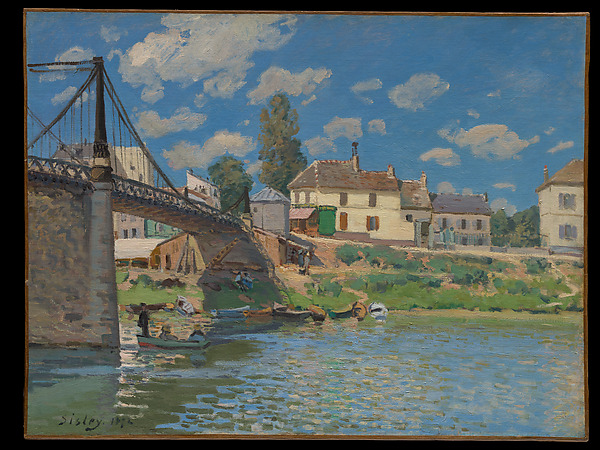
The Bridge at Villeneuve-la-Garenne

