Famous work · not an exact-location map point
Vairumati
The Tahitian goddess Vairumati enthroned in a bright landscape — a real Tahitian setting peopled with an invented myth.
No single real-world viewpoint
A Tahitian woman posed as the invented ancestress-goddess Vairumati, with an invented ritual bird and idol; the mythology is Gauguin's reconstruction. Generic setting; the marker is the whole island.
Vairumati — at a glance
- Artist
- Paul Gauguin (1848–1903)
- Year
- 1897
- Movement
- Post-Impressionism / Symbolism
- Place
- Rural Tahiti — with an invented Tahitian myth
- Viewpoint
- A real Tahitian landscape peopled with a reconstructed goddess and rite
- Medium
- Oil on canvas
- Dimensions
- c. 73 × 94 cm
- Now at
- Musée d'Orsay, Paris
Overview
Vairumati is one of the large Tahitian figure paintings Paul Gauguin made in 1897, during his second and final period in the Pacific. A young woman sits, nearly nude, on a bright cloth in the open, one arm raised; a large white bird with a lizard in its claws stands beside her; behind, two shadowy figures and a carved relief. She is meant as Vairumati, the beautiful mortal woman who, in a Tahitian legend Gauguin drew from, became the ancestress of the Areoi society and was made a goddess. It is oil on canvas, about 73 by 94 cm, and it hangs in the Musée d'Orsay, Paris.
Where was Vairumati painted?
Scholarship The landscape, vegetation, cloth and the woman's features are drawn from what Gauguin saw around him in rural Tahiti. But the subject — the goddess, the ritual bird, the carved idol behind — is a reconstruction: the old Tahitian religion had been suppressed by missionaries decades earlier, and Gauguin assembled his ‘Tahitian mythology’ from a French traveller's book (J.-A. Moerenhout), other cultures' art, and imagination. The picture mixes a real place with a myth that was no longer living.
What is in the painting?
The woman sits frontally on an orange-and-white striped cloth spread on grass, legs to one side, right arm raised, a cigarette between her fingers; a flower behind her ear. To the right, a large white bird holds a small green lizard. Behind, a low relief or frieze of figures in a warm ground, and two dim standing women. The colour is flat, warm and unshaded, bounded by contours.
Look closely
The hieratic pose
The woman sits frontal and still, arm raised, like an idol or an Egyptian relief figure.
The white bird and lizard
A large white bird beside her holds a small green lizard — an invented ritual attribute.
The relief behind
A low friezelike carving of figures fills the warm background.
The flat outlined colour
Broad, unshaded areas of warm colour bounded by firm contours.
Analysis
Composition and technique
A frontal seated figure filling the canvas against a flat, friezelike background, in warm unshaded colour.
Scholarship Gauguin gives the woman the still, hieratic pose of an idol or an Egyptian relief, sets her against a flattened decorative background, and keeps the colour in broad, outlined areas — turning a portrait-like figure into a cult image.
Meaning and interpretation
Interpretations differ. What the artist documented, what museums and scholars propose, and later or speculative theories are marked and kept separate.
A constructed goddess
The picture is read as Gauguin building, for a European audience, a Tahitian sacred past — the ancestress-goddess, the symbolic bird and lizard — from fragments and imagination, and giving a living Tahitian woman the role. Modern discussion weighs its beauty against the colonial fantasy and the power relations behind it.
History & provenance
The painting entered the French national collections and hangs in the Musée d'Orsay, Paris.
Sources
- Musée d'Orsay, Paris — collection entry for Paul Gauguin, ‘Vairumati’ (1897)
- Belinda Thomson (ed.), ‘Gauguin: Maker of Myth’ (Tate, 2010)
Related paintings

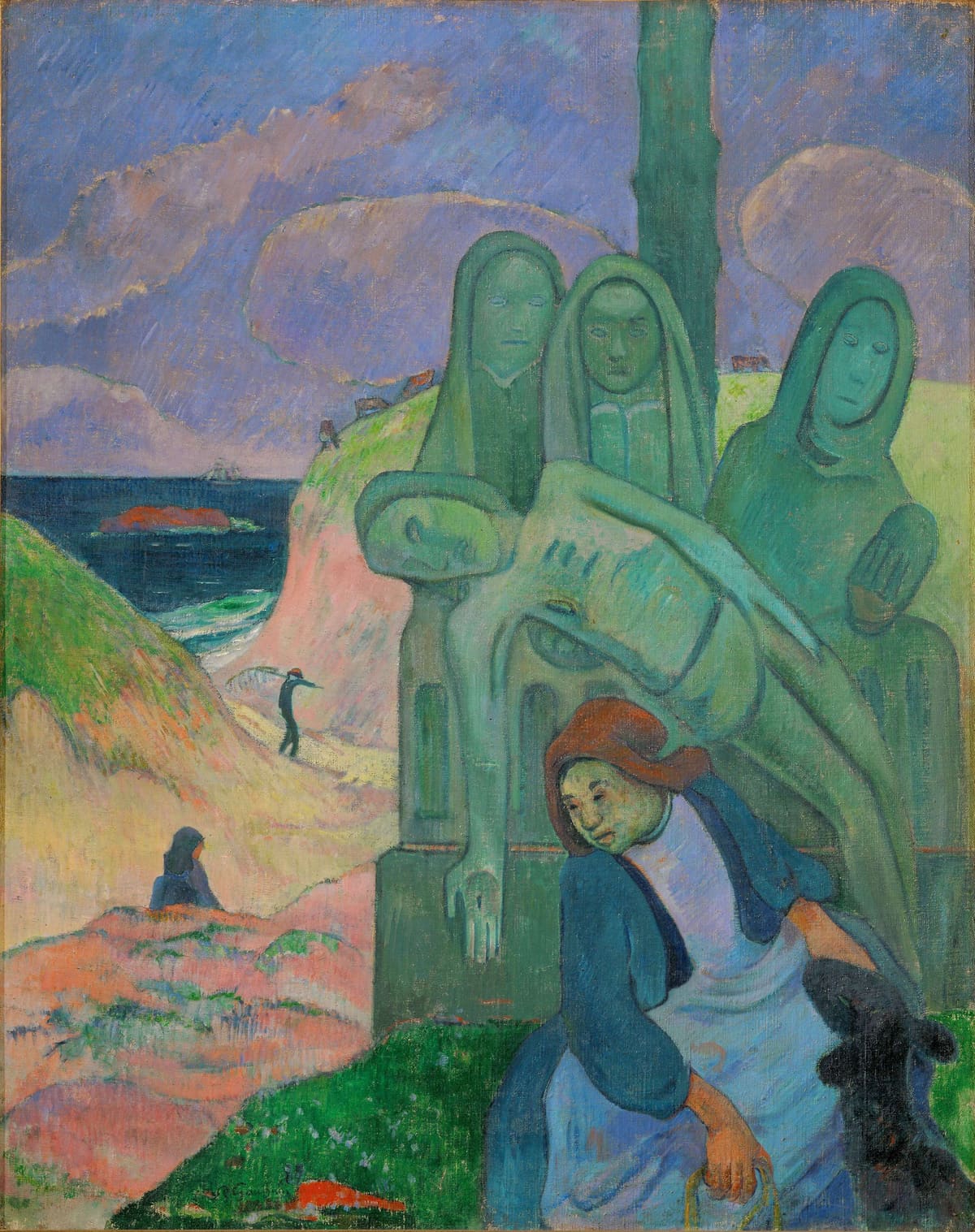
When Will You Marry?
1892
Gauguin's Tahitian canvas of 1892 — real islanders in real dress, without the invented deity.

Arearea
1892
Gauguin's ‘Joyousness’ of 1892 — a real Tahitian landscape with an invented rite.

Tahitian Women on the Beach
1890
Gauguin's first-year Tahiti beach, closer to what he actually saw.
More by Paul Gauguin

The Yellow Christ