
Tahitian Women on the Beach
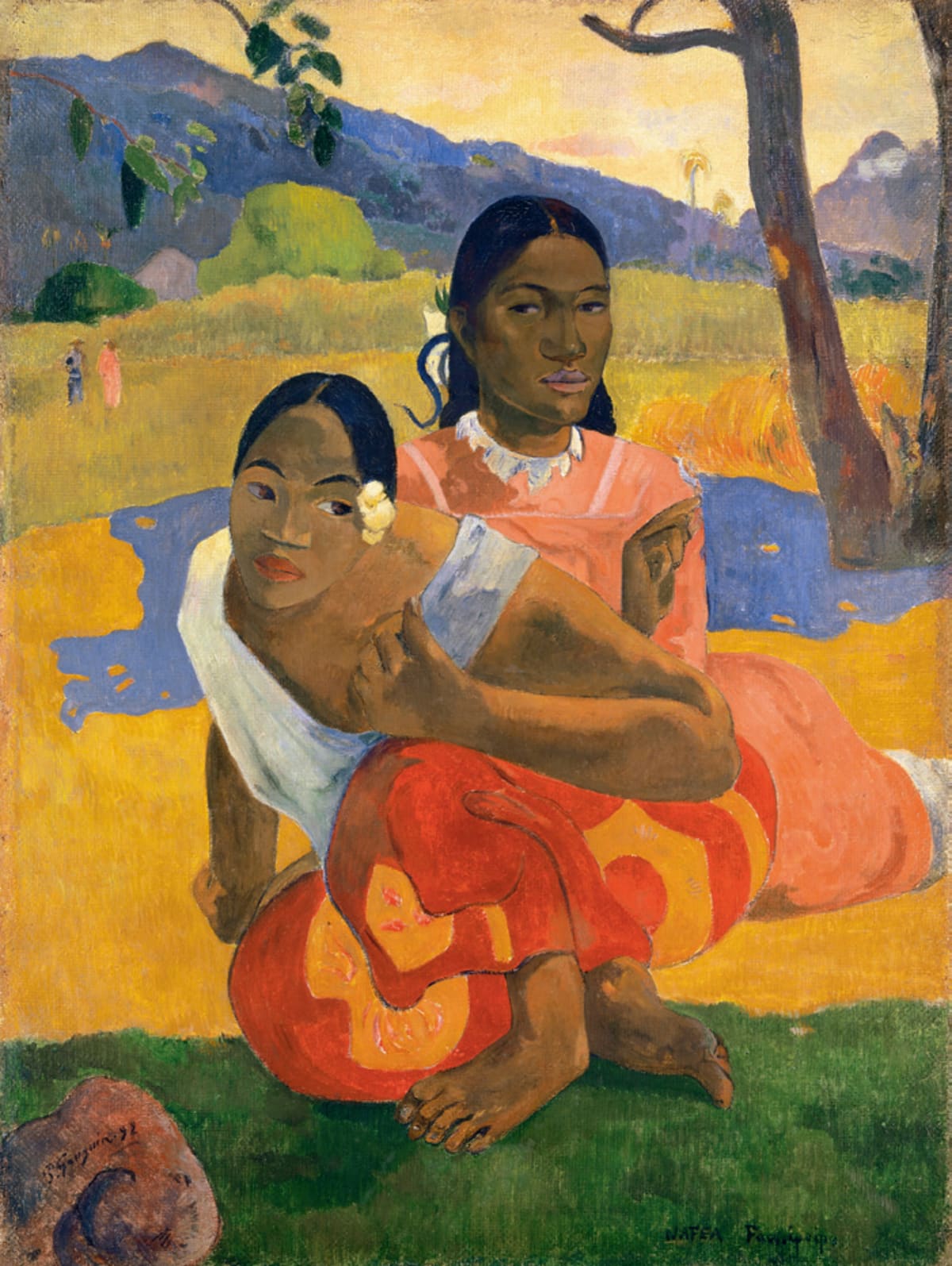
Two Tahitian women seated on a beach, painted during Gauguin's first year on the island — a real coast, filtered through his idea of an ‘unspoiled’ world.
Tahiti
The painting depicts a real landscape or cityscape. The precise viewpoint the artist used may be unknown, so the marker shows the general area.
Tahitian Women on the Beach — at a glance
- Artist
- Paul Gauguin (1848–1903)
- Year
- 1891
- Movement
- Post-Impressionism / Symbolism
- Place
- A beach on the south coast of Tahiti (Mataiea district)
- Viewpoint
- A real Tahitian coast — not a marked spot; figures posed, not observed
- Medium
- Oil on canvas
- Dimensions
- c. 69 × 91 cm
- Now at
- Musée d'Orsay, Paris
Overview
Tahitian Women on the Beach is one of the first important canvases Paul Gauguin painted after arriving in Tahiti in 1891. Two young women in Tahitian and European-missionary dress sit close together on pink sand: one in a striped skirt gazes out, the other in a pale pink mission gown looks down, plaiting palm fibre. It is oil on canvas, about 69 by 91 cm, and it hangs in the Musée d'Orsay, Paris.
The story behind the painting
Scholarship Gauguin sailed to Tahiti expecting an untouched paradise and found instead a French colony with a capital, Papeete, already Europeanised. He moved out to the rural district of Mataiea on the south coast and there painted Tahitian people and landscape, drawing on their appearance and surroundings while shaping them to his own vision of a simpler, freer life. The two costumes in this picture — traditional and missionary — record exactly the cultural mixture he had hoped to escape.
Where was Tahitian Women on the Beach painted?
Scholarship The setting is a beach on the south coast of Tahiti, in the largely rural Mataiea district where Gauguin lived in 1891–93. Tahiti's coasts, lagoons and pink-and-black sand are real and largely still there, though heavily developed around Papeete. Gauguin did not record a marked, identifiable spot; the beach is a real kind of place on the island rather than a fixed viewpoint, and the figures are posed, not observed by chance.
What is in the painting?
The two women fill the foreground, seated on sand painted rose and ochre. The nearer woman, in a blue-and-white striped pareu, sits square to the viewer, hands in her lap, expression grave. The second leans against her, in a high-necked pink dress of the kind the missions introduced, working plant fibre in her fingers. Behind them, a flat band of sand, then the sea and a strip of pale sky; the space is shallow and the colours laid in flat areas.
Look closely
The two costumes
A traditional striped pareu on one woman, a mission-introduced pink dress on the other.
The grave gaze
The nearer woman looks straight out, unsmiling — read as dignity, melancholy, or a mood Gauguin imposed.
The pink sand
The beach is painted rose and ochre in flat, unshaded areas.
The shallow space
Sand, sea and sky are flat bands behind the figures; there is almost no depth.
Analysis
Composition and technique
Two large, still figures pressed to the picture plane, against flat bands of sand, sea and sky.
Scholarship Gauguin builds the picture from broad, unshaded areas of colour bounded by firm contours, the two women locked together as a single mass. There is almost no depth; the design is close to that of the Breton pictures, transferred to a new subject.
Meaning and interpretation
Interpretations differ. What the artist documented, what museums and scholars propose, and later or speculative theories are marked and kept separate.
A constructed ‘paradise’
The picture is read as Gauguin's attempt to present Tahiti as grave, timeless and unspoiled — while the missionary dress and his own outsider's, colonial position complicate that. Modern discussion weighs the beauty of the images against the fantasy and the power relations behind them.
The women's gravity
The stillness and the direct, unsmiling gaze of the nearer woman have been read as dignity, as melancholy, or as Gauguin imposing a mood; his own writings are not a reliable guide.
History & provenance
The painting returned to France with Gauguin, passed through collections, and entered the French national collections; it hangs in the Musée d'Orsay, Paris.
Sources
- Musée d'Orsay, Paris — collection entry for Paul Gauguin, ‘Femmes de Tahiti’ / ‘Sur la plage’ (1891; oil on canvas, c. 69 × 91 cm)
- Belinda Thomson (ed.), ‘Gauguin: Maker of Myth’ (Tate, 2010)
Frequently asked
Where is this beach?
On the south coast of Tahiti, in the rural Mataiea district where Gauguin lived during his first stay on the island in 1891–93. It is a real kind of Tahitian beach rather than a marked, identifiable spot.
Did Gauguin find the paradise he expected?
No. Tahiti was already a French colony with a Europeanised capital. He moved to the countryside and painted his own idea of an unspoiled life; the missionary dress on one of the women records the cultural mixture he had hoped to avoid.
Why is one woman in a pink high-necked dress?
It is a mission dress, a garment Christian missionaries introduced to the islands. The other woman wears a traditional striped pareu — the two costumes side by side show colonial Tahiti as it actually was.
How should the painting be seen today?
As a beautiful image and, at the same time, a constructed colonial fantasy. Discussion now weighs Gauguin's art against the power relations and the myth-making behind it.
Where is the painting now?
In the Musée d'Orsay, Paris.
Related paintings

More by Paul Gauguin

The Yellow Christ
The Green Christ

Arearea
Also connected to Tahiti