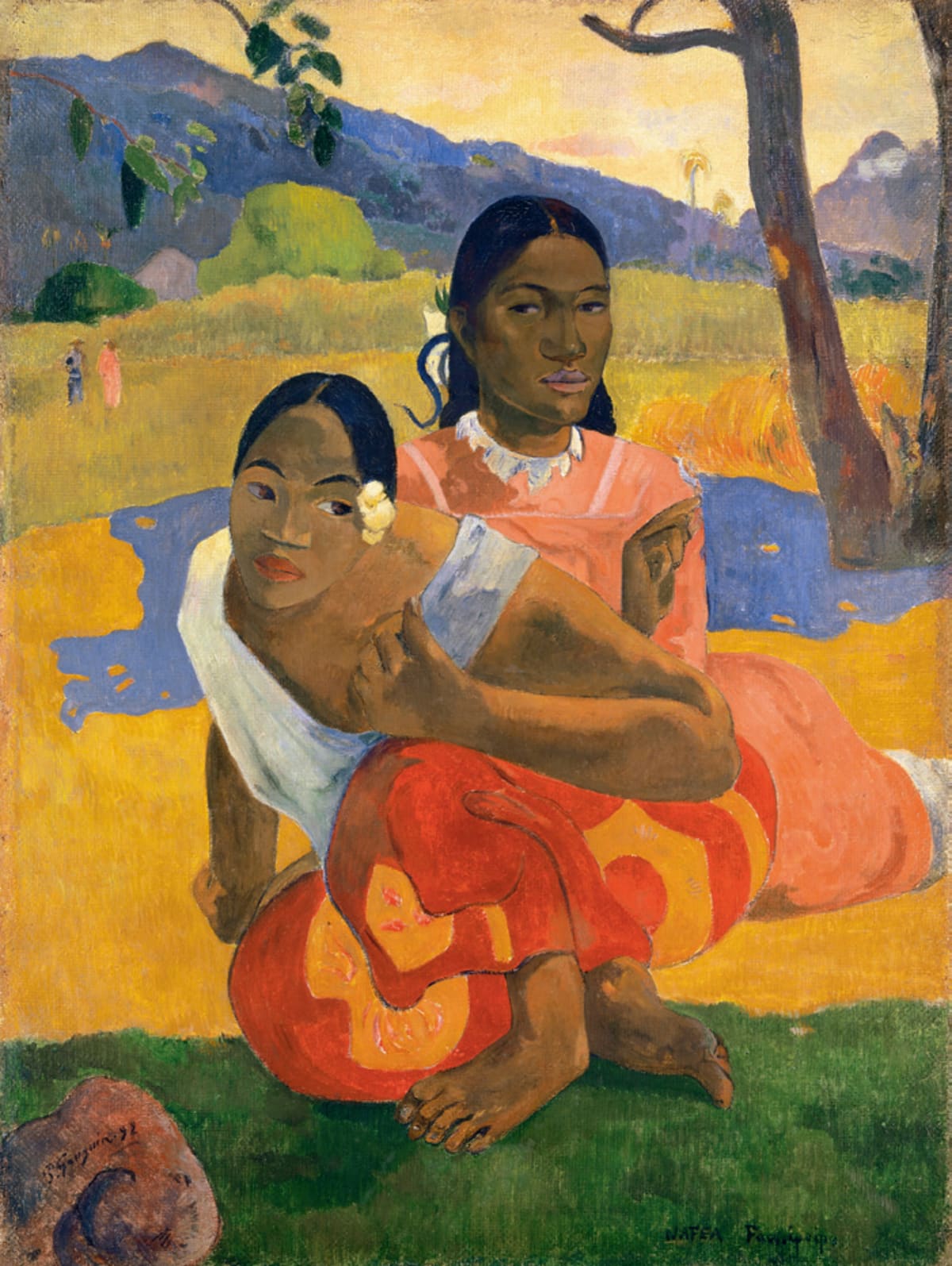
When Will You Marry?
Two Tahitian women in a bright, flat landscape from Gauguin's first stay in Tahiti — a general place, not a fixed spot.
Tahiti
The painting depicts a real landscape or cityscape. The precise viewpoint the artist used may be unknown, so the marker shows the general area.
When Will You Marry? — at a glance
- Artist
- Paul Gauguin (1848–1903)
- Year
- 1892
- Movement
- Post-Impressionism / Symbolism
- Place
- Mataiea, Tahiti (French Polynesia) — a general area
- Viewpoint
- Not a fixed spot — a composite Tahitian landscape
- Medium
- Oil on canvas
- Dimensions
- c. 101 × 77 cm
- Now at
- Private collection (sold 2015; formerly on loan to the Kunstmuseum Basel)
Overview
When Will You Marry? — its Tahitian title, Nafea Faa Ipoipo — is a painting Paul Gauguin made in 1892, in the first year of his first stay in Tahiti. It shows two young women in the foreground of a rising landscape of fields and hills, painted in bright, flat, non-naturalistic colour. It is oil on canvas, about 101 by 77 cm.
For decades it hung at the Kunstmuseum Basel on long loan from a Swiss family collection; it was sold privately in 2015 and is no longer on public display.
Gauguin in Tahiti
Gauguin arrived in Tahiti in 1891, seeking a life and an art outside Europe. He settled at Mataiea, on the south coast of the main island, and in 1892 produced a run of paintings of Tahitian women in strong colour, each given a Tahitian title painted onto the canvas.
He sent many of these works back to France, hoping to sell them and to build a reputation as the painter of a ‘primitive paradise’ — an image he also promoted in his writings, which mix observation with self-mythology.
Where was When Will You Marry? painted?
Gauguin lived at Mataiea on the south coast of Tahiti in 1892, and the landscape here — cultivated ground rising to hills, with a hut and scattered figures — is representative of that area.
Scholarship It is not a specific, locatable view. Gauguin composed his Tahitian backgrounds from memory and imagination as much as observation, so the picture appears on the map only as a broad region, not a viewpoint.
What is in the painting?
Two women fill the foreground. The one in front crouches in a patterned pareu — a Tahitian wrap — a flower behind her ear. The one behind sits upright in a high-necked, pink European-style ‘missionary’ dress, one hand raised in a gesture.
Behind them the ground rises in flat zones of yellow, green and blue-violet to distant hills, with a hut and one or two more figures. The Tahitian words ‘NAFEA Faa ipoipo’ are painted into the lower left.
Look closely
The flower behind the ear
On the crouching woman — in Tahitian custom, a sign of being available for a partner.
The pink dress
The seated woman wears a high-necked European-style dress brought by Christian missionaries.
The painted title
‘NAFEA Faa ipoipo’ is lettered directly onto the lower left of the canvas.
The vertical landscape
The ground rises in flat bands almost straight up behind the figures, with a hut set into the hillside.
Arbitrary colour
A pure-yellow field, blue shadows, violet hills — none of it natural local colour.
Details that are easy to miss. The flower tucked behind the front woman's ear is, in Tahitian custom, a sign that she is looking for a partner; the woman behind wears a high-necked pink dress introduced by missionaries; the Tahitian title is painted into the lower left of the canvas; and the landscape rises almost vertically behind the figures, with a hut set into the coloured hillside.
Analysis
Composition & perspective
The two large foreground figures are pressed against a steeply tilted, near-flat landscape with no real depth.
Scholarship Gauguin stacks the ground in bands rather than receding it, so the hills sit almost directly above the women. The crouching and seated figures make a stable triangle in the front plane; the smaller background figures and the hut are set into the coloured zones like motifs in a tapestry.
Colour and light
Arbitrary, saturated colour in flat areas — a yellow field, a pink dress, blue-violet hills — outlined and unshaded.
Scholarship Gauguin abandons natural local colour: the ground can be pure yellow, the shadows blue, the hills violet. Forms are bounded by dark contours and filled with even colour, with almost no modelling — a decorative, deliberately un-Western handling drawn partly from his interest in folk art, stained glass and Japanese prints.
Handling and technique
Thin, matte paint in flat planes, with a Tahitian title lettered onto the surface.
The paint is applied thinly and evenly, the drawing simplified, the surface kept flat and mural-like. Lettering the Tahitian title directly onto the canvas — which Gauguin did on many of these works — reinforces the sense of the picture as a designed object, almost a poster.
Meaning and interpretation
Interpretations differ. What the artist documented, what museums and scholars propose, and later or speculative theories are marked and kept separate.
The question in the title
The title poses a question — ‘When will you marry?’ — and the picture sets a woman in a traditional wrap against one in a Europeanised dress, the flower behind an ear signalling availability in Tahitian custom. Gauguin left the situation deliberately open.
Museum framing
Museums present the 1892 Tahiti paintings as Gauguin's search for a bold, non-naturalistic art built on a culture he saw as unspoiled — while noting that this ‘paradise’ was already colonised and Christianised, which the missionary dress in the picture records.
A colonial fantasy, reassessed
Recent scholarship reads these works critically: as the projection of a European man onto Tahitian women, shaped by the power relations of empire, and unreliable as a record of Tahitian life. This reappraisal is now standard in the literature.
History & provenance
- 1892Painted at Mataiea, Tahiti, during Gauguin's first stay.
- 1917Enters the collection of Rudolf Staechelin, Basel.
- 20th c.On long-term loan to the Kunstmuseum Basel.
- 2015Sold privately by the Staechelin family; leaves public display.
The painting was in the Staechelin family collection in Basel for most of a century and hung at the Kunstmuseum Basel on loan. The family sold it privately in 2015; it is no longer publicly shown.
Sources
- Kunstmuseum Basel — records of the Rudolf Staechelin loan collection and the 2015 sale
- George T. M. Shackelford & Claire Frèches-Thory, ‘Gauguin Tahiti’ (Museum of Fine Arts, Boston / Musée d'Orsay, 2004)
- Nancy Mowll Mathews, ‘Paul Gauguin: An Erotic Life’ (2001); recent Gauguin scholarship reassessing the Tahiti works
Frequently asked
Where was When Will You Marry? painted?
At Mataiea, on the south coast of the island of Tahiti, during Gauguin's first stay there in 1891–93.
Is the landscape a real place?
It is representative of the Mataiea area but not a specific view. Gauguin built his Tahitian backgrounds from memory and imagination as well as observation.
What does the title mean?
‘Nafea Faa Ipoipo’ is Tahitian for ‘When will you marry?’ Gauguin lettered it onto the canvas, as he did on many of his 1892 Tahiti paintings, and left the scene's meaning open.
Why is one woman dressed so differently?
The woman in front wears a traditional Tahitian pareu; the one behind wears a high-necked pink dress introduced by Christian missionaries — a contrast that records the colonised, Christianised Tahiti Gauguin actually found.
How should the painting be understood today?
Recent scholarship treats these works critically — as a European man's projection onto Tahitian women, shaped by empire — rather than as a reliable picture of Tahitian life.
Where is the painting now?
It was sold privately in 2015 and is no longer on public display. It had previously hung at the Kunstmuseum Basel on long-term loan.
Related paintings

More by Paul Gauguin

The Yellow Christ

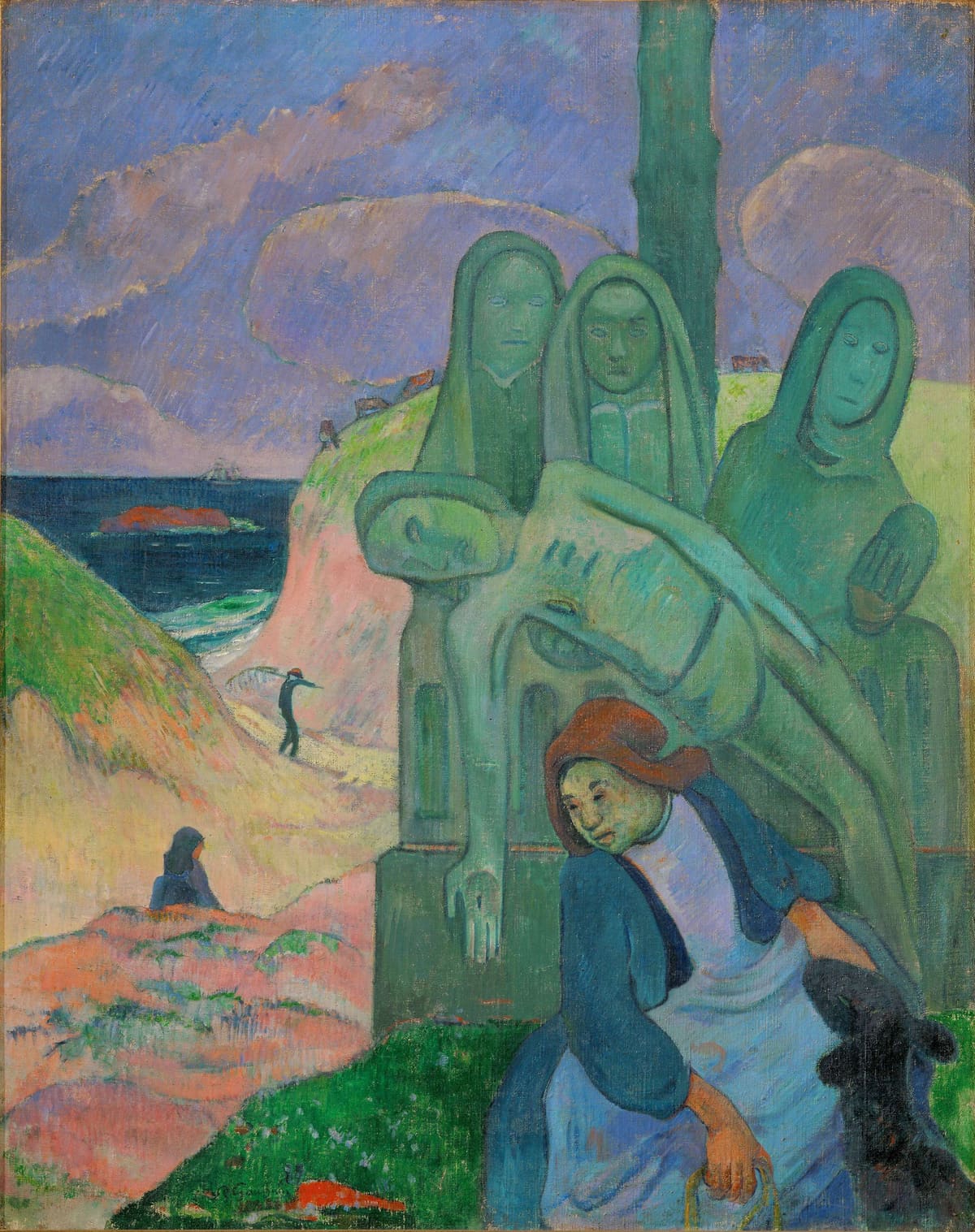
The Green Christ

Arearea
Also connected to Tahiti