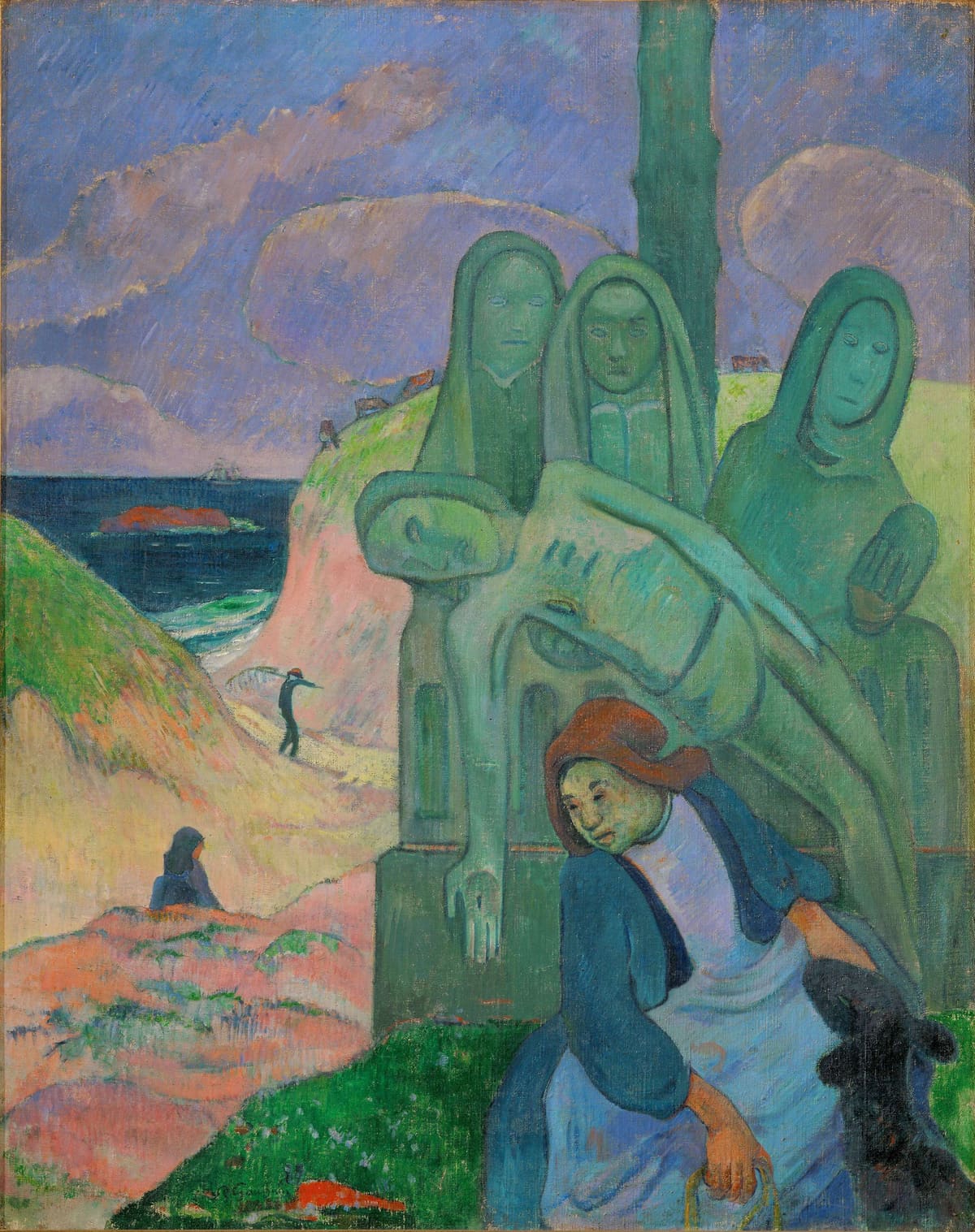
The Green Christ
A real granite wayside calvary at Nizon in Brittany — still standing — with Breton women set beside it under a grey-green light.
Calvaire de Nizon, Brittany
The painting shows a real, identified place that you can find today. The exact spot the artist worked from is not necessarily known.
The Green Christ — at a glance
- Artist
- Paul Gauguin (1848–1903)
- Year
- 1889
- Movement
- Synthetism / Pont-Aven School
- Place
- Nizon, near Pont-Aven, Brittany, France
- Viewpoint
- The Nizon calvary — the monument still stands; Gauguin moved it into an open landscape
- Medium
- Oil on canvas
- Dimensions
- c. 92 × 73 cm
- Now at
- Royal Museums of Fine Arts of Belgium, Brussels
Overview
The Green Christ — also called Breton Calvary — is a painting Paul Gauguin made at Pont-Aven in Brittany in the autumn of 1889. It shows a weathered stone group of the dead Christ and mourning women, painted grey-green, with a living Breton woman crouched at its foot. It is oil on canvas, about 92 by 73 cm, and it hangs in the Royal Museums of Fine Arts of Belgium in Brussels.
It is one of a pair with The Yellow Christ, made the same season, both taking a real Breton religious monument as their starting point.
Gauguin in Brittany
Gauguin worked at Pont-Aven and the nearby hamlet of Le Pouldu in 1889, developing with Émile Bernard the flat-colour, hard-outlined style later called Synthetism. He was drawn to what he saw as the ancient, undiluted Catholic faith of rural Brittany, and to its roadside crosses and calvaries.
In The Green Christ he set a real stone Deposition group against a low Breton landscape and placed a woman in local dress beside it, joining the carved figures to the living ones.
Where was The Green Christ painted?
The sculpture is the calvary in the churchyard of Nizon, a village just north of Pont-Aven in Finistère, Brittany — a granite group of the dead Christ held by mourning women, carved in the 16th or 17th century and worn by centuries of weather.
Museum interpretation It is still in place. Gauguin painted it grey-green and moved it into an open landscape; the monument itself can be seen today at Nizon.
How we know
- Depicts the real granite calvary at Nizon that Gauguin painted.
What is in the painting?
A grey-green stone group fills the left of the canvas: the dead Christ lowered across the knees of a seated woman, with two more figures behind. At its foot, a live Breton woman in a black shawl and white coif crouches, her hands folded.
Beyond, a low green field slopes to the sea, with a thatched cottage, a cow, and small figures — men gathering seaweed on the shore.
Look closely
The stone calvary
A real 16th- to 17th-century granite group from Nizon churchyard — the dead Christ across a mourning woman's knees.
The praying woman
A live Breton woman in a black shawl and white coif, crouched at the foot of the monument, echoing the pose carved above her.
The all-over green
The grey-green of the stone is carried across the fields and the light, unifying the whole picture.
The seaweed-gatherers
Small figures work the shore in the distance, past a thatched cottage and a cow.
Details that are easy to miss. The stone group is a real Deposition calvary from the churchyard at Nizon; the whole picture is tinted the grey-green of that stone; the small figures on the shore beyond are gathering seaweed, a real Breton livelihood; and the live woman's pose echoes the seated mourning figure carved above her.
Analysis
Composition & perspective
The carved monument and the living woman are locked together in the front plane, with the landscape flattened up behind them.
Scholarship Gauguin presses the stone group and the crouching woman close to the picture surface, so that the sculpted and the real figures read as one mass. The ground behind rises steeply with little recession; the cottage, cow and seaweed-gatherers sit in the green like motifs in a design.
Colour and light
A dominant grey-green — the colour of the stone spread across the whole picture — with the Breton woman's black and white as the only strong contrast.
Scholarship Gauguin unifies the canvas under the sculpture's own grey-green, carrying it into the fields and the light. Forms are outlined and filled with flat, muted colour; there is almost no modelling and no bright sun — a heavy, overcast Breton atmosphere.
Handling and technique
Flat areas of low-key colour bounded by dark contours — the Synthetist manner Gauguin developed at Pont-Aven.
The paint is thin and matte, the drawing simplified, the colour arbitrary and unified. The approach owes something to stained glass and folk carving, and to Gauguin and Bernard's shared interest in a bold, decorative alternative to Impressionism.
Meaning and interpretation
Interpretations differ. What the artist documented, what museums and scholars propose, and later or speculative theories are marked and kept separate.
Living faith and old stone
The picture joins a real Breton woman at prayer to a centuries-old carved calvary, presenting the region's religion as continuous and rooted — the ‘primitive’ Christianity Gauguin came to Brittany to find.
Gauguin's self-projection
As with his later Tahiti works, scholars note that Gauguin's ‘authentic’ Brittany was partly his own invention, shaped by what he wanted to see. The crouching woman and the grey light are as much mood as document.
History & provenance
- Autumn 1889Painted at Pont-Aven, one of a pair with The Yellow Christ.
- 1891Sold at the Hôtel Drouot auction Gauguin held to fund his first trip to Tahiti.
- 20th c.Enters Belgian collections.
- TodayRoyal Museums of Fine Arts of Belgium, Brussels.
The painting was among the works Gauguin sold in 1891 to pay for his passage to Tahiti. It is now in the Royal Museums of Fine Arts of Belgium in Brussels.
Sources
- Royal Museums of Fine Arts of Belgium, Brussels — collection entry for ‘Le Christ vert (Calvaire breton)’ (oil on canvas, c. 92 × 73 cm)
- Belinda Thomson, ‘Gauguin by Himself’ (1993); Isabelle Cahn et al., ‘Gauguin and the Impressionists’ / Pont-Aven catalogues
- Commune de Pont-Aven / Nizon — the churchyard calvary at Nizon
Frequently asked
Is the calvary in The Green Christ a real monument?
Yes. It is the granite calvary — a carved group of the dead Christ and mourning women — in the churchyard at Nizon, near Pont-Aven in Brittany, made in the 16th or 17th century.
Can you visit it?
Yes. The calvary still stands at Nizon. Gauguin painted it grey-green and set it in an open landscape, but the monument itself is unchanged.
Why is everything green?
Gauguin spread the grey-green colour of the weathered stone across the whole canvas — fields, light and all — to bind the carved figures and the living woman into one.
Is there a companion painting?
Yes. The Green Christ is one of a pair with The Yellow Christ, made the same autumn at Pont-Aven, also from a real Breton crucifix.
What are the figures in the background doing?
Gathering seaweed on the shore — a real Breton livelihood — while a cow grazes by a thatched cottage.
Where is the painting now?
In the Royal Museums of Fine Arts of Belgium, Brussels.
Related paintings


More by Paul Gauguin

The Yellow Christ

