Famous work · not an exact-location map point
Arearea
Two women and a red dog under trees in Tahiti, with an idol and dancers behind — Gauguin's ‘joyousness’, part real, part invented.
No single real-world viewpoint
Real rural-Tahiti landscape but an invented idol and worshipping procession ('Joyousness'); no identifiable location, and the marker is the whole island.
Arearea — at a glance
- Artist
- Paul Gauguin (1848–1903)
- Year
- 1892
- Movement
- Post-Impressionism / Symbolism
- Place
- Rural Tahiti (Mataiea district) — with an invented idol and rite
- Viewpoint
- A real landscape mixed with an imagined pagan ceremony
- Medium
- Oil on canvas
- Dimensions
- c. 75 × 94 cm
- Now at
- Musée d'Orsay, Paris
Overview
Arearea — the Tahitian word means something like ‘joyousness’ or ‘pastimes’ — is one of the paintings Paul Gauguin made in 1892 in Tahiti and brought back to Paris. In the foreground, two women in Tahitian dress sit under trees on flat planes of red and yellow ground, a bright vermilion dog beside them; behind, smaller figures walk in procession towards a large carved idol. It is oil on canvas, about 75 by 94 cm, and it hangs in the Musée d'Orsay, Paris.
Where was Arearea painted?
Scholarship Gauguin painted this while living in the rural district of Mataiea on the south coast of Tahiti, and the trees, dress and landscape draw on what he saw there. But the large idol and the worshipping procession are his own invention: by the 1890s the old Tahitian religion had long been suppressed by missionaries, and Gauguin reconstructed a ‘primitive’ ceremony from books, imagination and other cultures' art. The picture mixes a real place with an imagined pagan Tahiti.
What is in the painting?
The nearer woman sits square to the viewer, hands in her lap; the second plays a reed pipe or sits turned away. The red dog stands between them and the picture edge. The ground is laid in flat zones of orange-red and yellow-green, tree trunks rising through it. In the upper background, three or four small figures move towards a big blue-grey idol with raised arms.
Look closely
The red dog
A bright vermilion dog stands between the two women and the edge of the picture.
The flat red ground
The earth is laid in unbroken zones of orange-red and yellow-green — colour chosen for effect.
The idol and procession
In the background, small figures walk towards a large blue-grey carved figure with raised arms — Gauguin's invention.
The pipe
The second woman plays, or holds, a reed pipe — the ‘music’ of the title.
Analysis
Composition and colour
Flat zones of unnatural colour — red earth, a red dog — with a foreground group and a small distant rite.
Artist's own account Gauguin uses colour for feeling and design, not accuracy: the ground is red where no ground is red, the dog vermilion. He wrote of wanting his Tahitian pictures to be musical harmonies of colour carrying a mood rather than reports of a scene.
Meaning and interpretation
Interpretations differ. What the artist documented, what museums and scholars propose, and later or speculative theories are marked and kept separate.
An invented golden age
The picture is read as Gauguin constructing, for a European audience, a Tahiti of ease, music and unbroken religion — a myth, assembled partly from a real place and partly from imagination, and shadowed by his own colonial position.
History & provenance
Gauguin showed the painting in Paris in 1893; it later entered the French national collections and hangs in the Musée d'Orsay, Paris.
Sources
- Musée d'Orsay, Paris — collection entry for Paul Gauguin, ‘Arearea’ (‘Joyeusetés’, 1892; oil on canvas, c. 75 × 94 cm)
- Belinda Thomson (ed.), ‘Gauguin: Maker of Myth’ (Tate, 2010)
Related paintings

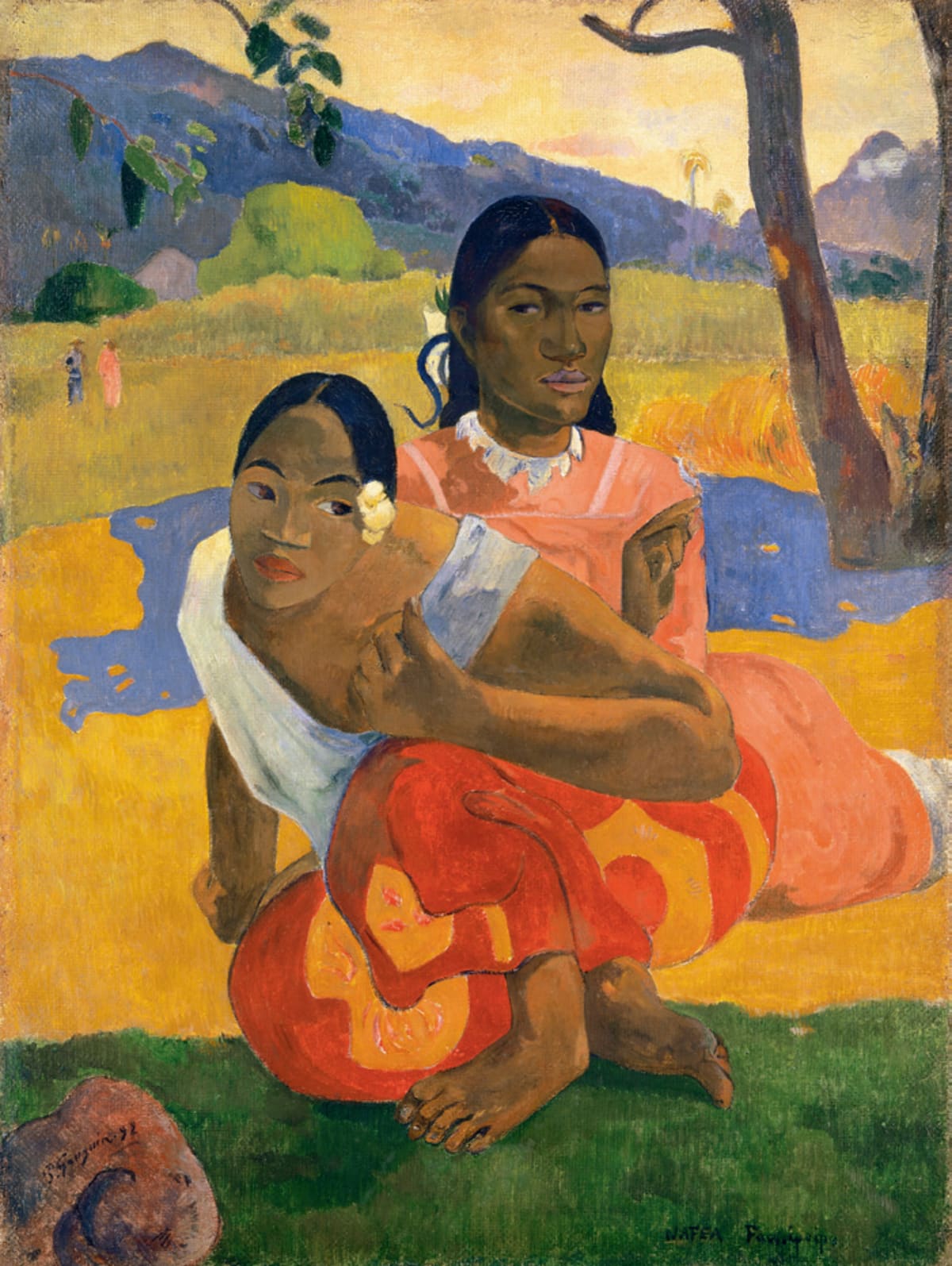
When Will You Marry?
1892
Gauguin's other 1892 Tahitian canvas — the same island, the same flat symbolic colour.

Tahitian Women on the Beach
1890
Gauguin's Tahitian beach of 1891 — closer to what he actually saw, without the invented rite.

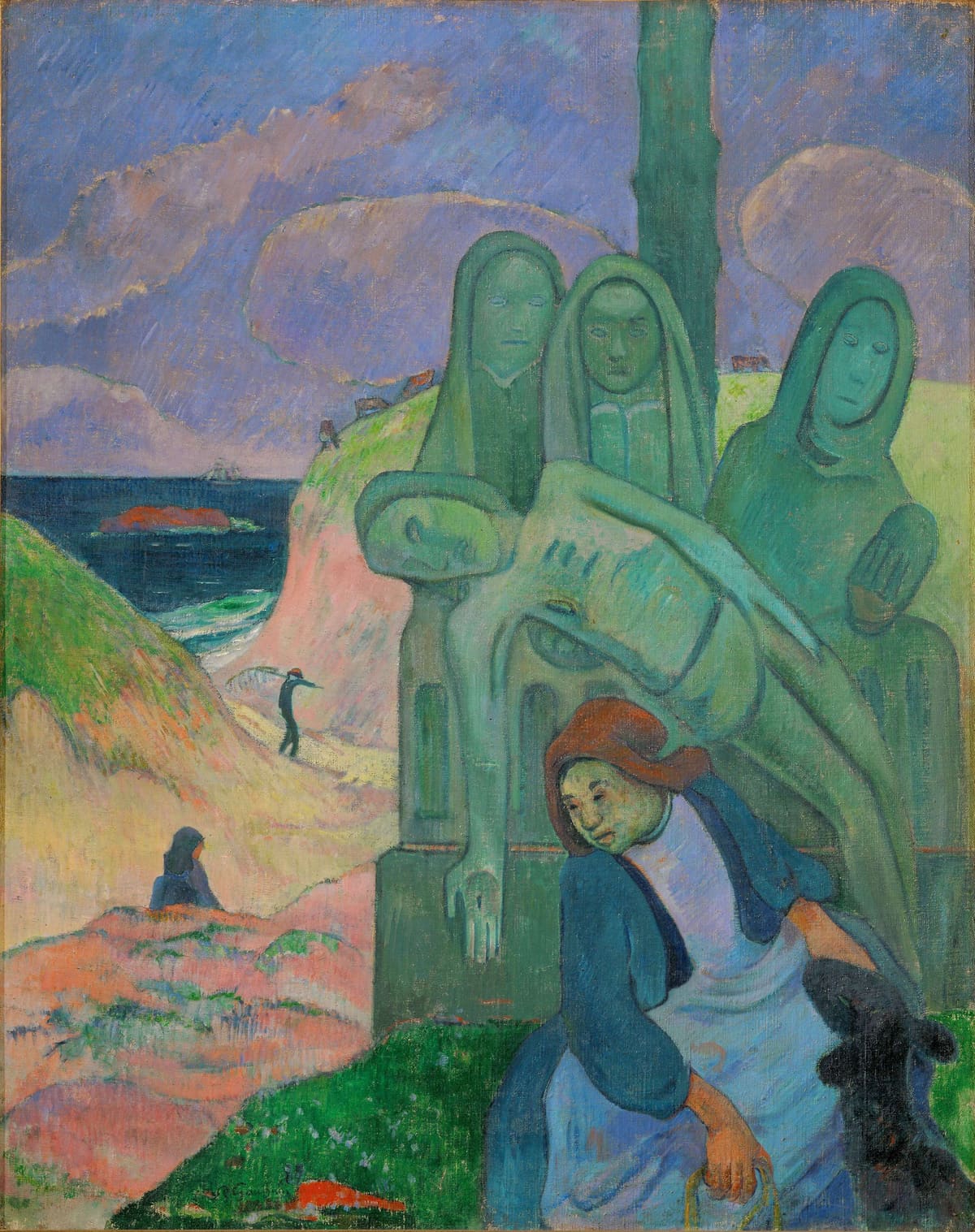
The Green Christ
1889
Gauguin in Brittany, 1889 — real wayside calvary and landscape, the method he carried to the Pacific.
More by Paul Gauguin

The Yellow Christ