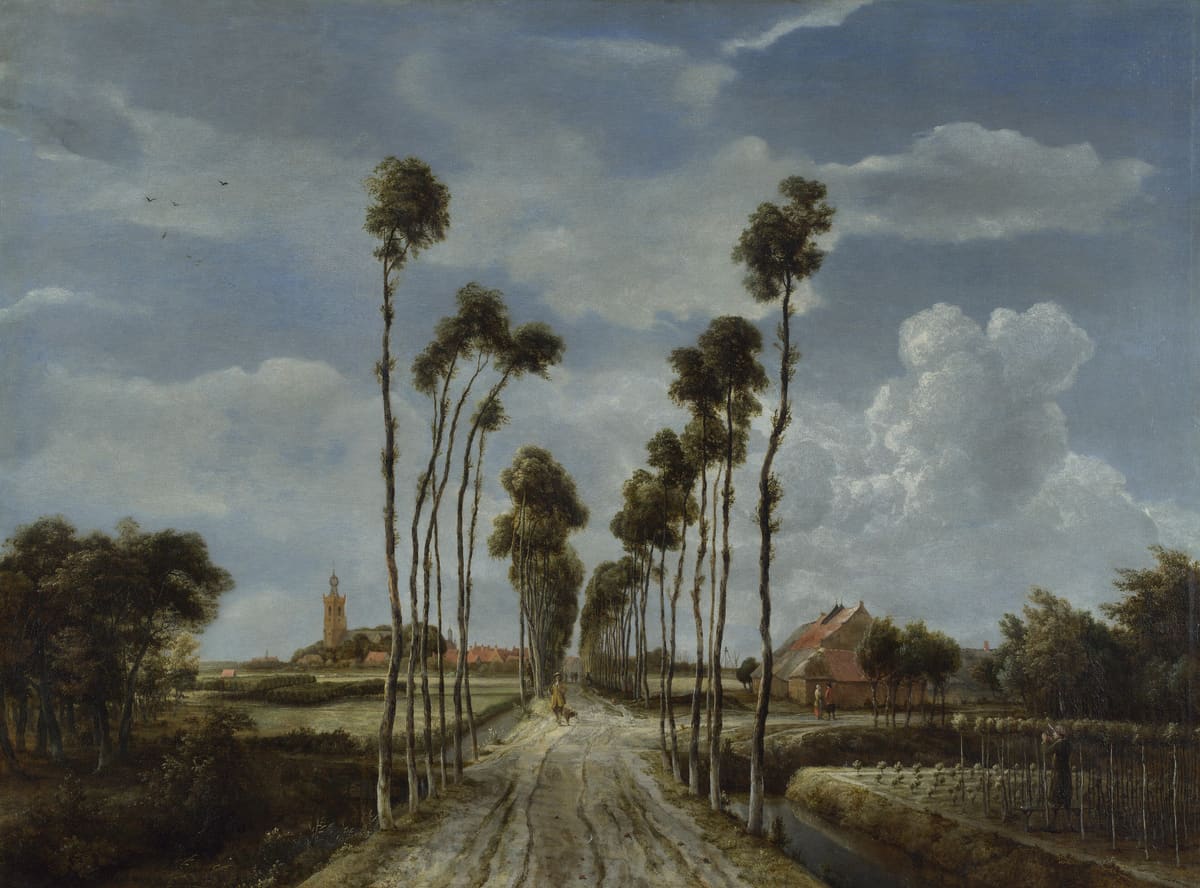
The Avenue at Middelharnis
A dead-straight avenue of tall, spindly trees running into the village of Middelharnis — the road and its trees survive.
The Avenue at Middelharnis — viewpoint
A standpoint is recorded for this painting, but it has not been independently confirmed against a museum or scholarly source, so treat it as approximate.
The Avenue at Middelharnis — at a glance
- Artist
- Meindert Hobbema (1638–1709)
- Year
- 1689
- Movement
- Dutch Golden Age
- Place
- Middelharnis, Goeree-Overflakkee, the Netherlands
- Viewpoint
- The straight avenue into the village from the north — road and church survive; trees replanted
- Medium
- Oil on canvas
- Dimensions
- c. 104 × 141 cm
- Now at
- The National Gallery, London
Overview
The Avenue at Middelharnis is the most famous painting by Meindert Hobbema, and one of the best-known of all Dutch landscapes. It was made in 1689 and shows a straight, rutted road running from the foreground into a village, flanked by two rows of very tall, thin, top-heavy trees. It is oil on canvas, about 104 by 141 cm, and it hangs in the National Gallery, London.
Hobbema had largely given up painting for a job as a wine-gauger by this date; the picture is a late, deliberate masterpiece.
Where was The Avenue at Middelharnis painted?
Middelharnis is a village on the island of Goeree-Overflakkee, in the estuary landscape of the south-western Netherlands.
Museum interpretation The road is the straight avenue leading into the village from the north, across the flat, drained polder land, with the church of Middelharnis rising at the end. The avenue still runs on the same line and has been replanted with trees more than once since 1689; the church tower is unchanged, and the framing can be matched closely from the road today.
What is in the painting?
A wide, muddy road runs straight away from the viewer to a low horizon, its ruts converging. On either side stands a line of slender trees, their trunks bare for most of their height and their foliage bunched at the top. A man with a dog and a gun walks towards us on the road; in a field to the right, a gardener tends rows of young trees in a nursery, and a couple talk by a fence. The village, with its church spire, closes the view.
Above it all, a huge sky of white and grey cloud fills more than half the canvas.
Look closely
The converging ruts
The wheel ruts in the muddy road run straight to the vanishing point at the church — the engine of the perspective.
The man with a dog and gun
A single figure walks towards the viewer down the centre of the road.
The tree nursery
In the field on the right, a gardener tends rows of young trees — a worked, planned landscape.
The church spire
The tower of Middelharnis church closes the view at the end of the avenue, and still stands.
The top-heavy trees
Bare trunks for most of their height, with foliage bunched only at the top — pruned roadside trees.
Analysis
Composition & perspective
A textbook one-point perspective — the road, the ruts and the two tree lines all rush to a single point at the church.
Scholarship Hobbema drives the perspective harder than almost any earlier landscape: the road runs dead-centre, the converging ruts and the flanking trees pull the eye straight to the vanishing point at the village. The near-symmetry is broken just enough by the nursery field and the figures on the right. The low horizon leaves the sky dominant.
Colour and light
Fresh greens and warm earth on the ground, under a bright, breezy, cloud-filled Dutch sky.
The palette is cool and natural — green fields, brown road, grey-white cloud — with a shaft of sun falling across the middle distance. The tall trees are painted with a light, feathery touch at the top and firm dark trunks below.
Meaning and interpretation
Interpretations differ. What the artist documented, what museums and scholars propose, and later or speculative theories are marked and kept separate.
A managed landscape
The picture is often read as an image of the ordered, man-made Dutch countryside — the ruler-straight avenue, the drained fields, the tree nursery — rather than wild nature. The daring perspective is the real subject.
Influence out of proportion to its fame at the time
Little regarded for a century, the painting became hugely influential once it reached England in the 1820s, shaping how later landscapists — including the British school — handled a road running into depth.
History & provenance
The painting stayed in the Netherlands into the early nineteenth century, was bought for an English collection, and was presented to the National Gallery, London, in 1871. It is one of the gallery's most reproduced works.
Featured in Famous Painting Locations: 13 Real Places You Can Visit
Sources
- The National Gallery, London — collection entry for Meindert Hobbema, ‘The Avenue at Middelharnis’ (1689; oil on canvas, c. 104 × 141 cm; presented 1871)
- Seymour Slive, ‘Dutch Painting 1600–1800’ (Yale University Press, 1995)
Frequently asked
Is the avenue in the painting a real road?
Yes. It is the straight tree-lined road leading into the village of Middelharnis, on the island of Goeree-Overflakkee in the south-western Netherlands.
Can you visit it?
Yes. The avenue still follows the same line into the village and has been replanted with trees several times since 1689; the church tower at the end is unchanged, and the view can be matched from the road.
Why are the trees so tall and thin?
They are mature trees that have been pruned up their trunks over many years, leaving the foliage only at the top — a common look for a planted roadside avenue.
What is happening in the field on the right?
A gardener is tending rows of young trees in a nursery, and a couple talk by a fence — small signs that this is a worked, managed landscape.
Why is the painting so famous?
For its extreme, exact one-point perspective: the road and the tree lines rush to a single point at the village church. It became very influential on later landscape painting after it reached England.
Where is the painting now?
In the National Gallery, London, since 1871.

