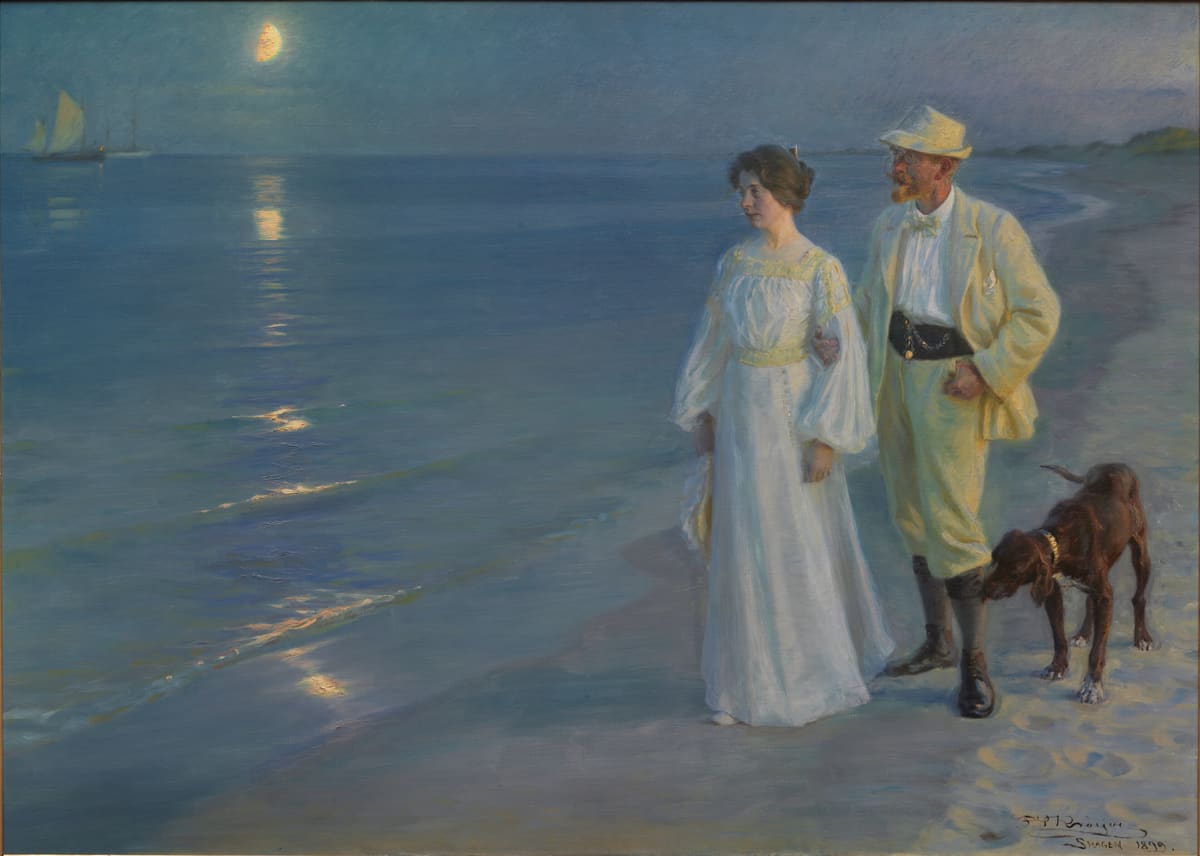
Summer Evening at Skagen Beach – The Artist and his Wife
Krøyer and his wife Marie walking the beach at Skagen at dusk — a stretch of shore at the northern tip of Denmark that is unchanged.
Skagen
This is a documented exact viewpoint — you can stand roughly where the artist stood and look at the same scene.
Summer Evening at Skagen Beach – The Artist and his Wife — at a glance
- Artist
- Peder Severin Krøyer (1851–1909)
- Year
- 1899
- Movement
- Skagen School / Naturalism
- Place
- The beach at Skagen, northern Jutland, Denmark
- Viewpoint
- A stretch of open beach at the ‘blue hour’ — shoreline and light unchanged
- Medium
- Oil on canvas
- Dimensions
- c. 135 × 187 cm
- Now at
- Skagens Museum, Denmark
Overview
This is one of the most loved paintings of the Skagen artists' colony, made by Peder Severin Krøyer in 1899. It shows the painter and his wife, Marie, walking away from the viewer along the beach at Skagen in the long blue twilight of a Danish summer night, their dog running ahead. It is oil on canvas, about 135 by 187 cm, and it hangs in the Skagens Museum.
Krøyer painted several versions of this ‘blue hour’ beach subject; this is the best known.
The story behind the painting
From the 1870s a colony of Scandinavian painters gathered each summer at Skagen, a fishing town at the far northern tip of Jutland, drawn by the flat light and the meeting of two seas. Krøyer, its central figure, married the painter Marie Triepcke in 1889 and settled there.
This picture is both a portrait of the marriage — the couple arm in arm, or close, on the shore — and a study of a particular effect of light: the deep, even blue that fills the sky and the sea after sunset in the north. Krøyer suffered increasingly from mental illness in these years, and the marriage later broke down; the calm of the painting is often felt against that.
Where was Summer Evening at Skagen Beach – The Artist and his Wife painted?
Museum interpretation The setting is the wide, flat sand beach on the outskirts of Skagen. The shoreline, the low dunes and the huge sky are essentially unchanged, and Skagen is still an artists' and visitors' town; the Skagens Museum and Krøyer's house are open. The picture records a stretch of open beach at a time of evening rather than a single fixed viewpoint.
What is in the painting?
Two figures in pale clothes walk away from the viewer along the tide line: Krøyer in a light suit and hat, Marie beside him in a long white dress. A white dog trots ahead across the wet sand. The sea is a band of deep grey-blue; the sky above it the same blue, lightening only faintly at the horizon; the wet sand mirrors both.
There is no incident and almost no colour but blue and white.
Look closely
Krøyer and Marie
The painter in a pale suit and hat, his wife in a long white dress, walking away from the viewer along the tide line.
The white dog
Running ahead across the wet sand — the only real movement in the picture.
The near-uniform blue
Sea, sky and the mirror of the wet sand are almost the same deep blue after sunset.
The low horizon
The join of sea and sky sits near the bottom, so most of the canvas is open blue.
Analysis
Composition & perspective
A very low horizon and two small figures placed off-centre, with the whole picture given to sea, sky and their reflection.
Scholarship Krøyer keeps the horizon low and the figures small, walking out of the picture, so the eye rests on the vast blue field and the mirror of the wet sand. The dog and the couple are the only movement; the design is deliberately empty and calm.
Colour and light
The ‘blue hour’: a single deep blue filling sea and sky after sunset, with the figures and the dog picked out in white.
Scholarship Krøyer built a series of paintings around this northern after-sunset light, when there is still enough of it to see by but everything reads blue. Here the blue is nearly uniform across sea, sky and reflection; the white dress, suit and dog are the only breaks, and they too are cooled by the light.
Meaning and interpretation
Interpretations differ. What the artist documented, what museums and scholars propose, and later or speculative theories are marked and kept separate.
A portrait of a marriage
The museum presents it as a double portrait of Krøyer and Marie, painted at the height of their life at Skagen — an image of companionship in a shared, chosen place.
Read against what followed
Because Krøyer's illness worsened and the marriage ended in divorce within a decade, later viewers often find a melancholy or a fragility in the stillness. That is hindsight; the picture itself is serene.
History & provenance
The painting is in the Skagens Museum, founded by the colony's own artists to keep their work in the town where it was made.
Featured in Famous Painting Locations: 13 Real Places You Can Visit
Research Included in the Painting Location Precision Study
Sources
- Skagens Museum — collection entry for P. S. Krøyer, ‘Sommeraften på Skagen Sønderstrand’ (‘Summer Evening at Skagen Beach – The Artist and His Wife’, 1899)
- Statens Museum for Kunst / Skagens Museum — literature on Krøyer's ‘blue hour’ beach paintings
Frequently asked
Where is Summer Evening at Skagen Beach set?
On the wide sand beach at Skagen, the fishing town at the far northern tip of Jutland, Denmark, where a colony of Scandinavian painters gathered each summer.
Can you visit the spot?
Yes. The beach, the low dunes and the huge sky are essentially unchanged, and Skagen is still a visitors' town; the Skagens Museum and Krøyer's house are open. It is a stretch of open beach rather than one fixed viewpoint.
Who are the two figures?
The painter P. S. Krøyer and his wife, the painter Marie Krøyer, walking with their dog. It is a double portrait.
Why is everything blue?
It shows the ‘blue hour’ — the long twilight after sunset in the far north, when there is still light to see by but the sky, the sea and the wet sand all read deep blue.
Where is the painting now?
In the Skagens Museum, Skagen, Denmark.
Related paintings

More by Peder Severin Krøyer
