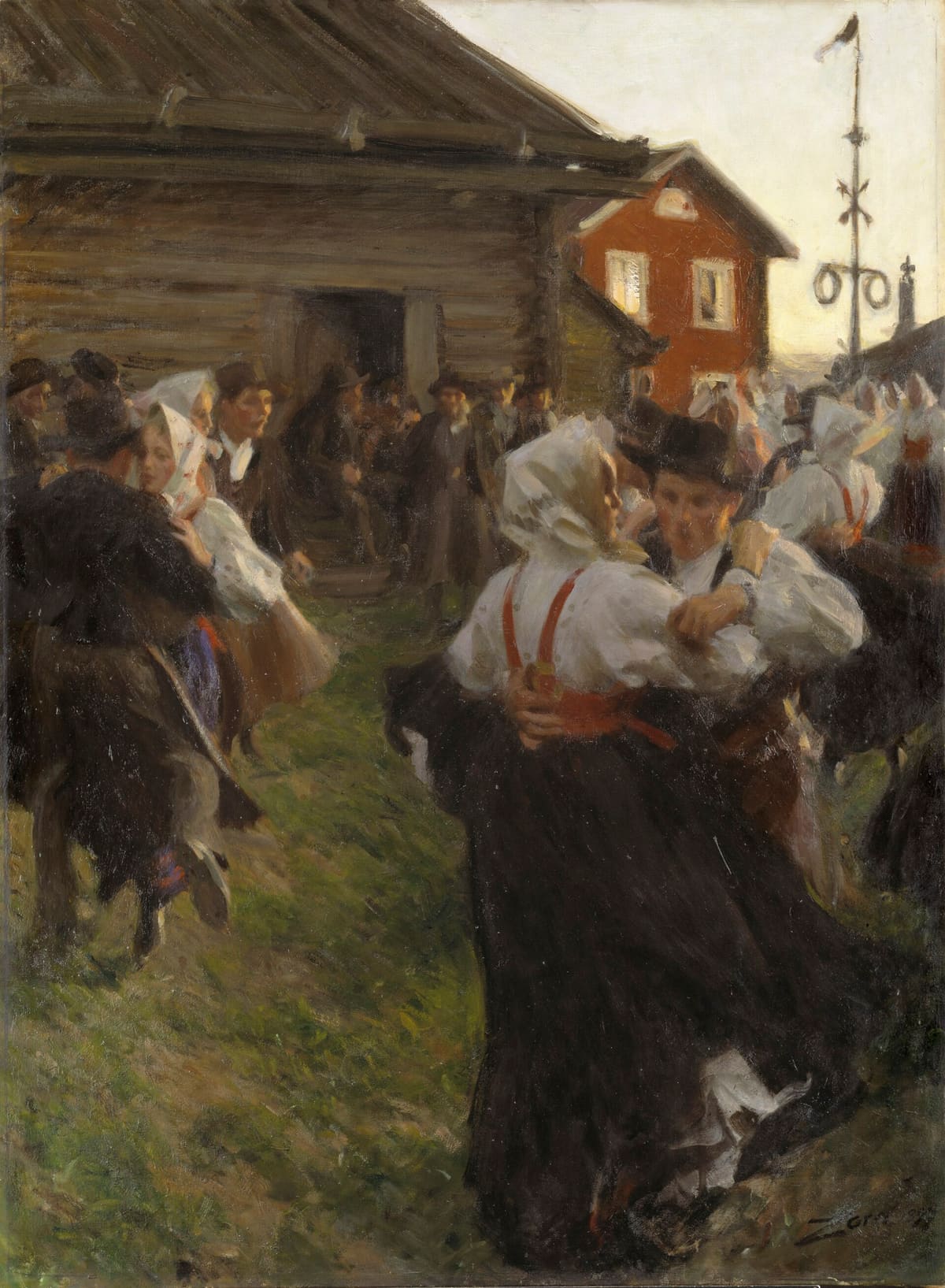
Midsummer Dance
The Midsummer's-eve dance at Mora in Dalarna, Sweden — painted at dusk near Anders Zorn's own home.
Morkarlby
A standpoint is recorded for this painting, but it has not been independently confirmed against a museum or scholarly source, so treat it as approximate.
Midsummer Dance — at a glance
- Artist
- Anders Zorn (1860–1920)
- Year
- 1897
- Movement
- Nordic National Romanticism / Naturalism
- Place
- Mora, Dalarna, Sweden
- Viewpoint
- A meadow near the village on Midsummer's eve — a living custom, not a fixed viewpoint
- Medium
- Oil on canvas
- Dimensions
- c. 140 × 98 cm (upright)
- Now at
- Nationalmuseum, Stockholm
Overview
Midsummer Dance is one of Anders Zorn's best-known paintings, made in 1897. It shows a crowd of villagers dancing outdoors on Midsummer's eve in the long, pale twilight of the Swedish summer night. It is oil on canvas, about 140 by 98 cm, and it hangs in the Nationalmuseum in Stockholm.
Zorn painted it in and around Mora, the Dalarna village where he had grown up and, by the 1890s, built his house and studio.
The story behind the painting
Zorn had made an international career as a society portraitist in Paris, London and the United States, but from the mid-1890s he spent more and more time at Mora, painting the customs and people of Dalarna and collecting its buildings and crafts.
Midsummer's eve — the celebration of the year's shortest night — was the great festival of the region: a raised and decorated maypole, folk dress, fiddle music and dancing that ran until dawn. Zorn treated it as a subject worthy of a large exhibition canvas.
Where was Midsummer Dance painted?
Mora sits at the northern end of Lake Siljan in Dalarna, in central Sweden — Zorn's home district, and one where traditional dress and midsummer customs were still strong.
Museum interpretation The dance is set on a farmyard or meadow near the village in the low light of the northern midsummer night. Zorn's home, Zorngården, and the open-air museum of Dalarna buildings he assembled are open to visitors at Mora, and midsummer is still celebrated there; the picture records a living local custom rather than a fixed topographic viewpoint.
What is in the painting?
Couples whirl across the foreground in folk costume — the women in white sleeves, striped aprons and dark bodices, the men in waistcoats and caps. A fiddler plays at the left. Behind the dancers, a red-painted timber farmhouse with white window frames, and beyond it the pale, luminous sky of a night that never quite goes dark.
The nearest couple is caught mid-turn, the woman's skirt swinging out, her partner leaning back against the spin.
Look closely
The spinning couple
The nearest dancers are caught mid-turn, the woman's striped skirt swinging out, the man leaning against the spin.
The fiddler
A musician plays at the left, driving the dance.
The folk dress
White sleeves, striped aprons and dark bodices for the women; waistcoats and caps for the men — the traditional dress of Dalarna.
The red farmhouse
A red-painted timber house with white window frames stands behind the dancers — the standard building of the region.
The midsummer sky
The pale, shadowless light of a night that never fully darkens.
Analysis
Composition & perspective
The tall, upright format and a swirling foreground couple give the whole picture the momentum of the dance.
Scholarship Zorn builds the design around the spinning near couple, cropped close and slightly off-centre, with the other dancers, the fiddler and the farmhouse spiralling back from them. The vertical canvas and the diagonal lean of the figures keep the eye moving.
Colour and light
The warm reds and whites of costume and cottage glow against the cool silver of the midsummer night sky.
Scholarship Zorn plays the strong local colour of the folk dress and the red farmhouse against the pale, shadowless light of the northern night, when the sun barely sets. The brushwork is broad and confident, the highlights on white linen and skin laid on wet and fast.
Meaning and interpretation
Interpretations differ. What the artist documented, what museums and scholars propose, and later or speculative theories are marked and kept separate.
A record of a living tradition
The picture is read as Zorn's assertion of the worth of his home region: its costume, music and midsummer ritual painted at the scale and with the ambition of international art.
National Romanticism
It belongs to a wider Nordic movement of the 1890s that turned to folk life and landscape as the basis of a national art. Zorn's collecting and his open-air museum at Mora were part of the same impulse.
History & provenance
The painting was acquired for the Swedish national collection and hangs in the Nationalmuseum in Stockholm; Zorn's house and museum at Mora hold much of his other work.
Featured in Famous Painting Locations: 13 Real Places You Can Visit
Sources
- Nationalmuseum, Stockholm — collection entry for Anders Zorn, ‘Midsommardans’ (‘Midsummer Dance’, 1897; oil on canvas)
- Zornmuseet, Mora — Zorn's house, collection and open-air museum
- Johan Cederlund et al., ‘Anders Zorn: Sweden's Master Painter’ (2013)
Frequently asked
Where is Midsummer Dance set?
At Mora, in the Dalarna region of central Sweden — Anders Zorn's home village, at the northern end of Lake Siljan.
Can you visit the place?
Yes. Zorn's home, Zorngården, and the open-air museum of old Dalarna buildings he assembled are open at Mora, and midsummer is still celebrated in the region. The painting records a custom rather than one fixed spot.
What is being celebrated?
Midsummer's eve — the shortest night of the year — with a decorated maypole, folk dress, fiddle music and dancing that lasted until dawn.
Why is the sky so light?
In central Sweden at midsummer the sun barely sets, so the night stays pale and silvery — the light Zorn painted.
Where is the painting now?
In the Nationalmuseum, Stockholm.
