Famous work · not an exact-location map point
La belle Angèle
A portrait of an innkeeper's wife at Pont-Aven in Breton dress, framed in a roundel beside a Peruvian idol — a picture the sitter refused.
No single real-world viewpoint
A decorative portrait of the Pont-Aven innkeeper Marie-Angélique Satre; no depicted place — the coordinate is the village.
La belle Angèle — at a glance
- Artist
- Paul Gauguin (1848–1903)
- Year
- 1889
- Movement
- Symbolism / Cloisonnism (Pont-Aven school)
- Place
- Pont-Aven, southern Brittany, France
- Viewpoint
- A portrait against a flat decorative ground — tied to Pont-Aven by the sitter and costume, not a view
- Medium
- Oil on canvas
- Dimensions
- c. 92 × 73 cm
- Now at
- Musée d'Orsay, Paris
Overview
La Belle Angèle is a portrait Paul Gauguin painted in the summer of 1889 during one of his stays at Pont-Aven in Brittany. Angèle Satre, the young wife of an innkeeper, sits in traditional Breton dress and a tall lace coif, hands folded, inside a large circle set against a decorative background of flowers; her name, ‘LA BELLE ANGÈLE’, is lettered on the flat lower band, and to the left stands a small orange ceramic figure, an idol Gauguin modelled on Peruvian pottery. It is oil on canvas, about 92 by 73 cm, and it hangs in the Musée d'Orsay, Paris. The sitter is said to have found it ugly and refused it.
Where was La belle Angèle painted?
Scholarship Pont-Aven is a small town on the river Aven in southern Brittany that drew a colony of painters from the 1860s; Gauguin worked there repeatedly and the ‘Pont-Aven school’ takes its name from it. Angèle Satre and her husband kept an inn in the town. The picture has no landscape setting — Angèle sits against a flat patterned ground — so it is tied to Pont-Aven by the sitter, the costume and the moment rather than by a depicted view. The town survives and markets its painters' heritage.
What is in the painting?
Angèle is seated half-length inside a bold circle, wearing the black dress, embroidered fichu and stiff white lace coif of the Pont-Aven region, her expression grave. Behind the circle, a flat field of blue-green scattered with pink and white flowers and haystack shapes; the lettered band below; the little orange-and-gold idol on a shelf at the lower left. The design borrows the framing device of Japanese prints.
Look closely
The lettered band
‘LA BELLE ANGÈLE’ is lettered across the flat lower strip — text as part of the picture surface.
The Breton coif
The tall, stiff white lace headdress of the Pont-Aven region.
The little idol
A small orange-and-gold ceramic figure on a shelf at the lower left, modelled on Peruvian pottery.
The tondo frame
A bold circle cuts the sitter out from a flat flowered ground — borrowed from Japanese prints.
Analysis
Composition and technique
A figure isolated in a circle against a flat decorative ground, with a lettered caption and a symbolic idol alongside.
Scholarship Gauguin treats the portrait like a design or an icon: the tondo cuts the sitter out from a patterned background, the name is part of the picture surface, and the idol introduces the ‘primitive’ note that ran through his work. Colour is flat and unshaded, bounded by firm outlines.
History & provenance
The painting was bought by Edgar Degas at auction in 1891 and later entered the French national collections; it hangs in the Musée d'Orsay, Paris.
Sources
- Musée d'Orsay, Paris — collection entry for Paul Gauguin, ‘La Belle Angèle’ (1889)
- Belinda Thomson, ‘Gauguin’ (Thames & Hudson)
Related paintings

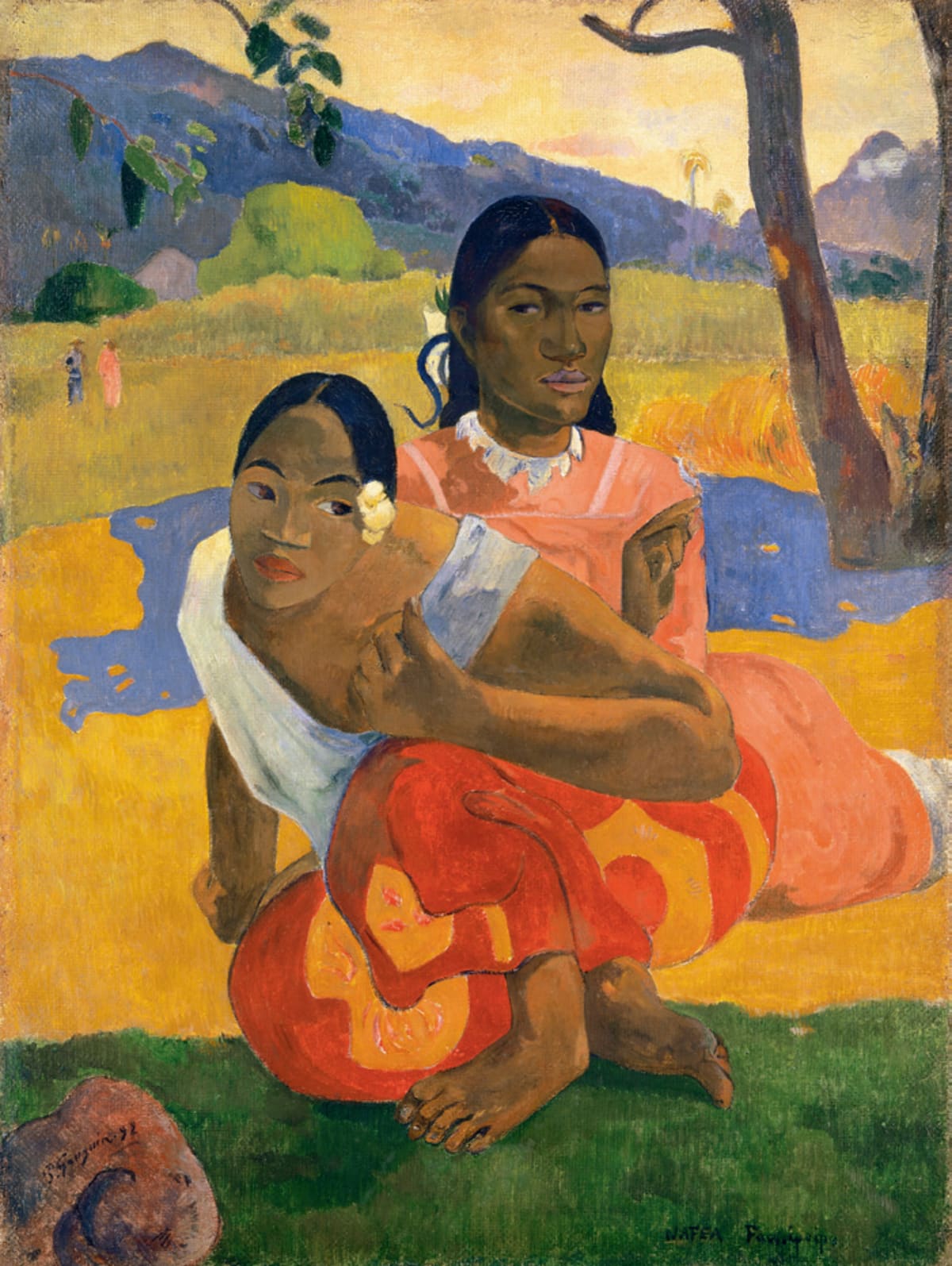
The Yellow Christ
1889
Gauguin at Pont-Aven the same summer — the flat, outlined Breton style.

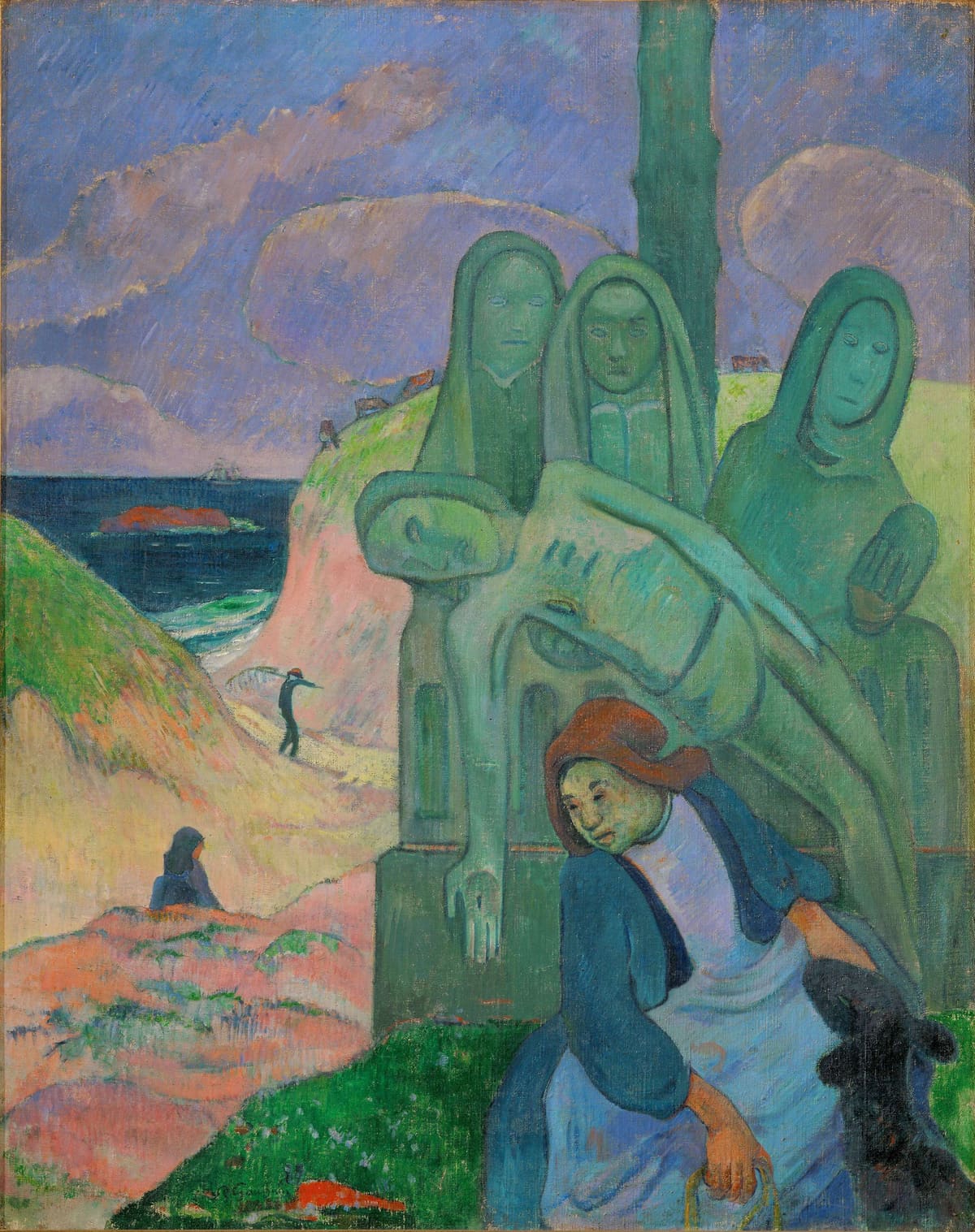
The Green Christ
1889
Gauguin's other 1889 Breton calvary.

Agostina Segatori Sitting in the Café du Tambourin
1887
Van Gogh's Paris café portrait of 1887 — a friend of Gauguin's on a similar bold, flat-ground portrait idea.
More by Paul Gauguin
The Yellow Christ