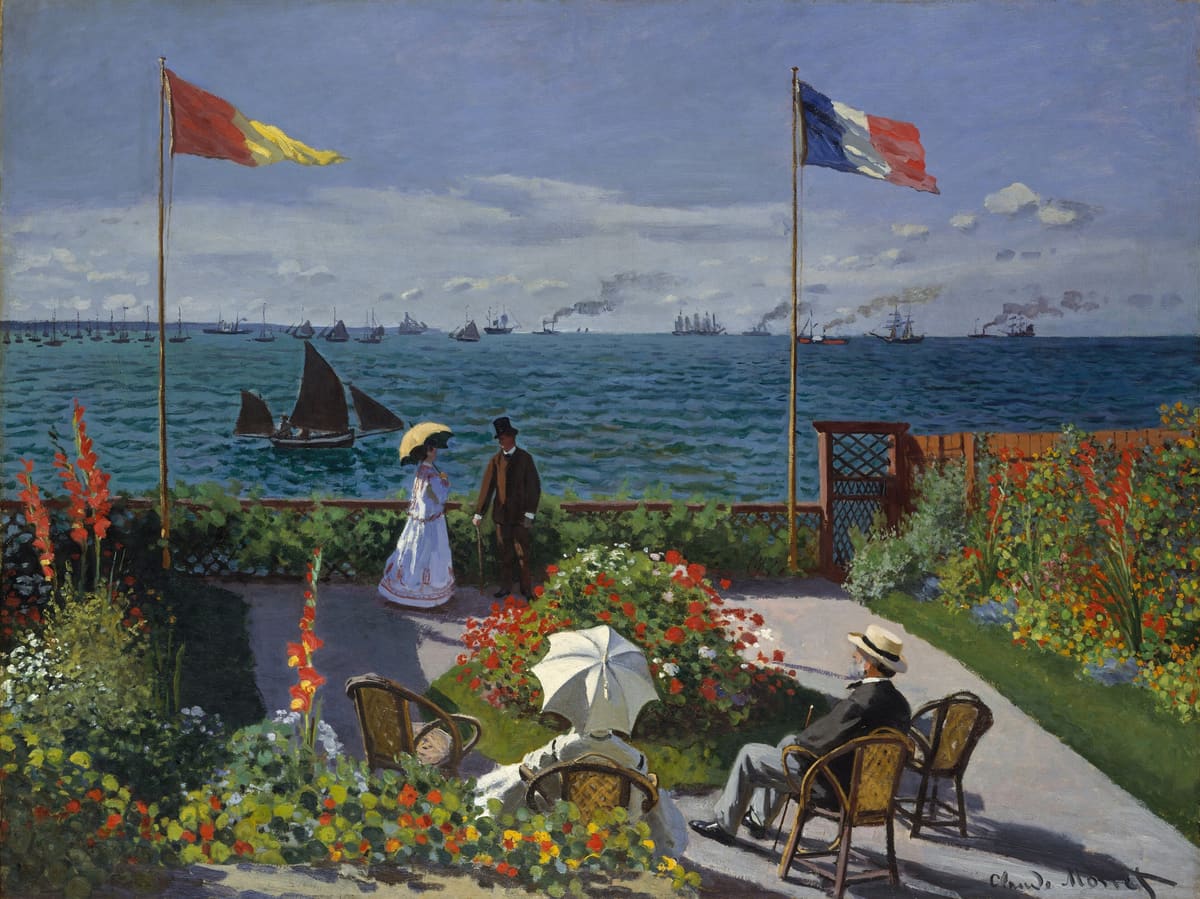
Beach in Pourville
The chalk-cliff coast at Pourville near Dieppe — a Monet beach picture famously stolen from a Polish museum and recovered.
Hautot-sur-Mer
The painting depicts a real landscape or cityscape. The precise viewpoint the artist used may be unknown, so the marker shows the general area.
Beach in Pourville — at a glance
- Artist
- Claude Monet (1840–1926)
- Year
- 1882
- Movement
- Impressionism
- Place
- Pourville, commune of Hautot-sur-Mer, near Dieppe, Normandy
- Viewpoint
- The chalk-cliff beach — shore, cliffs and coast path survive; a general viewpoint
- Medium
- Oil on canvas
- Dimensions
- c. 60 × 73 cm
- Now at
- National Museum in Poznań, Poland (stolen 2000, recovered 2010)
Overview
Beach in Pourville (Plage à Pourville) is one of the many canvases Claude Monet painted on the Normandy coast in 1882, during long stays at Pourville and Dieppe. It shows a windy day on a shingle beach: white-capped grey-green sea, a stretch of shore with a few small figures, and the cliffs curving away, under a fast sky. It is oil on canvas, about 60 by 73 cm, and it belongs to the National Museum in Poznań, Poland.
In September 2000 the painting was cut from its frame and stolen from the Poznań museum; it was recovered by Polish police in 2010 and returned, with visible restoration.
Where was Beach in Pourville painted?
Scholarship Pourville-sur-Mer is a small seaside hamlet in the commune of Hautot-sur-Mer, just west of Dieppe on the chalk-cliff coast of the Pays de Caux. Monet rented there in 1882 and painted the beach, the cliffs, the customs officer's cabin on the cliff-top and the church at nearby Varengeville. The beach, the cliffs and the coast path survive and are much visited; the picture records a stretch of that shore in particular weather rather than a marked spot.
What is in the painting?
A broad grey shingle beach runs across the foreground, a few small dark figures on it. Beyond, the choppy sea in bands of grey, green and white; on the right, the pale chalk cliff rises and curves out of the frame. The sky is filled with moving grey and white cloud. The whole picture is painted in quick, broken strokes.
Look closely
The chalk cliff
The pale cliff rises on the right and curves out of the frame — the coast of the Pays de Caux.
The choppy sea
Grey, green and white water painted in short, restless strokes.
The small figures
A few dark shapes on the shingle give the scale of the empty beach.
The moving sky
Grey and white cloud dragged across the upper half of the canvas.
Analysis
Composition and technique
A low beach foreground, a band of restless sea, the cliff at one side, and a large moving sky.
Scholarship Monet keeps the design simple and lets the brushwork carry the wind: short choppy strokes for the sea, longer dragged ones for the cloud, flecks for the figures and the shingle. It is a plein-air study of a grey, blowy Channel day.
History & provenance
The painting entered the collection of the National Museum in Poznań; stolen in 2000 and recovered in 2010, it is again held by the museum.
Sources
- Muzeum Narodowe w Poznaniu (National Museum in Poznań) — collection entry for Claude Monet, ‘Plage à Pourville’ (1882); account of the 2000 theft and 2010 recovery
- Wildenstein, ‘Monet: catalogue raisonné’ — the 1882 Pourville / Dieppe campaign
Related paintings


More by Claude Monet
Impression, Sunrise
Woman with a Parasol – Madame Monet and Her Son

Houses on the Achterzaan