View of Florence
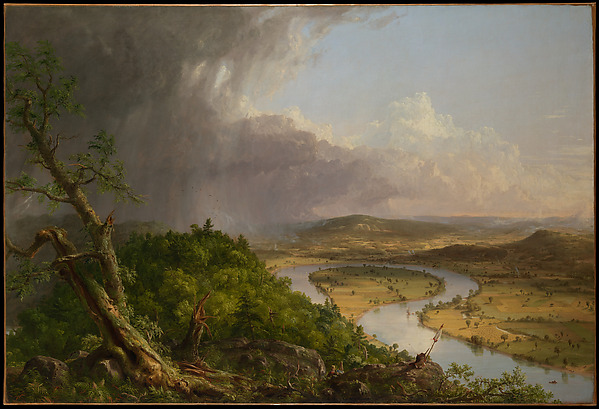
Florence spread out below its hills in golden evening light, the dome of the cathedral at its centre — Thomas Cole's classic panorama from the south.
Florence Cathedral
The painting shows a real, identified place that you can find today. The exact spot the artist worked from is not necessarily known.
View of Florence — at a glance
- Artist
- Thomas Cole (1801–1848)
- Year
- 1837
- Movement
- Hudson River School
- Place
- Florence, from the hill of San Miniato al Monte, Italy
- Viewpoint
- The San Miniato / Piazzale Michelangelo hill — the panorama of Florence is unchanged and matchable
- Medium
- Oil on canvas
- Dimensions
- c. 100 × 160 cm
- Now at
- Cleveland Museum of Art
Overview
View of Florence is a large, luminous panorama Thomas Cole painted in 1837, from studies made during his second European tour. From a wooded height south of the city, it looks north-west across the Arno valley in the warm light of late afternoon: cypresses and a monastery wall in the foreground, peasants and a monk on the road, the river winding through, and the whole spread of Florence beyond, dominated by the dome of the cathedral and the tower of the Palazzo Vecchio, with the Apennines behind. It is oil on canvas, about 100 by 160 cm, and it hangs in the Cleveland Museum of Art.
Where was View of Florence painted?
Scholarship The viewpoint is the hill of San Miniato al Monte, the Romanesque church and monastery on high ground on the south (left-bank) side of Florence — the same hill on which the Piazzale Michelangelo was later laid out (1869) as a public belvedere. The classic panorama of Florence from here, with the Duomo at its heart, is unchanged and is one of the most photographed views in Italy, so Cole's prospect can be matched closely, allowing for the growth of the modern city on the plain.
What is in the painting?
A dark foreground of cypresses, a rough road and a monastery wall, with small figures — a monk, peasants, a woman — resting or walking. The land falls to the Arno, crossed by bridges; beyond, the pale city fills the middle distance, Brunelleschi's dome and the campanile clear at its centre, other towers and roofs around. Blue hills close the view under a sky glowing gold and rose.
Look closely
The cathedral dome
Brunelleschi's dome and the campanile stand clear at the centre of the pale city.
The dark foreground
Cypresses, a road and a monastery wall, with a monk and peasants, frame the view and launch the eye.
The winding Arno
The river threads the valley between the height and the city, crossed by bridges.
The golden light
Late-afternoon light glows gold and rose over the city and the Apennines behind.
Analysis
Composition and technique
A shaded, populated foreground height opening onto a sunlit city in the valley, framed by trees and hills.
Scholarship Cole uses the classical device of a dark, incident-filled foreground to launch the eye into a radiant distance where the famous city lies laid out and small. The warm evening light idealises the scene; the composition owes much to Claude Lorrain.
History & provenance
The painting is in the Cleveland Museum of Art.
Sources
- Cleveland Museum of Art — collection entry for Thomas Cole, ‘View of Florence from San Miniato’ (1837)
- Comune di Firenze — the Piazzale Michelangelo and the San Miniato hill
Related paintings


Current display status
Currently on viewMore by Thomas Cole