The Oxbow
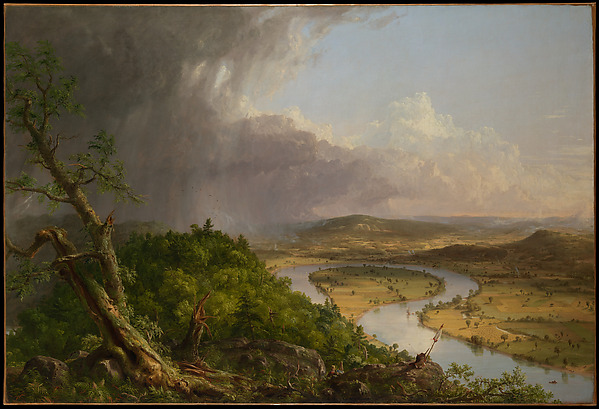
The great looping bend of the Connecticut River seen from the summit of Mount Holyoke, Massachusetts, as a thunderstorm clears — the view is still there.
The Oxbow
The painting depicts a real landscape or cityscape. The precise viewpoint the artist used may be unknown, so the marker shows the general area.
The Oxbow — at a glance
- Artist
- Thomas Cole (1801–1848)
- Year
- 1836
- Movement
- Hudson River School
- Place
- Summit of Mount Holyoke, Connecticut River valley, Massachusetts
- Viewpoint
- The mountain summit (now Skinner State Park) — the panorama can still be matched
- Medium
- Oil on canvas
- Dimensions
- c. 130 × 193 cm
- Now at
- Metropolitan Museum of Art, New York
Overview
The Oxbow is the best-known painting by Thomas Cole, founder of the Hudson River School, made in 1836. Its full title is View from Mount Holyoke, Northampton, Massachusetts, after a Thunderstorm. From a high, wild foreground of storm-blasted trees the view opens onto a sunlit valley where the Connecticut River doubles back on itself in a near-complete loop — the ‘oxbow’ — among tidy farms. It is oil on canvas, about 130 by 193 cm, and it hangs in the Metropolitan Museum of Art, New York.
The story behind the painting
Scholarship Cole painted it for exhibition and sale while he was preoccupied with his allegorical series ‘The Course of Empire’; he wrote of grudging the time. He worked from oil and pencil sketches made on Mount Holyoke, then a popular scenic overlook reached by a summit house. He even painted himself into the picture — a tiny figure with a parasol and easel on the slope, mid-canvas, looking back at the viewer.
Where was The Oxbow painted?
Scholarship The viewpoint is the summit of Mount Holyoke, a ridge rising about 280 m above the Connecticut River valley near the towns of Northampton and Hadley, in western Massachusetts. The mountain is now within Skinner State Park; a road and trails reach the top, where the restored nineteenth-century Summit House still stands, and the loop of the river — though the 1840 floods later cut the neck of the bend, turning the oxbow into a separate lake — is still clearly visible below. The panorama Cole painted can be matched closely from the summit today.
What is in the painting?
The canvas is split diagonally. The left and foreground are wilderness: a shattered, lightning-struck tree, tangled undergrowth, dark cloud and slanting rain still falling over the hills. The right and distance are cultivated and sunlit: the river curling through green and gold fields, farmsteads, grazing land, smoke rising from clearings, low blue hills beyond. On the near slope, the small self-portrait of the artist at his easel.
Look closely
The lightning-struck tree
A shattered, blasted tree dominates the wild left foreground.
The tiny self-portrait
An artist with a parasol and easel sits on the near slope, mid-canvas, looking back at the viewer.
The oxbow loop
The river doubles back on itself in a near-complete circle among the sunlit fields.
The retreating rain
Slanting grey rain still falls over the hills on the left as sun breaks over the valley on the right.
Analysis
Composition & perspective
A diagonal divides storm-lit wilderness on the left from sunlit farmland on the right, with the river loop as the centre.
Scholarship Cole runs the division from lower left to upper right: broken trees and retreating storm against ordered fields and clear sky. The eye is carried from the wild foreground down to the shining oxbow and out to the hazy horizon. The tiny painter on the slope marks the join between the two worlds.
Colour and light
Dark storm greens and greys on the left giving way to warm gold and clear blue on the right.
Cole keys the two halves against each other: bruised cloud, wet dark foliage and slate rain on the wilderness side; sunlit yellow-green fields, pale river and soft blue distance on the settled side. Light breaks through exactly over the cultivated valley.
Meaning and interpretation
Interpretations differ. What the artist documented, what museums and scholars propose, and later or speculative theories are marked and kept separate.
Wilderness and civilisation
The picture is read as a meditation on the American land at a moment of rapid settlement: untamed nature on one side, the farmed, improved valley on the other, and the choice between them left open. Some see markings on a distant hillside as Hebrew letters reading ‘the Almighty’ or ‘Noah’, read upside down — a divine signature on the landscape, though this is debated.
Cole's ambivalence
Cole admired the pastoral valley but mourned the clearing of the forests elsewhere in his work; The Oxbow holds both feelings without resolving them.
History & provenance
The painting was sold soon after it was made, passed through American collections, and was given to the Metropolitan Museum of Art, New York, in 1908.
Sources
- The Metropolitan Museum of Art, New York — collection entry for Thomas Cole, ‘View from Mount Holyoke... (The Oxbow)’ (1836; oil on canvas, c. 130 × 193 cm)
- Massachusetts Department of Conservation and Recreation — Skinner State Park and the Summit House, Mount Holyoke
Frequently asked
Where is the view in The Oxbow?
From the summit of Mount Holyoke, a ridge above the Connecticut River valley near Northampton and Hadley in western Massachusetts, looking down at the great loop (‘oxbow’) of the river.
Can you go there?
Yes. The mountain is in Skinner State Park; a road and trails reach the top, where the restored nineteenth-century Summit House stands, and the river loop is still clearly visible. The panorama can be matched closely.
Is the oxbow still a bend in the river?
Not quite. Floods in 1840 cut through the narrow neck of the loop, leaving the oxbow as a separate crescent-shaped lake beside the straightened river. The shape is still obvious from above.
Is Cole in the painting?
Yes — a tiny self-portrait, an artist with a parasol and easel on the near slope near the centre, looking back at the viewer, at the dividing line between wilderness and farmland.
What does the storm-versus-sunshine split mean?
It is usually read as wild nature against settled, cultivated land — the American landscape at a moment of rapid change, with the choice between them left open.
Where is the painting now?
In the Metropolitan Museum of Art, New York.
Related paintings

More by Thomas Cole

View of Florence
