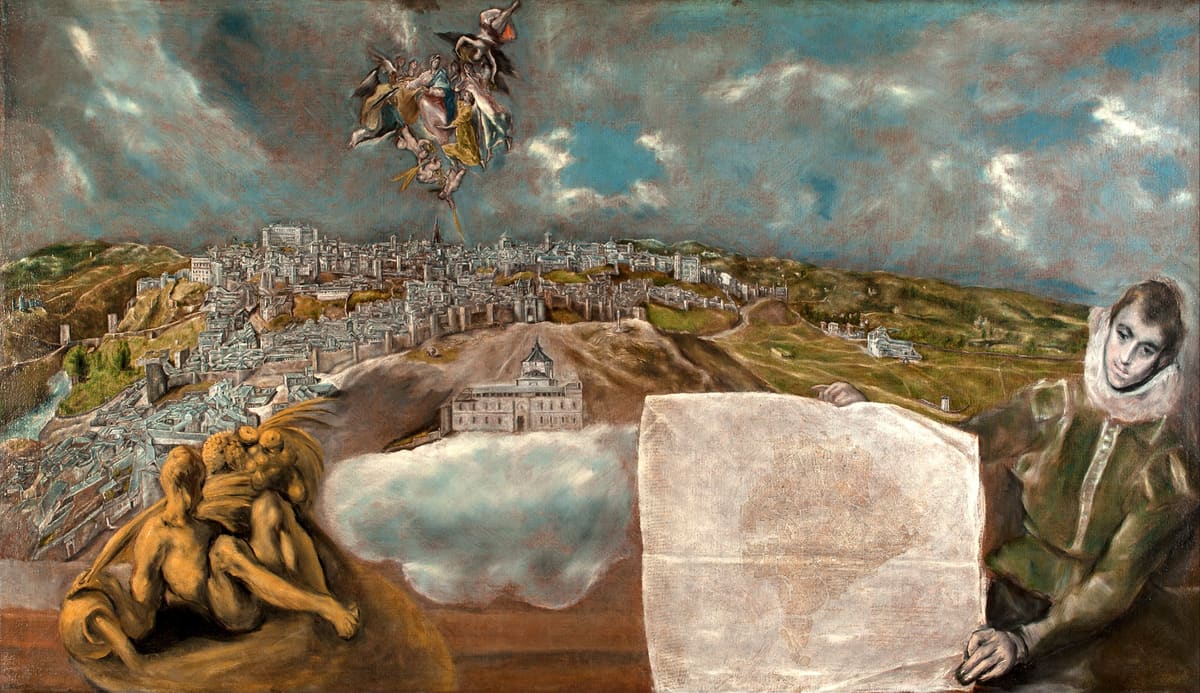
View and Plan of Toledo
El Greco's own painted map-and-view of Toledo, with the buildings he could not fit rearranged and a floating cloud carrying the Virgin.
Toledo
The painting depicts a real landscape or cityscape. The precise viewpoint the artist used may be unknown, so the marker shows the general area.
View and Plan of Toledo — at a glance
- Artist
- El Greco (Doménikos Theotokópoulos, 1541–1614)
- Year
- c. 1608
- Movement
- Spanish Mannerism
- Place
- Toledo, on the river Tagus, central Spain
- Viewpoint
- The city from the north — skyline largely unchanged (World Heritage); buildings rearranged by the artist
- Medium
- Oil on canvas
- Dimensions
- c. 132 × 228 cm
- Now at
- Museo del Greco, Toledo
Overview
View and Plan of Toledo is an unusual work by El Greco, painted around 1608 near the end of his life in the city where he had settled. It is part landscape, part diagram: a panoramic view of Toledo on its hill above the river Tagus, with, in the lower right, a young man holding up a drawn ground-plan of the city, and, floating on a cloud above, the Virgin and Child with angels bringing vestments for a local saint. An inscription explains the artist's choices. It is oil on canvas, about 132 by 228 cm, and it hangs in the Museo del Greco in Toledo.
The artist's own explanation
Artist's own account A painted cartouche in the picture records El Greco's reasoning: he has represented the Hospital of Tavera as a model held on a cloud, because otherwise it would have hidden the city gate; and he has shown the plan separately so that the streets and the positions of the buildings can be understood. It is a rare case of a painter explaining, on the canvas, why his ‘view’ is not literally accurate.
Where was View and Plan of Toledo painted?
Scholarship Toledo, the former Spanish capital, stands on a granite hill almost encircled by the gorge of the river Tagus, in central Spain. El Greco shows the city from the north, with the Alcántara bridge, the castle of San Servando, the walls and the towers of the churches and the cathedral. The historic centre is a UNESCO World Heritage Site and the silhouette on its hill is still one of the most recognisable in Europe, so the view can be broadly matched — but, as his own inscription admits, El Greco moved buildings for clarity.
What is in the painting?
The city fills the upper two-thirds: green slopes and the winding Tagus in the foreground, the Alcántara bridge, and the massed towers and roofs of Toledo climbing to the cathedral spire and the square Alcázar. In the lower right, a youth in contemporary dress kneels holding a large drawn plan of the streets. Lower left, the Tavera hospital is shown as a small floating model. Above the city, a break of cloud carries the Virgin and saints.
Look closely
The Alcántara bridge
The Roman-founded bridge crosses the Tagus gorge in the foreground, below the city walls.
The held-up plan
A kneeling youth in the lower right displays a large drawn ground-plan of Toledo's streets.
The floating hospital
The Tavera hospital is shown as a small model on a cloud, lower left, so it would not hide the city gate.
The apparition
Above the towers, the Virgin and saints ride a break of cloud, bringing vestments.
Analysis
Composition and technique
A topographic panorama with a diagram and a vision spliced into it, held together by El Greco's restless light.
Scholarship El Greco combines three registers — the mapped city, the explanatory plan, the heavenly apparition — in one field, unifying them with his characteristic cold, silvery green light and nervous, elongated forms. The result is a document, a devotional image and a landscape at once.
Meaning and interpretation
Interpretations differ. What the artist documented, what museums and scholars propose, and later or speculative theories are marked and kept separate.
A portrait of a city and its holiness
The picture presents Toledo as both a real, mappable place and a sacred one, watched over from heaven. The cloud-borne Virgin bringing a chasuble refers to the legend of Saint Ildefonso, Toledo's own miracle. City pride and devotion are made one image.
History & provenance
The painting stayed in Toledo and is in the Museo del Greco, the museum in the city devoted to the artist.
Sources
- Museo del Greco, Toledo — collection entry for El Greco, ‘View and Plan of Toledo’ (c. 1608)
- UNESCO World Heritage — Historic City of Toledo
Frequently asked
Is this a real view of Toledo?
Largely, but adjusted. El Greco shows the real city on its hill above the Tagus, with the Alcántara bridge, walls, castle and cathedral — but a painted inscription in the picture admits he moved buildings and even floated the Tavera hospital on a cloud so it would not block the city gate.
Why is there a map in the painting?
El Greco added a separate drawn ground-plan, held up by a youth, so that the layout of the streets and the true positions of the buildings could be read alongside the view.
Can you match the view today?
Yes, broadly. Toledo's historic centre is a World Heritage Site and its skyline on the hill is largely unchanged; the profile can be recognised from the north, allowing for El Greco's rearrangements.
What is the floating figure above the city?
The Virgin, with the Christ Child and saints, on a break of cloud, bringing vestments — a reference to the local legend of Saint Ildefonso. It makes the picture a devotional image as well as a view.
Where is the painting now?
In the Museo del Greco, Toledo.
Related paintings


More by El Greco