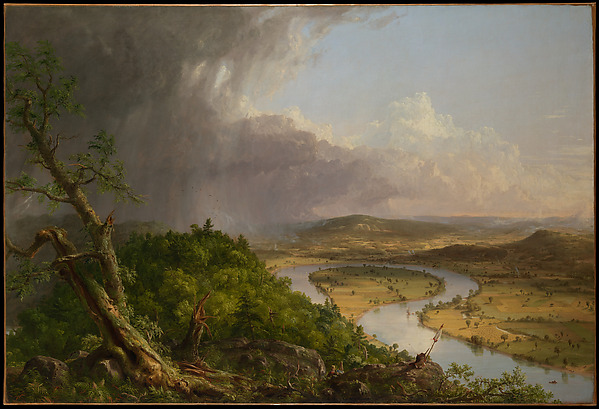
The Fountain of Vaucluse
The towering cliff and deep green spring where the river Sorgue rises at Fontaine-de-Vaucluse — the ruined ‘château de Pétrarque’ on the crag.
Sorgue
The painting shows a real, identified place that you can find today. The exact spot the artist worked from is not necessarily known.
The Fountain of Vaucluse — at a glance
- Artist
- Thomas Cole (1801–1848)
- Year
- 1841
- Movement
- Hudson River School
- Place
- Fontaine-de-Vaucluse, near Avignon, Provence, France
- Viewpoint
- The gorge and spring of the Sorgue below the great cliff — the site is unchanged and a major attraction; scale heightened
- Medium
- Oil on canvas
- Dimensions
- c. 174 × 267 cm
- Now at
- Dayton Art Institute, Ohio
Overview
The Fountain of Vaucluse is a dramatic landscape Thomas Cole painted in 1841, from studies made on his second European tour. It shows the deep gorge at Fontaine-de-Vaucluse: an enormous curved cliff face, hundreds of feet high, at whose foot the intense blue-green water of the Sorgue wells up and rushes away over rocks; a ruined castle perched on a spur; tiny figures and a bridge below. It is oil on canvas, about 174 by 267 cm, and it hangs in the Dayton Art Institute, Ohio.
Where was The Fountain of Vaucluse painted?
Scholarship Fontaine-de-Vaucluse is a village east of Avignon, in Provence, built around one of the largest karst springs in the world: at the end of a closed valley (the ‘vallis clausa’ that gave Vaucluse its name), the river Sorgue emerges from the base of a 230-metre cliff in a deep pool. The ruin on the crag above is traditionally called the ‘château de Pétrarque’, after the poet Petrarch, who lived at Vaucluse in the fourteenth century. The cliff, the spring, the rushing river and the castle ruin are all unchanged and the site is a major natural attraction, so Cole's view can be matched, allowing for his heightening of the scale and light.
What is in the painting?
The sheer, concave cliff fills the upper two-thirds of the canvas, warm grey and ochre, streaked and overhanging. At its base, the spring pool and the young Sorgue foam white over boulders. On a rocky spur left of centre stands the broken tower and walls of the castle. Far below, a small stone bridge, a few figures, trees. The light is stormy, with sun breaking on the cliff and the water.
Look closely
The overhanging cliff
The concave rock face fills the upper two-thirds of the canvas, streaked and looming.
The spring pool
The Sorgue wells up blue-green at the cliff's foot and foams white over boulders — the one vivid colour.
The ‘château de Pétrarque’
A broken tower and walls stand on a rocky spur, traditionally linked to the poet Petrarch.
The tiny bridge and figures
A small stone bridge and a few people far below give the cliff its overwhelming scale.
Analysis
Composition and technique
A single overwhelming cliff face, the bright spring and rushing river at its foot, a ruined tower for scale.
Scholarship Cole makes the cliff almost the whole picture, dwarfing the castle and the figures, and lights it with a dramatic broken sky — the sublime landscape used to overwhelm the human. The intense colour of the spring water is the one vivid note against the grey rock.
History & provenance
The painting is in the Dayton Art Institute, Ohio.
Sources
- Dayton Art Institute, Ohio — collection entry for Thomas Cole, ‘The Fountain of Vaucluse’ (1841)
- Commune de Fontaine-de-Vaucluse — the spring of the Sorgue and the château
Related paintings


More by Thomas Cole