View of Delft
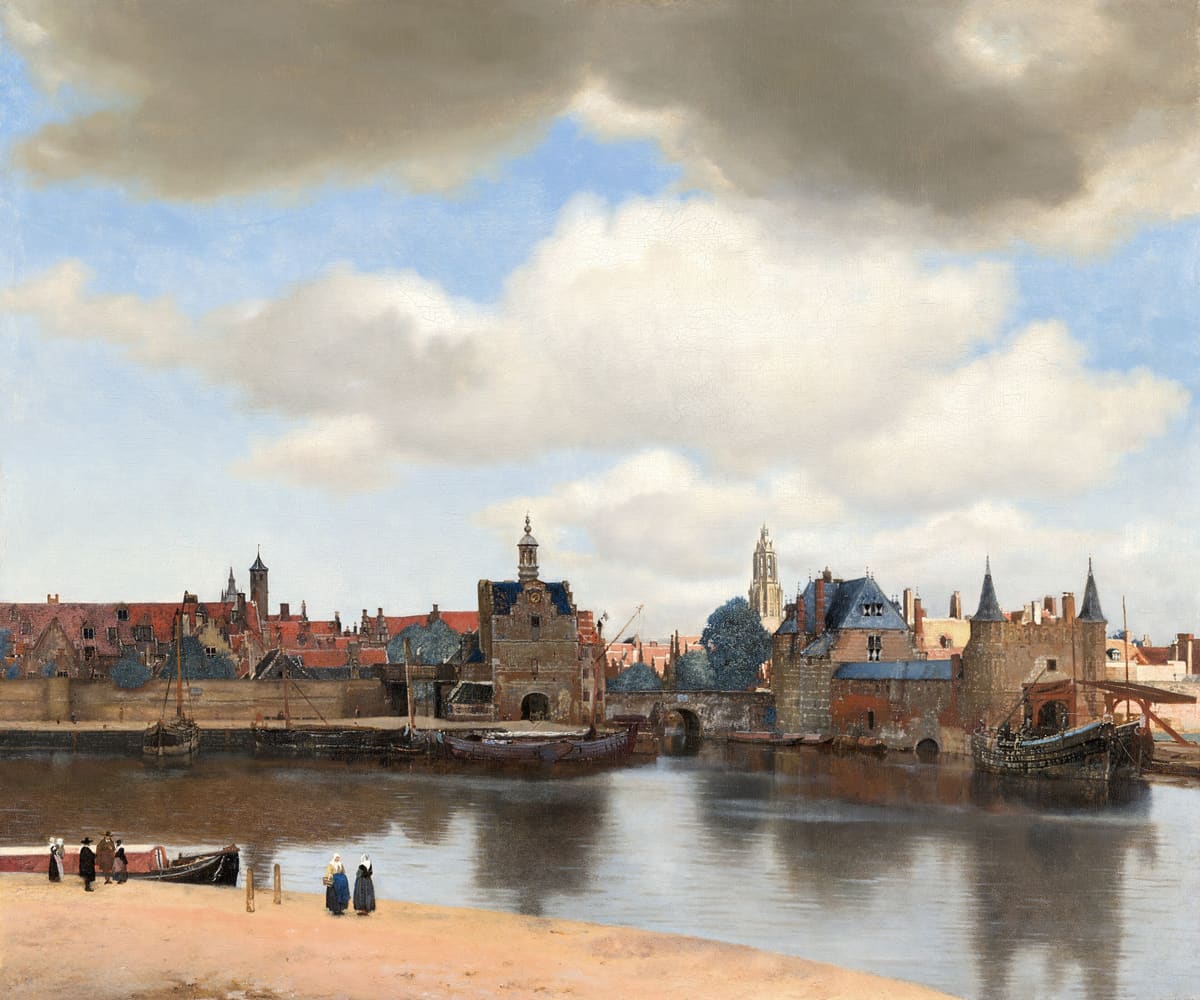
Vermeer's home city, painted from an upper window on the south bank of the harbour, looking north.
Delft, seen from the south bank near the Kolk / Hooikade
This is a documented exact viewpoint — you can stand roughly where the artist stood and look at the same scene.
View of Delft — at a glance
- Artist
- Johannes Vermeer (1632–1675)
- Year
- c. 1660–1661
- Movement
- Dutch Golden Age
- Place
- Delft, the Netherlands — seen from the south bank
- Viewpoint
- An upper room on the Schie's south side, near today's Hooikade — locatable
- Medium
- Oil on canvas
- Dimensions
- 96.5 × 115.7 cm
- Now at
- Mauritshuis, The Hague (inv. 92)
Overview
View of Delft is Johannes Vermeer's only pure townscape and his largest surviving painting — a portrait of his home city, laid out as a long band across still water under a wide sky. It is oil on canvas, about 96.5 by 115.7 cm, and it has belonged to the Mauritshuis in The Hague since 1822.
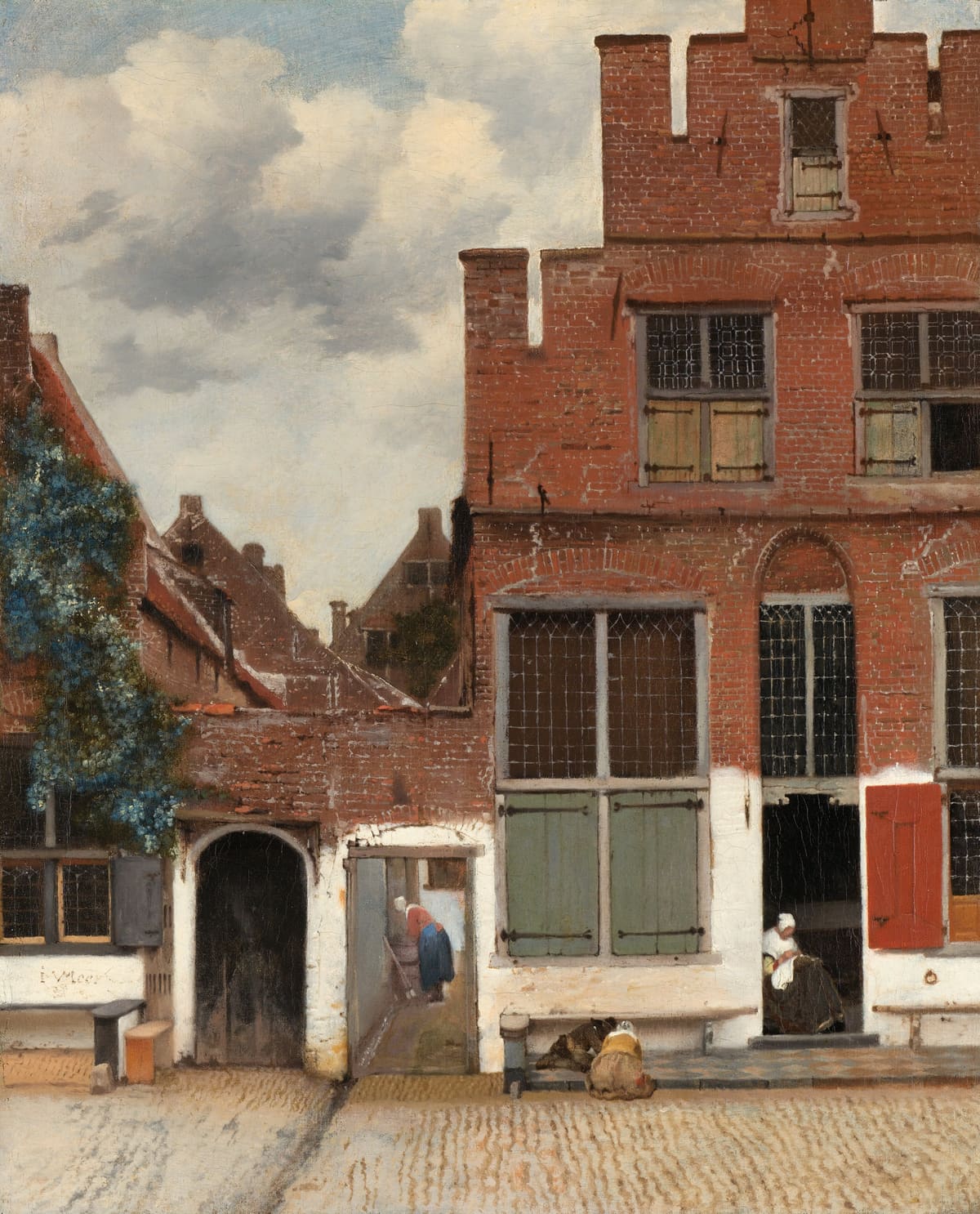
Fewer than forty paintings by Vermeer are known. This is one of only two in which he looked at the world outside a room; the other, The Little Street, is a close-up view of a Delft house-front.
Delft in Vermeer's time
Delft in the mid-17th century was a walled city of around 25,000 people, a centre of the pottery and brewing trades. Vermeer was born there, baptised in the Nieuwe Kerk that rises in the picture, and buried in the Oude Kerk whose leaning tower stands in shadow at the left.
Six years before the painting, in 1654, a gunpowder-magazine explosion — the “Delft Thunderclap” — killed about a hundred people and flattened part of the city, including the studio of the painter Carel Fabritius, who died in it. Whether View of Delft carries any memory of that is debated (see Meaning below).
Where was View of Delft painted?
Vermeer painted from an upper storey of a house on the south side of the Schie, at the Kolk — a triangular outer harbour dug in 1614 — roughly where the Hooikade runs today, looking north into the city.
Scholarship The buildings can be named. At the water's edge stand the Schiedam Gate (left, with a clock in its face) and the Rotterdam Gate (right, its two pointed towers) flanking the mouth of the canal into town; the roofed Kethel Gate sits further in. Behind the roofs, the tower of the Nieuwe Kerk catches full sunlight, while the Oude Kerk tower stays in shadow.
The two big gates were pulled down in the 19th century, but the line of the quay, the bridge and canal mouth, and the two church towers still fix the spot and the framing from the modern Hooikade. Scholars disagree on the season — herring boats and green leaves have been read as early May, a clock reading and the shadows as early September — but agree it is morning.
How we know
- Mauritshuis places the viewpoint on the south side of Delft; the two depicted city gates were demolished 1834/1836 but the Nieuwe Kerk tower and the waterfront survive.
What is in the painting?
In the foreground, a strip of pale sand on the near quay, moored boats — including two herring busses being rigged — and a small group of figures on the bank: women in conversation, a man. The water is almost still and holds a broken reflection of the town.
The city itself lies under a bank of cloud shadow, its walls and gates blue-grey. Beyond, a band of sunlight falls on the tiled roofs and, brightest of all, on the tower of the Nieuwe Kerk.
Look closely
The Rotterdam Gate
Twin pointed towers at the right, at the mouth of the canal into town — the most prominent structure, and the picture's weight.
The Schiedam Gate
At the left of the water, with a clock set into its face reading about seven — one of the few clues to the time of day.
The Nieuwe Kerk tower
Rising over the roofs and catching full sun while the rest of the town is in cloud shadow.
The herring boats
Two large fishing boats moored on the near side, being rigged — read by some scholars as a clue to the season.
Figures on the sand
A small group on the near quay: women in conversation, a man — tiny, and the only life in the foreground.
The reflection
The town's mirror image lies broken across the almost-still water of the harbour.
Details that are easy to miss. The clock set into the Schiedam Gate; the herring boats being fitted out on the near side; the tiny figures talking on the sand; the way the Nieuwe Kerk tower is lit while the Oude Kerk stays dark; the broken, shivering reflection of the town in the water; the pale spit of sand across the foreground; and the small patch of yellow wall by the Rotterdam Gate that Proust singled out.
Analysis
Composition & perspective
The city is laid out as a long horizontal band, low on the canvas, beneath a sky that fills the upper half.
The horizon and the line of the quay run flat across the picture; the two gate-towers act as near-central verticals; the reflection doubles the town downward into the water. The eye travels along the water to the one sunlit tower. It is close to symmetrical, weighted a little to the right by the mass of the Rotterdam Gate.
Colour and light
Vermeer sets a cool, shadowed town against a warm, sunlit distance, and studs the boats and water with small beads of thick pale paint.
Scholarship The shadowed walls are laid in blue-grey; the sunlit roofs in warm ochre and red. Scattered across the boats, the water and the near roofs are Vermeer's “pointillés” — tiny raised dots of light colour standing for glints of sun.
Scholarship Whether Vermeer used a camera obscura is much argued. The soft, haloed highlights on the herring boats — like the blur an imperfect 17th-century lens would produce — are the main evidence offered on the yes side; there is no documentary proof either way.
Handling and technique
It is oil on canvas, with an unusually thick, granular paint surface in the lit passages over smoother glazes elsewhere.
Vermeer built the sky and water in thin layers and loaded the highlights with impasto. The yellow-ochre stretch of wall near the Rotterdam Gate is the “little patch of yellow wall” that the dying writer Bergotte fixes on in Marcel Proust's In Search of Lost Time — the passage that made the painting famous far beyond art history.
Meaning and interpretation
Interpretations differ. What the artist documented, what museums and scholars propose, and later or speculative theories are marked and kept separate.
A portrait of the city
The plain reading is civic: Vermeer painting his own town with great care, at its calmest — a likeness rather than a message.
Memory of the disaster?
Some scholars connect the picture's stillness to the 1654 gunpowder explosion — an image of a city healed and at peace. It is an interpretation; Vermeer left no statement about the painting at all.
An experiment in light
Others treat the subject as almost secondary to the real problem Vermeer set himself: rendering sunlight, cloud shadow and reflection on water with total conviction.
History & provenance
- c. 1660–61Painted in Delft, probably for Vermeer's patron Pieter van Ruijven.
- 1696Sold in the Dissius auction, Amsterdam (lot 31, 200 guilders), among 21 Vermeers.
- 18th c.Passes through several Dutch collections.
- 1822Bought at the Stinstra sale for the Mauritshuis / the Dutch state.
- TodayA centrepiece of the Mauritshuis, The Hague (inv. 92).
The painting seems never to have left the Netherlands for long. After the 1696 sale it moved through Dutch hands until the state secured it at auction in 1822; it has been on view at the Mauritshuis ever since.
Featured in Famous Painting Locations: 13 Real Places You Can Visit
Research Included in the Painting Location Precision Study
Sources
- Mauritshuis, The Hague — collection entry for ‘View of Delft’ (oil on canvas, 96.5 × 115.7 cm; inv. 92; acquired 1822)
- Walter Liedtke, ‘Vermeer and the Delft School’ (Metropolitan Museum of Art, 2001) — topography, viewpoint and technique
- Arthur K. Wheelock Jr., ‘Johannes Vermeer’ (National Gallery of Art / Mauritshuis, 1995)
- Donald Olson & Russell Doescher (Texas State University) — study proposing a time and season for the scene from the light and the Schiedam Gate clock
- Marcel Proust, ‘À la recherche du temps perdu’ (‘La Prisonnière’) — the death of Bergotte and the ‘petit pan de mur jaune’
Frequently asked
Where did Vermeer paint View of Delft from?
From an upper window of a house on the south bank of the harbour, at the Kolk basin — roughly where the Hooikade runs today — looking north into the city.
Can you find the spot today?
Closely. The two city gates in the picture were demolished in the 19th century, but the line of the quay, the canal mouth and the towers of the Nieuwe Kerk and Oude Kerk still fix the viewpoint and the framing from the modern Hooikade.
What buildings can you see?
At the water: the Schiedam Gate (left) and the twin-towered Rotterdam Gate (right), with the Kethel Gate behind. Over the roofs: the tower of the Nieuwe Kerk in sunlight and the Oude Kerk tower in shadow.
Why is only one church tower lit?
A bank of cloud shadow lies over the town while sunlight breaks through beyond it, striking the Nieuwe Kerk tower — the church that holds the tomb of William of Orange and where Vermeer was baptised.
Did Vermeer use a camera obscura?
It is debated. The soft, haloed highlights on the boats resemble the blur of an imperfect early lens, which some take as evidence; there is no documentary proof.
What is the “little patch of yellow wall”?
A small stretch of sunlit yellow wall near the Rotterdam Gate. In Marcel Proust's novel the writer Bergotte dies gazing at it, and the phrase made the painting famous with general readers.
How big is View of Delft?
Oil on canvas, about 96.5 by 115.7 cm — Vermeer's largest surviving painting.
Where is the original now?
In the Mauritshuis in The Hague, where it has hung since 1822 (inv. 92).
How many paintings by Vermeer survive?
Fewer than forty are generally accepted. This is his only pure cityscape, alongside the close-up View of houses in Delft known as The Little Street.
Related paintings

The Little Street
1658
Vermeer's only other view of the outside world — a Delft house-front, seen close up instead of from across the water.

The Courtyard of a House in Delft
1658
Pieter de Hooch's Delft courtyard, painted within a year or two — the same town at ground level.

A View of Delft
1652
Carel Fabritius's tiny 1652 view of Delft — Fabritius worked in the town and died in the 1654 gunpowder explosion.
More by Johannes Vermeer