The Little Street
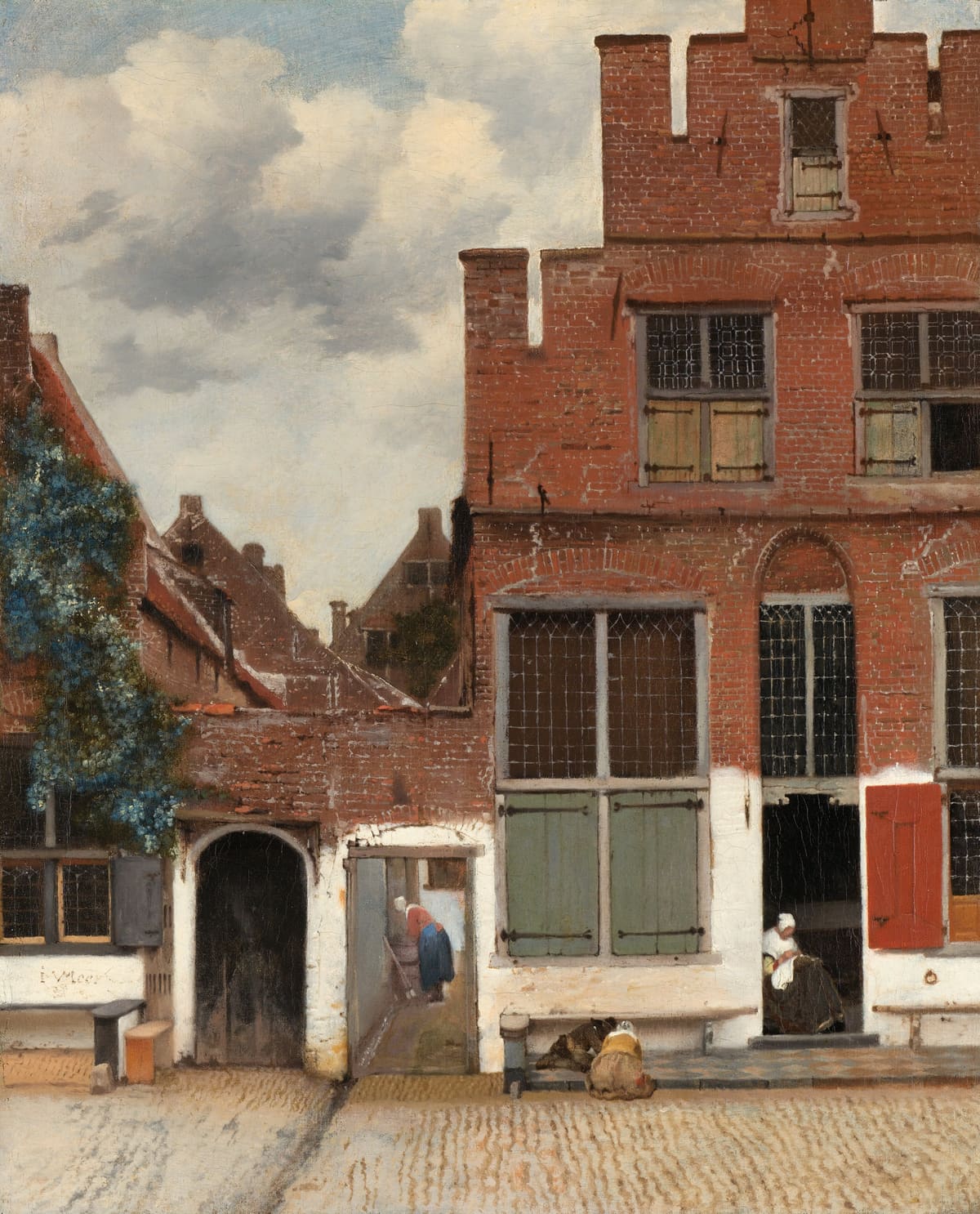
Two ordinary Delft house-fronts — identified from a 17th-century tax record as Vlamingstraat 40–42.
Vlamingstraat
The painting shows a real, identified place that you can find today. The exact spot the artist worked from is not necessarily known.
The Little Street — at a glance
- Artist
- Johannes Vermeer (1632–1675)
- Year
- c. 1658–1661
- Movement
- Dutch Golden Age
- Place
- Vlamingstraat, Delft, the Netherlands
- Viewpoint
- Facing the house-fronts at Vlamingstraat 40–42 — identified from tax records; buildings gone
- Medium
- Oil on canvas
- Dimensions
- c. 54 × 44 cm
- Now at
- Rijksmuseum, Amsterdam
Overview
The Little Street is a small painting — about 54 by 44 cm — and one of only two pictures in which Vermeer looked at the outside of a building rather than the inside of a room. It shows an ordinary Delft house-front given the same close attention Vermeer usually reserved for interiors. It is oil on canvas and hangs in the Rijksmuseum, Amsterdam.
For a long time the site was thought unidentifiable. In 2015 a historian pinned it, from a tax record, to a specific address on the Vlamingstraat in Delft.
Where was The Little Street painted?
Scholarship In 2015 Frans Grijzenhout examined Delft's 1667 ‘kadegeld’ register — a tax on the width of properties along the canals, used to pay for dredging. He matched the widths of the houses and the two passages in Vermeer's picture to the plots at Vlamingstraat 40 and 42, on the north side, where a canal (the Voldersgracht end) once ran.
The right-hand house was owned by Vermeer's aunt, Ariaentgen Claes, who sold tripe from the passage; his mother and sister lived diagonally opposite across the water. The identification is the leading view, though not universally accepted. The present buildings on the site are later.
What is in the painting?
A tall brick house with a stepped Dutch gable fills the right of the canvas, a smaller house to the left, the two separated by a narrow arched passage. The brickwork is patched and repointed; the lower walls are whitewashed; green wooden shutters and a bench sit by the doors.
A woman in a white cap sews in the right-hand doorway. Another woman stoops over a task in the passage. Two children crouch on the pavement playing a game by the gutter. A vine and some plants grow against the wall above.
Look closely
The two passages
A narrow arched passage between the houses and a second gap at the left — their widths are what fixed the address.
The woman sewing
In the right-hand doorway a woman bends over needlework, framed by the dark opening.
The children
Two children crouch on the pavement over a game, down by the gutter.
The patched brick
The wall has been repaired with bricks of different colours, and the mortar is picked out touch by touch.
The climbing vine
A vine and plants grow up the wall between the upper windows.
The signature
Tucked against the window at the lower left, on the face of the wall.
Details that are easy to miss. The two children on the pavement are bent over a game by the gutter; a woman is at work deep in the shadowed passage, not just standing in it; the brickwork has been patched with different-coloured bricks; a vine climbs the wall between the upper windows; and the signature is tucked against the window at the lower left.
Analysis
Composition & perspective
Vermeer builds the picture almost entirely from flat rectangles — walls, windows, shutters, doorways — stacked like a grid.
Scholarship The house-fronts are seen nearly straight on, so the design is a near-abstract arrangement of verticals and horizontals: window against shutter against wall against passage. The two dark doorway openings and the passage give the only real depth. The small figures are set into this grid at ground level, low and off-centre.
Colour and light
Warm reds and browns of old brick against cool grey whitewash and greenish shutters, under a soft overcast light.
Scholarship The palette is quiet: worn brick-red, ochre, the grey-white of the render, muted green. The light is even and shadowless, an overcast Delft day, so the surfaces are described by their own colour and texture rather than by strong sun. Vermeer paints the mortar between the bricks and the streaks on the whitewash almost stone by stone.
Handling and technique
Fine, patient paint, with tiny thick touches for the crumbling brick and the pointing.
Vermeer works the wall surfaces in small dabs and drags of thick paint, building the texture of aged brick, flaking whitewash and worn wood. The picture is signed at the lower left, on the wall beside the window.
Meaning and interpretation
Interpretations differ. What the artist documented, what museums and scholars propose, and later or speculative theories are marked and kept separate.
An ordinary house, closely seen
The museum presents it as exactly what it appears to be: a plain, slightly run-down Delft street given monumental care — domestic life, repair and quiet work made worth a painting.
A family connection
Grijzenhout's identification adds that the right-hand house belonged to Vermeer's aunt and stood near his mother's home, which would make it a personal as well as a formal subject. The interpretive weight of that is debated.
History & provenance
- c. 1658–61Painted in Delft.
- 1696Sold in the Dissius auction, Amsterdam, among 21 Vermeers.
- 18th–19th c.Passes through Dutch collections.
- 1921Given to the Rijksmuseum by Sir Henry Deterding.
- 2015Frans Grijzenhout identifies the site as Vlamingstraat 40–42.
The painting entered the Rijksmuseum in 1921 as a gift from the oil magnate Henry Deterding and has been on view there since. The 2015 address identification was published by the museum with a small exhibition.
Sources
- Rijksmuseum, Amsterdam — collection entry for ‘The Little Street’ (SK-A-2860; oil on canvas, c. 54 × 44 cm; gift of Sir Henry Deterding, 1921)
- Frans Grijzenhout, ‘Vermeer's The Little Street: A More Than Ordinary Story’ (Rijksmuseum / Amsterdam University Press, 2015)
- Walter Liedtke, ‘Vermeer: The Complete Paintings’ (2008)
Frequently asked
Where is the street in The Little Street?
A 2015 study of Delft's canal tax records identifies it as Vlamingstraat 40 and 42, on the north side, where a canal once ran — a short walk from Vermeer's painters' guild.
Can you visit the spot?
You can stand on the Vlamingstraat in Delft, but the houses Vermeer painted are gone; the present buildings on the site are later.
How was the location worked out?
Frans Grijzenhout matched the widths of the houses and passages in the painting to the plot widths recorded in Delft's 1667 ‘kadegeld’ register, a tax on canal frontage.
Is the identification certain?
It is the leading view and was published by the Rijksmuseum, but not every scholar accepts it.
Did Vermeer have a personal link to the house?
According to the 2015 study the right-hand house belonged to Vermeer's aunt, and his mother and sister lived across the water — which would make it a family scene.
How many outdoor scenes did Vermeer paint?
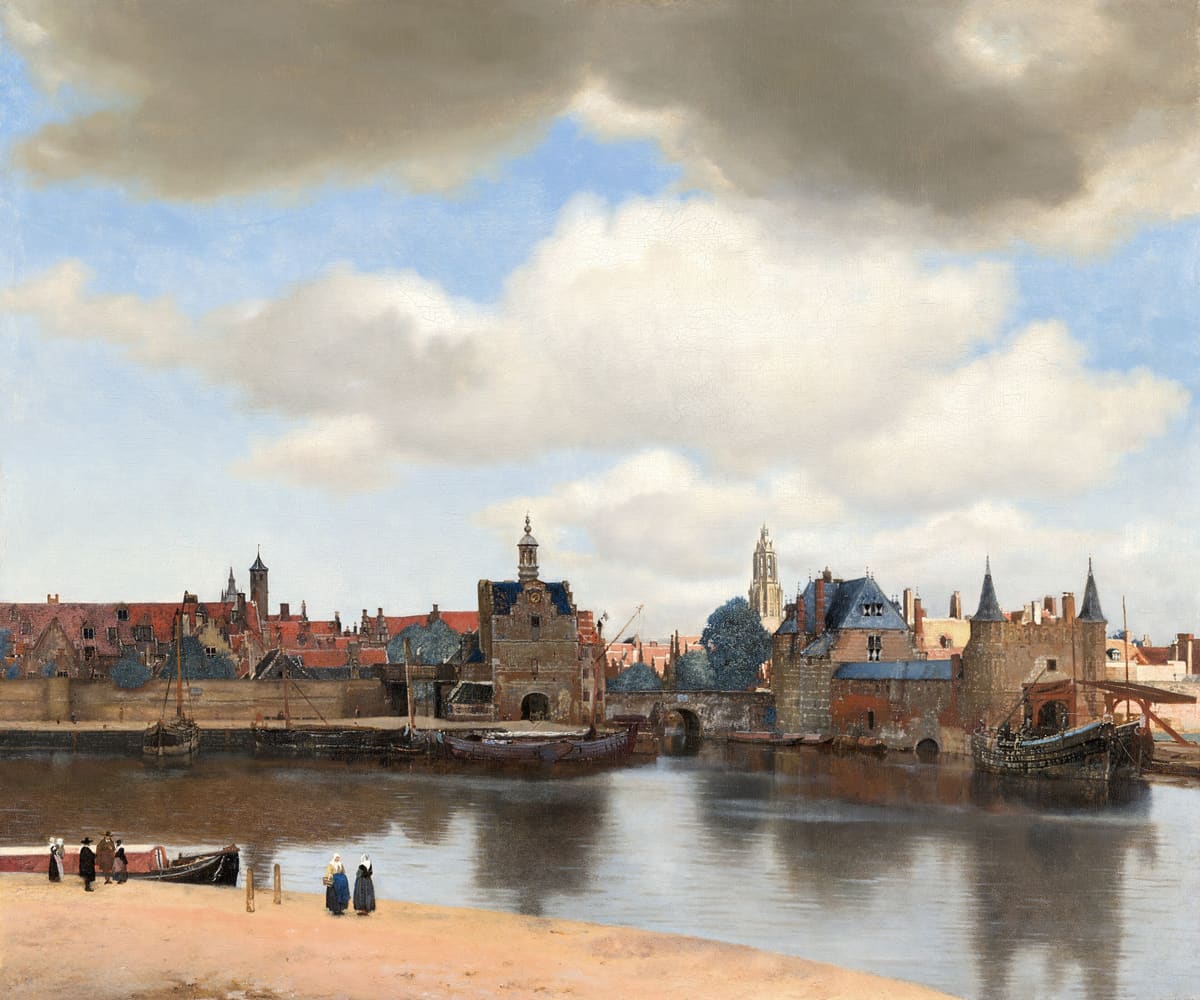
Only two survive: The Little Street and the larger View of Delft. His roughly thirty-four other accepted works are interiors and figure paintings.
Where is the painting now?
In the Rijksmuseum, Amsterdam, since 1921.
Related paintings


More by Johannes Vermeer