
Under the Bridge of Hampton Court
The Thames seen through the arches of the old bridge at Hampton Court — Sisley's boldest English picture; that bridge is gone.
Hampton Court Bridge
The painting shows a real, identified place that you can find today. The exact spot the artist worked from is not necessarily known.
Under the Bridge of Hampton Court — at a glance
- Artist
- Alfred Sisley (1839–1899)
- Year
- 1874
- Movement
- Impressionism
- Place
- The Thames at Hampton Court, Richmond upon Thames, London
- Viewpoint
- Beneath the 1865 road bridge — that bridge was replaced in 1933; the crossing and river remain
- Medium
- Oil on canvas
- Dimensions
- c. 50 × 76 cm
- Now at
- Kunstmuseum Winterthur, Switzerland
Overview
Under the Bridge of Hampton Court is one of a group of about seventeen canvases Alfred Sisley painted in the summer and early autumn of 1874, on his only extended visit to England, staying at Hampton Court on the Thames. This is the most daring: the viewer is placed right under the bridge, looking out through its iron and timber spans to the sunlit river, boats and the far bank. It is oil on canvas, about 50 by 76 cm, and it hangs in the Kunstmuseum Winterthur, Switzerland.
Where was Under the Bridge of Hampton Court painted?
Scholarship Hampton Court is on the Thames in the borough of Richmond upon Thames, south-west of central London, beside Cardinal Wolsey's and Henry VIII's palace. The bridge Sisley painted was the third road bridge on the site, a lattice-girder structure of 1865. It was demolished and replaced by the present brick-and-concrete bridge (by Edwin Lutyens and W. P. Robinson) in 1933, so the exact bridge in the picture no longer exists; the crossing, the river, the palace and the riverside are all still there and the general view can be matched.
How we know
- The real Hampton Court bridge; 'River Thames' is the whole river.
What is in the painting?
The dark underside of the bridge fills the top of the canvas — girders, cross-braces and the pale piers rising from the water. Framed by them, the bright Thames: rowing boats and a punt, figures, the green far bank with trees and a building or two, all in clear summer light. The contrast between the shadowed structure and the sunlit river is the whole point.
Look closely
The girders overhead
The dark underside of the bridge — braces and cross-members — fills the top of the picture like abstract bars.
The pale piers
The bridge piers rise from the water on both sides, framing the view.
The sunlit river
Between the structure, rowing boats and a punt on the bright Thames, with the green far bank beyond.
The light contrast
Deep shadow in the bridge, full sun on the water — the picture's whole idea.
Analysis
Composition and technique
A dark grid of bridge structure across the top and sides, framing a small bright rectangle of sunlit river.
Scholarship Sisley takes an almost photographic, worm's-eye position and lets the ironwork make a strong dark frame around the luminous water. It is an unusually modern, cropped composition for its date — the girders read almost as abstract bars.
History & provenance
The English pictures of 1874 are among Sisley's finest; this one is in the Kunstmuseum Winterthur, Switzerland.
Sources
- Kunstmuseum Winterthur — collection entry for Alfred Sisley, ‘Under the Bridge of Hampton Court’ (1874)
- MaryAnne Stevens (ed.), ‘Alfred Sisley’ (Royal Academy, 1992) — the 1874 English pictures
Related paintings

More by Alfred Sisley
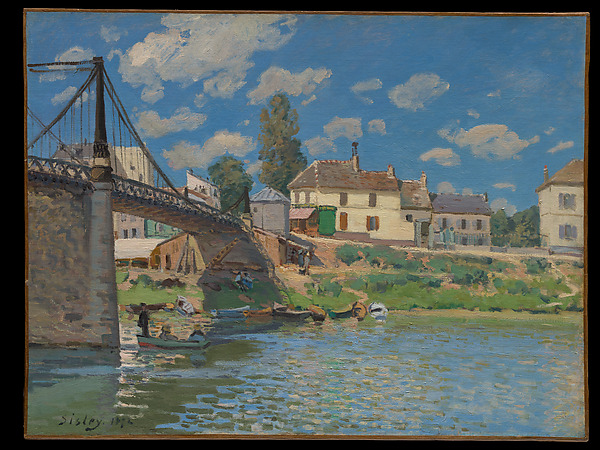
The Bridge at Villeneuve-la-Garenne

