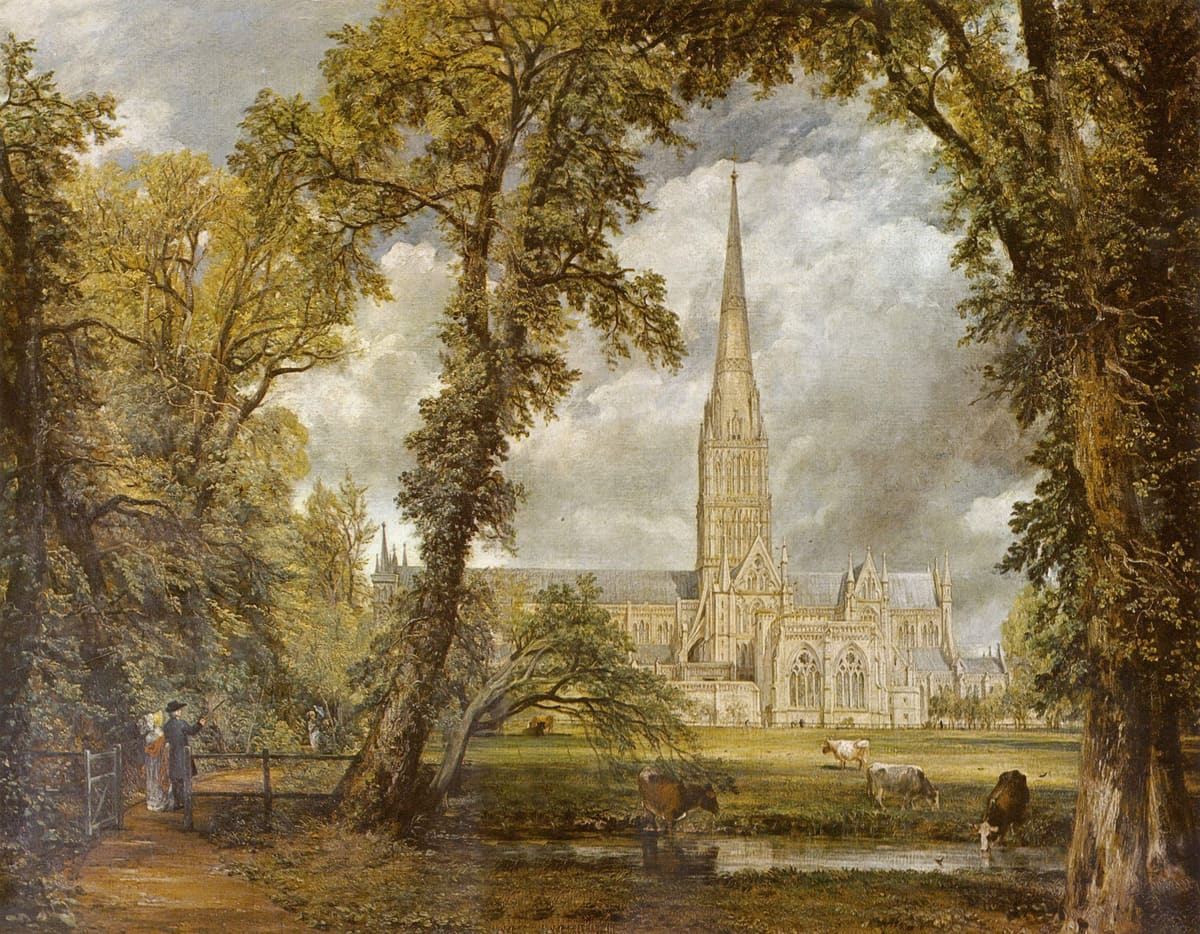
Salisbury Cathedral from the Bishop's Grounds
Britain's tallest spire, seen across the water meadows and framed by trees from the Bishop of Salisbury's own garden.
Salisbury Cathedral
The painting shows a real, identified place that you can find today. The exact spot the artist worked from is not necessarily known.
Salisbury Cathedral from the Bishop's Grounds — at a glance
- Artist
- John Constable (1776–1837)
- Year
- 1823 (main version); further versions to c. 1826
- Movement
- English Romantic landscape
- Place
- Bishop's Palace grounds, Salisbury, Wiltshire, England
- Viewpoint
- The Bishop's garden, looking NE across the meadows — view preserved; framing trees gone
- Medium
- Oil on canvas
- Dimensions
- c. 88 × 112 cm (V&A version)
- Now at
- Victoria and Albert Museum, London (other versions elsewhere)
Overview
Salisbury Cathedral from the Bishop's Grounds is a subject Constable painted in several versions in the 1820s for his close friend John Fisher, Bishop of Salisbury. The cathedral, with its record-breaking spire, is framed between two tall trees and seen from the Bishop's own garden. The main exhibited version, about 88 by 112 cm, is in the Victoria and Albert Museum, London; others are in the Frick Collection, the Metropolitan Museum of Art and the National Gallery, London.
A painting for the Bishop
Constable had a deep friendship with John Fisher — the Bishop was a steady patron and correspondent for twenty years — and stayed repeatedly at the palace. The Bishop commissioned this view and appears in it: the small figure at the lower left, pointing out the spire to his wife.
Scholarship Fisher disliked the heavy stormcloud over the cathedral in Constable's first large version and asked for something brighter, so Constable painted a second, sunnier version (now in the Frick Collection) — evidence that the picture was a personal commission worked to the patron's taste.
Where was Salisbury Cathedral from the Bishop's Grounds painted?
The viewpoint is the grounds of the Bishop's Palace at Salisbury — today Salisbury Cathedral School — to the south and south-west of the cathedral, looking north-east across the water meadows of the River Avon.
Museum interpretation The cathedral itself is unchanged, and the line of sight across the meadows from the Cathedral Close survives. The two big trees that arch over the view in the painting are gone, and the exact framing cannot be reproduced, but the prospect of the cathedral from the meadows is one of the most protected views in England.
What is in the painting?
The grey cathedral, with its 123-metre spire — the tallest of any church in Britain — rises in the middle distance between two tall trees whose branches meet overhead to frame it. Cows stand and lie in the sunlit foreground meadow; a small figure walks a path at the right.
At the lower left, half in shadow, the Bishop and his wife stand looking towards the cathedral, the Bishop's arm raised towards the spire.
Look closely
The Bishop and his wife
Two small figures in shadow at the lower left; the Bishop's arm is raised towards the spire.
The arch of trees
The two flanking trees lean in and meet overhead in a pointed arch that mirrors the cathedral's own.
The cattle
Cows graze and lie in the sunlit foreground meadow, setting the scale of the view.
The spire through the canopy
The 123-metre spire — the tallest in Britain — pierces the tree canopy at the centre.
Constable's white flecks
Small dabs of pure white sparkle on the wet leaves, as in The Hay Wain.
Details that are easy to miss. The Bishop and his wife stand in shadow at the lower left, his arm lifted towards the spire; cattle graze and rest in the foreground meadow; a low fence and a gate cross the middle ground; and the branches of the two framing trees deliberately meet at the top in a pointed arch that mirrors the cathedral's own.
Analysis
Composition & perspective
The cathedral is caught inside a natural arch of trees, so a vast building is held like a picture within the picture.
Scholarship Constable makes the two flanking trees lean in and interlace at the top, forming a Gothic-arch shape that echoes the cathedral's own architecture and frames it exactly. The foreground meadow, the cattle and the small figures set the scale; the spire pierces the tree canopy at the centre.
Colour and light
Fresh greens and a cool, showery light, with the pale stone of the cathedral catching a break of sun.
Scholarship Constable renders a moist English day: varied unblended greens in the trees and meadow, grey-white cloud, and a shaft of light picking out the cathedral's west front and spire. Small flecks of white sparkle on the wet foliage in his usual way. The first version's dark cloud, which the Bishop rejected, gave it a stormier cast.
Handling and technique
Detailed and comparatively tight in the cathedral, looser and more broken in the trees and meadow.
The building is drawn with care — Constable knew its architecture well — while the foliage and grass are worked with a flickering, loaded touch. He made oil sketches on the spot and repeated the composition in full-size versions to different specifications.
Meaning and interpretation
Interpretations differ. What the artist documented, what museums and scholars propose, and later or speculative theories are marked and kept separate.
A friendship and a place
The picture records both a building Constable revered and a friendship: the Bishop who commissioned it stands in it, pointing out his own cathedral. It is a private, affectionate work as much as a public view.
Nature and the Church in harmony
The way the trees form a Gothic arch around the cathedral has been read as an image of nature and religion in accord — a Romantic idea. Constable did not spell this out, and the tree-framing was also a practical way to compose a huge building into a landscape.
History & provenance
- 1823The main version exhibited at the Royal Academy; commissioned by Bishop John Fisher.
- 1826Constable paints a brighter second version for the Bishop after he objects to the dark sky.
- 1857The large version enters the South Kensington (later Victoria and Albert) Museum, London.
- TodayVersions in the V&A, the Frick Collection, the Metropolitan Museum of Art and the National Gallery, London.
Constable painted the subject in at least three full-size versions and several sketches. The principal exhibited canvas came to the Victoria and Albert Museum in 1857; the sunnier version made for the Bishop is now in the Frick Collection, New York.
Sources
- Victoria and Albert Museum, London — collection entry for ‘Salisbury Cathedral from the Bishop's Grounds’ (bequeathed by John Sheepshanks, 1857; oil on canvas, c. 88 × 112 cm)
- The Frick Collection, New York — entry for Constable's second, brighter version
- John Constable, correspondence with Archdeacon John Fisher and Bishop John Fisher, 1820s
Frequently asked
Where did Constable paint the view from?
From the grounds of the Bishop's Palace at Salisbury — now Salisbury Cathedral School — south-west of the cathedral, looking north-east across the water meadows of the Avon.
Can you see the same view today?
The cathedral is unchanged and the line of sight from the Cathedral Close and the meadows survives as one of England's most protected views. But the two large trees that frame the cathedral in the painting are gone, so the exact composition cannot be reproduced.
Who are the two small figures at the left?
Bishop John Fisher, who commissioned the picture, and his wife. The Bishop is pointing out the spire — his own cathedral — to her.
Why are there several versions?
The Bishop objected to the dark stormcloud over the cathedral in the first large version, so Constable painted a brighter one for him. He made at least three full-size versions in all.
How tall is the spire?
About 123 metres — the tallest church spire in Britain, and one Constable drew with real care.
Where is the main version now?
In the Victoria and Albert Museum, London, since 1857. Other versions are in the Frick Collection, the Metropolitan Museum of Art and the National Gallery, London.
Related paintings


More by John Constable
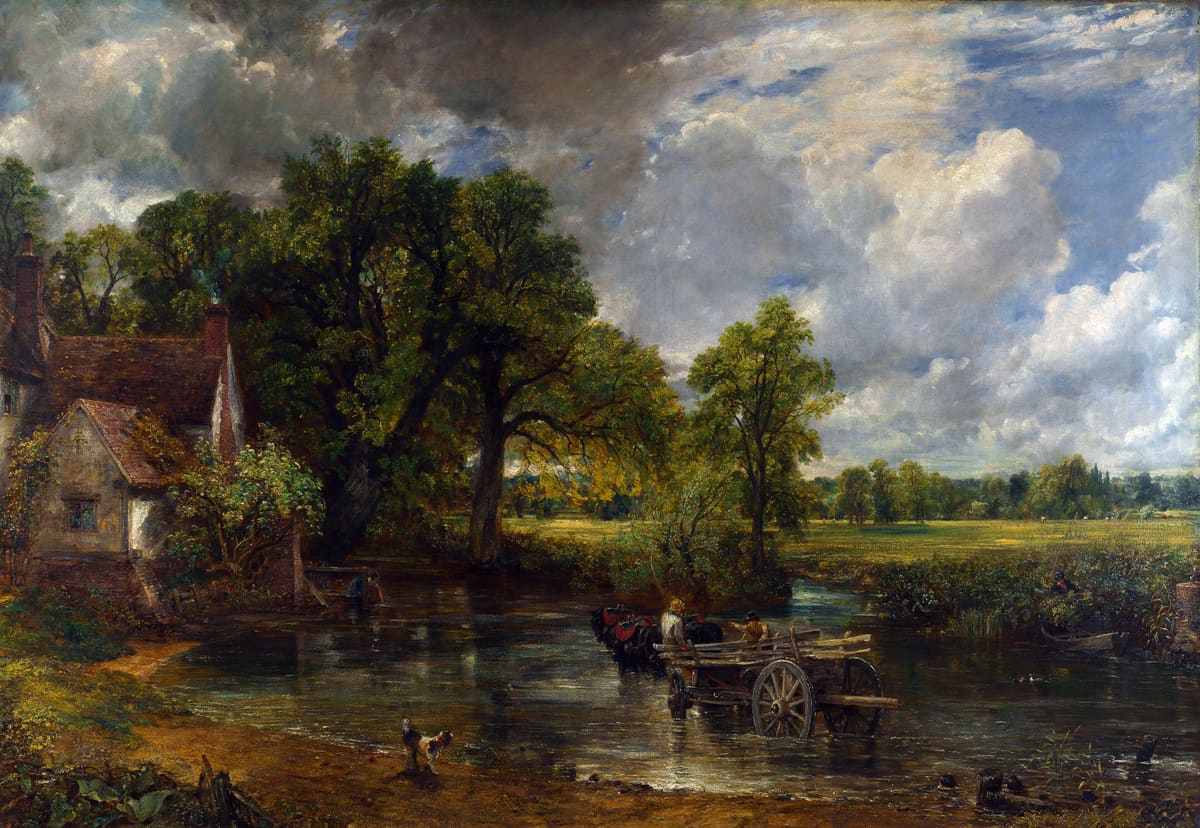
The Hay Wain


Salisbury Cathedral from the Meadows

The Vale of Dedham
Also connected to Salisbury Cathedral