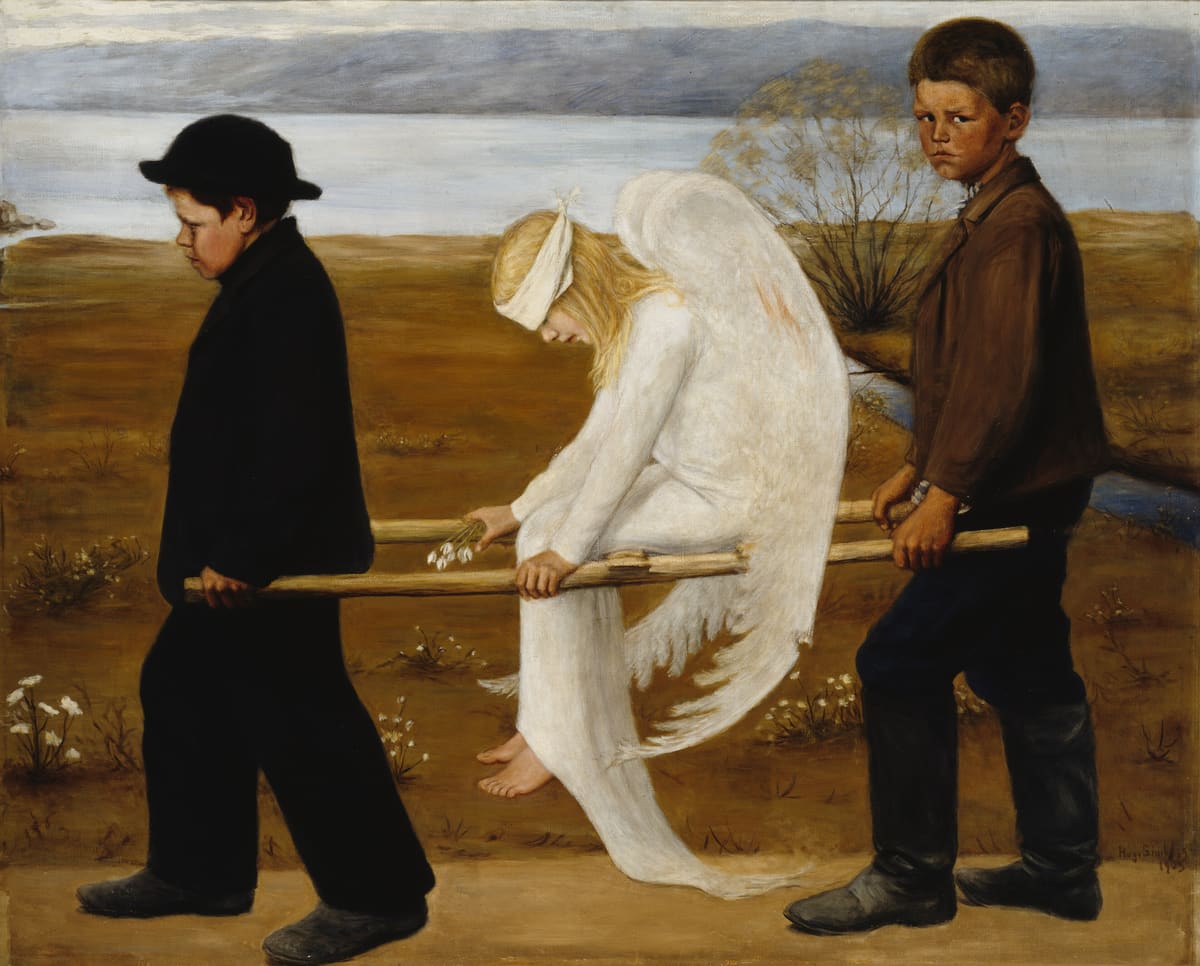
The Wounded Angel
Two boys carry a bandaged angel along a real Helsinki lakeside — a path Hugo Simberg walked while recovering from illness.
Eläintarha
The painting shows a real, identified place that you can find today. The exact spot the artist worked from is not necessarily known.
The Wounded Angel — at a glance
- Artist
- Hugo Simberg (1873–1917)
- Year
- 1903
- Movement
- Symbolism
- Place
- Töölönlahti bay, Eläintarha park, Helsinki, Finland
- Viewpoint
- The lakeside path Simberg walked while convalescing — still there
- Medium
- Oil on canvas
- Dimensions
- c. 127 × 154 cm
- Now at
- Ateneum, Finnish National Gallery, Helsinki
Overview
The Wounded Angel is the best-known painting by the Finnish artist Hugo Simberg, made in 1903. It shows two solemn boys in dark clothes carrying a white-winged girl on a wooden stretcher across bleak, early-spring parkland by water. It is oil on canvas, about 127 by 154 cm, and it hangs in the Ateneum, the Finnish National Gallery, in Helsinki.
Simberg refused to say what it meant, and asked that no single explanation be imposed. Finns voted it their ‘national painting’ in 2006.
The story behind the painting
Simberg had suffered a serious illness — meningitis — and painted the picture during his recovery. He made a version of the composition, then repeated the image on a much larger scale as a fresco in the nave of Tampere Cathedral in 1905–06.
Artist's own account Asked about its meaning, Simberg would only say that a picture should give each viewer their own thoughts, and he declined to interpret it. The title he used is simply ‘The Wounded Angel.’
Where was The Wounded Angel painted?
The background is a real, identifiable spot: the shore of Töölönlahti bay in the Eläintarha (in Swedish, Djurgården) park, just north of central Helsinki. It was a route Simberg is known to have walked while convalescing.
Museum interpretation The path, the water and the low far shore are still there. A large building visible across the bay in the picture was, in Simberg's day, an institution that housed the blind and disadvantaged boys — which fits the two stretcher-bearers.
What is in the painting?
Two boys carry a wooden bier along a path by the water. The one in front, in a dark cap, looks steadily out of the picture straight at the viewer; the one behind looks down. On the stretcher sits a girl with large white wings, dressed in white, her eyes bandaged and blood on one wingtip. In one hand she holds a small bunch of snowdrops — the first spring flower.
The land is bare: leafless trees, brown grass, grey water, a strip of pale sky. There is no sign of what hurt the angel.
Look closely
The front boy's stare
He looks straight out of the picture at the viewer — the only figure who does.
The bloodied wing
One of the angel's white wingtips is marked with blood; the cause is never shown.
The blindfold
Her eyes are bound with a white cloth.
The snowdrops
She holds a small bunch of the first spring flower in one hand.
The building across the bay
In Simberg's day an institution for the blind and for disadvantaged boys — which fits the stretcher-bearers.
Details that are easy to miss. The leading boy looks directly out at the viewer, the only figure who does; blood marks the tip of one of the angel's wings; her eyes are bound with a white cloth; she holds snowdrops, the earliest flower of the Finnish spring; and the building across the bay was an institution for the blind and for disadvantaged boys.
Analysis
Composition & perspective
A slow, level procession moving across the canvas, with the front boy's gaze breaking the fourth wall.
Scholarship The three figures form a shallow frieze crossing the picture from right to left, the stretcher held almost horizontal. The wide, empty landscape and the low horizon give the group a plodding, ceremonial weight. The direct stare of the leading boy pulls the viewer into the scene as a bystander.
Colour and light
Muted browns, greys and greens of a Nordic thaw, with the angel's white as the one bright note.
Scholarship The palette is deliberately drab: the boys' dark clothes, the bare brown ground, the grey bay. Against it, the angel's white dress and wings, and the little green-and-white snowdrops, stand out. The light is flat and cold, the light of early spring in the north.
Handling and technique
Careful, matte, evenly worked paint — closer to a fresco design than to loose easel painting.
Simberg paints with a dry, controlled touch and firm drawing. The composition was planned for repetition at architectural scale, and the large Tampere Cathedral fresco of 1905–06 follows it closely.
Meaning and interpretation
Interpretations differ. What the artist documented, what museums and scholars propose, and later or speculative theories are marked and kept separate.
Simberg's silence
Simberg would not explain the picture and asked that no fixed reading be attached to it. Its imagery — an injured heavenly being carried by ordinary boys — is left open.
Illness, healing and hope
Painted during Simberg's recovery from meningitis, it is often read as an image of fragility and endurance: the wounded ideal carried onward, the snowdrops standing for the first return of life after winter.
A national symbol
Since the 2006 vote that named it Finland's national painting, it has taken on a further, collective meaning as an emblem of resilience — a role assigned by the public rather than by the artist.
History & provenance
- 1903Painted in Helsinki during Simberg's recovery from meningitis.
- 1903Bought by the Finnish Art Society for the Ateneum collection.
- 1905–06Simberg repeats the image as a fresco in Tampere Cathedral.
- 2006Voted Finland's ‘national painting’ in an Ateneum poll.
The painting was acquired for the national collection the year it was made and has been a fixture of the Ateneum in Helsinki ever since.
Sources
- Ateneum / Finnish National Gallery, Helsinki — collection entry for ‘The Wounded Angel’ (‘Haavoittunut enkeli’)
- Tampere Cathedral — Simberg's 1905–06 fresco decoration
- Ateneum — documentation of the 2006 ‘national painting’ poll and the identified Eläintarha setting
Frequently asked
Where is The Wounded Angel set?
On the shore of Töölönlahti bay in the Eläintarha park, just north of central Helsinki — a path Simberg walked while recovering from illness.
Can you walk the same path?
Yes. The path, the water and the low far shore of the bay are still there in the Helsinki park.
What does the painting mean?
Simberg refused to say, and asked that no single explanation be attached to it. It is often read, given that he painted it while recovering from meningitis, as an image of fragility, healing and hope.
Why is the angel bandaged?
Her eyes are bound and one wing is bloodied, but the painting gives no cause. The wound and the blindfold are left unexplained.
What are the flowers she is holding?
Snowdrops — the first flower of the Finnish spring, often taken as a sign of returning life.
Is there another version?
Yes. Simberg repeated the image as a large fresco in the nave of Tampere Cathedral in 1905–06.
Where is the painting now?
In the Ateneum, the Finnish National Gallery, in Helsinki. It was voted Finland's national painting in 2006.
Related paintings
Christina's World
1948
Andrew Wyeth's figure alone in a bleak field before a real house — the same spare Northern landscape holding a body.

The Abbey in the Oakwood
1809
Friedrich's funeral procession in a winter landscape — an earlier Northern picture of carrying the fragile onward.