Famous work · not an exact-location map point
The Night Watch
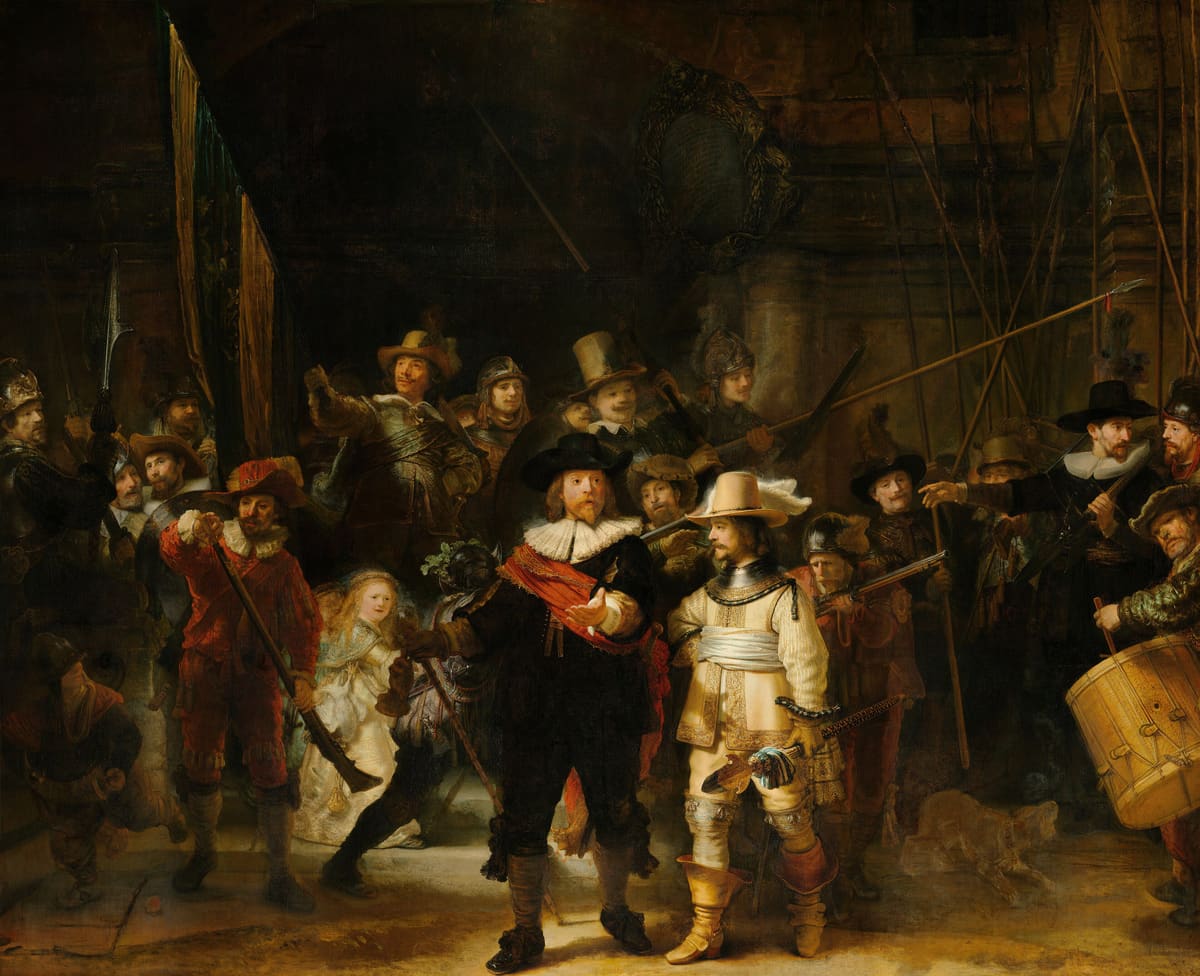
A civic militia company caught in the act of marching out — Rembrandt's biggest canvas, and a group portrait like no other.
No real-world viewpoint
This work does not depict a place you can visit — see the notes below.
The Night Watch — at a glance
- Artist
- Rembrandt van Rijn (1606–1669)
- Year
- 1642
- Movement
- Dutch Golden Age (Baroque)
- Subject
- The militia company of Captain Frans Banninck Cocq, Amsterdam
- Setting
- An imagined archway and courtyard — not a real, locatable place
- Medium
- Oil on canvas
- Dimensions
- c. 379 × 454 cm (trimmed from larger)
- Now at
- Rijksmuseum, Amsterdam (on loan from the City of Amsterdam)
Overview
The Night Watch is Rembrandt's largest surviving painting — now about 3.8 by 4.5 metres, and once larger. It is a group portrait of a company of the Amsterdam civic militia, painted in 1642 for their guild hall. It is oil on canvas and is the centrepiece of the Rijksmuseum in Amsterdam, on loan from the City of Amsterdam.
Its familiar name is a mistake. Centuries of darkened varnish made the scene look nocturnal; cleaning has shown it is set in daylight.
Who commissioned it, and why it was cut down
The picture was one of six large militia group portraits, by different painters, made for the great hall of the Kloveniersdoelen, the arquebusiers' guild house. The eighteen men whose portraits appear each paid a share of the cost.
Museum interpretation In 1715 the canvas was moved to Amsterdam's town hall and trimmed on all four sides to fit a space between two doors — most heavily on the left, where two figures were lost. A small contemporary copy by Gerrit Lundens records the full composition, and in 2021 the museum used it to reconstruct the missing strips digitally.
What is in the painting?
Captain Frans Banninck Cocq, in black with a red sash, gives the order to march; his lieutenant, Willem van Ruytenburch, in pale yellow with a white sash, steps forward beside him. Around and behind them the company spills out of a shadowed archway into strong light — men loading, firing and clearing muskets, a boy running with a powder horn, a drummer beating time at the right, pikes and a banner raised.
A small girl in a golden dress catches the light at the left; a dead fowl with prominent claws hangs at her belt — a play on the name of the arquebusiers' guild (the ‘klovenier’). Behind the crowd, a shield lists the eighteen sitters' names, added later.
Look closely
The captain's hand
Cocq's outstretched hand casts a sharp shadow across the lieutenant's yellow coat — a small feat of painted light.
The girl in gold
Lit like the officers, with a dead fowl and claws at her belt — an emblem of the arquebusiers' guild.
The firing musket
A gun is being discharged inside the crowd, its flash close to the girl's head.
The drummer
At the right edge, a drummer beats the company out — he was not one of the paying sitters.
The name shield
The painted shield listing the eighteen sitters was added later, above the archway.
The hidden faces
Figures crowd back into the dark arch; one eye peers out from the depths, sometimes said to be Rembrandt's own.
Details that are easy to miss. The shadow of the captain's outstretched hand falls across the lieutenant's yellow coat; a musket is being fired within the group, its flash near the girl; a helmeted figure is almost hidden behind the banner; a self-portrait-like face (sometimes said to be Rembrandt's own eye) peers out from the back; and the shield with the eighteen names was not part of the original picture.
Analysis
Composition & perspective
Rembrandt turned a row of paying portraits into a surging crowd, all of it built around the two officers stepping toward the viewer.
Scholarship Instead of the usual banked rows of equal faces, Rembrandt staged an action: the company mustering and moving off. The two officers advance out of the picture; the rest fan back into the dark arch behind. Diagonals of muskets, pikes and the banner cross the group, and the drummer at the right edge and the girl at the left balance the design.
Colour and light
A shaft of daylight picks out the lieutenant's yellow and the girl's gold from a mass of black, grey and steel.
Museum interpretation The company is largely in dark militia dress; Rembrandt drops a strong, almost theatrical light onto the captain's face and hand, the lieutenant's yellow coat, and the small girl, while pushing the rest into deep shadow. Recent technical study found that the paint was once brighter and that some colours have faded.
Handling and technique
Broad, loaded brushwork up close, resolving into sharp detail at a distance — Rembrandt's late manner, on a huge scale.
The paint ranges from thin, dark passages to thick impasto in the highlights — the captain's collar, the embroidery, the reflections on armour. ‘Operation Night Watch,’ the Rijksmuseum's ongoing research and conservation project begun in 2019, has mapped the canvas in extreme detail and identified early changes Rembrandt made as he worked.
Meaning and interpretation
Interpretations differ. What the artist documented, what museums and scholars propose, and later or speculative theories are marked and kept separate.
A militia on parade
At face value the picture shows a company of the civic guard — by 1642 more a social and ceremonial body than a fighting force — turning out with their captain, an image of Amsterdam's confident citizenry.
The girl and the claw
The gleaming girl at the left, with a dead fowl and its claws at her waist and a pistol behind her, is generally read as a mascot or emblematic figure whose attributes pun on the arquebusiers' name and equipment, rather than as a real member of the company.
‘Rembrandt lost his patrons’
A long-lived story holds that the sitters disliked being crowded into shadow and that the picture ruined Rembrandt's career. Scholars now largely reject this: the painting was admired, hung in a place of honour, and Rembrandt kept working for major clients for years.
History & provenance
- 1642Completed for the great hall of the Kloveniersdoelen, Amsterdam.
- 1715Moved to Amsterdam's town hall and trimmed on all four sides.
- 1808 / 1885Enters the national collection; moved to the new Rijksmuseum building.
- 1911 / 1975 / 1990Attacked with a knife, a knife again (serious), and acid; each time restored.
- 2019–‘Operation Night Watch’: a long public research and conservation project.
- 2021The trimmed strips are digitally reconstructed using the Lundens copy.
The painting has been in Amsterdam its whole life and is owned by the city, on long loan to the Rijksmuseum, where it hangs at the end of the Gallery of Honour. It has survived three attacks and is now studied and conserved in public view.
Sources
- Rijksmuseum, Amsterdam — collection entry for ‘The Night Watch’ (SK-C-5) and the ‘Operation Night Watch’ research pages
- Gerrit Lundens, copy after The Night Watch (The National Gallery, London / Rijksmuseum) — record of the untrimmed composition
- Ernst van de Wetering / Rembrandt Research Project — studies of the painting's technique and early changes
Frequently asked
Is The Night Watch actually a night scene?
No. The name came from centuries of darkened varnish. Cleaning has shown the company is mustering in daylight, with a strong shaft of sun falling across the officers.
Who are the main figures?
The man in black with the red sash is Captain Frans Banninck Cocq; the man in pale yellow beside him is his lieutenant, Willem van Ruytenburch. Around them is their company of the Amsterdam civic militia.
Why was the painting cut down?
In 1715 it was moved to Amsterdam's town hall and trimmed on all four sides to fit between two doors — most heavily on the left, where two figures were lost.
Can the missing parts be seen?
A small 17th-century copy by Gerrit Lundens records the full composition, and in 2021 the Rijksmuseum used it to reconstruct the trimmed strips digitally.
Who is the little girl in gold?
She is generally taken as an emblematic mascot rather than a real militia member: the dead fowl and claws at her belt pun on the name of the arquebusiers' guild.
Did the painting ruin Rembrandt's career?
That is an old legend. The picture was admired and hung in a place of honour, and Rembrandt continued to receive major commissions; scholars now reject the story.
Where is it now?
In the Rijksmuseum, Amsterdam, at the end of the Gallery of Honour, where it is being researched and conserved in public.
Related paintings


Also connected to Amsterdam

The Vegetable Market in Amsterdam
