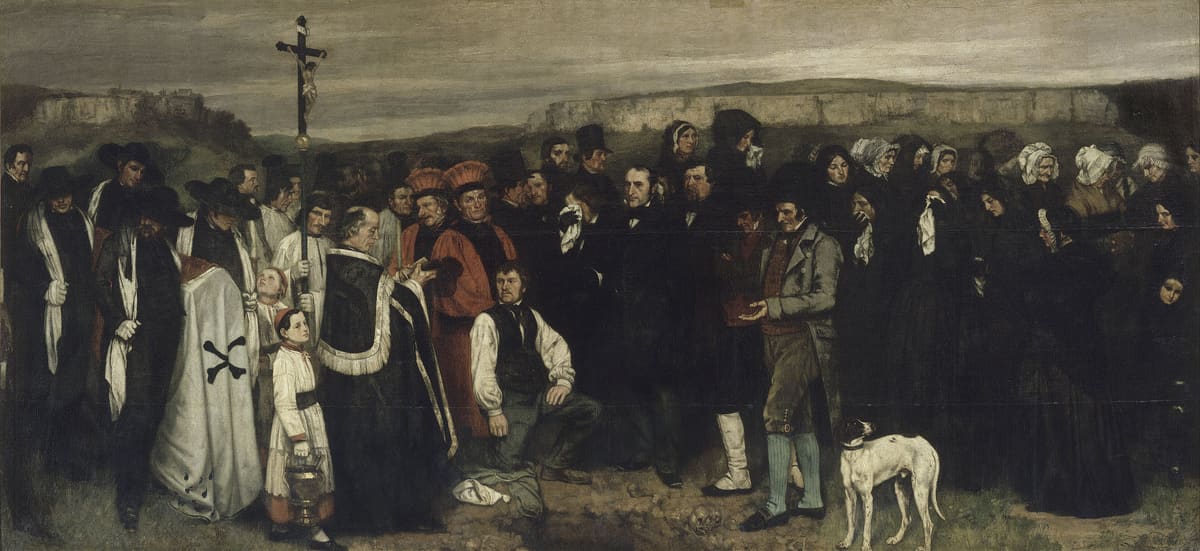
A Burial at Ornans
A village funeral in a real new cemetery at Ornans, painted life-size — and treated as a scandal in 1850.
Ornans
The painting depicts a real landscape or cityscape. The precise viewpoint the artist used may be unknown, so the marker shows the general area.
A Burial at Ornans — at a glance
- Artist
- Gustave Courbet (1819–1877)
- Year
- 1849–1850
- Movement
- Realism
- Place
- The cemetery at Ornans, Doubs, France
- Viewpoint
- The burial ground below the Roche du Mont — town and setting survive
- Medium
- Oil on canvas
- Dimensions
- c. 315 × 668 cm
- Now at
- Musée d'Orsay, Paris
Overview
A Burial at Ornans is an enormous canvas — over six metres wide — that Gustave Courbet painted in 1849–50. It shows a funeral in a country cemetery, with a long line of townspeople standing around an open grave. It is oil on canvas and hangs in the Musée d'Orsay, Paris.
Its size, its refusal to prettify ordinary provincial people, and its lack of any hero or moral caused an outcry when it was shown at the Paris Salon of 1850–51.
“The Burial at Ornans was in reality the burial of Romanticism.”
The story behind the painting
Courbet painted the picture in Ornans, in a former attic granary, working from about fifty of his own neighbours who posed one by one — his family, the mayor, the parish priest, the beadles in red robes, veterans of the Revolutionary wars, the local gravedigger.
Artist's own account He gave it the scale reserved for battles and coronations and filled it with unidealised faces of a small town. Critics attacked it as ugly, vulgar and socially dangerous. Courbet embraced the fight, and later called the picture ‘in reality the burial of Romanticism’ — the end of grand, idealised subject matter.
Where was A Burial at Ornans painted?
Ornans is a small town on the river Loue in the Doubs, in the Franche-Comté region of eastern France, where Courbet was born and spent much of his life.
Museum interpretation The funeral is set in the town's new cemetery, opened in 1848 on the plateau above the town. The low limestone cliff along the top of the picture is the real Roche du Mont, which stands behind the burial ground. The Courbet family house in Ornans is now the Musée Courbet.
What is in the painting?
A frieze of figures in black stretches the full width of the canvas around a freshly dug grave. At the left, pallbearers carry a draped coffin; a priest reads from a book, flanked by boys and by two beadles in bright red robes and hats. On the right stand the women of the town, some weeping into handkerchiefs.
In the centre foreground the gravedigger kneels beside the pit, and a small dog stands with its back to the mourners. Above the crowd, the pale cliff and a strip of grey sky.
Look closely
The two beadles in red
Their bright red robes and hats are the only strong colour in a wall of black.
The open grave
A plain black rectangle at the bottom edge — the nearest thing the picture has to a subject.
The kneeling gravedigger
A real Ornans man, posed at the edge of the pit, waiting.
The small dog
In the foreground, a dog stands with its back to the whole ceremony.
The Roche du Mont
The pale limestone cliff along the top of the canvas is the real ridge behind the cemetery.
Details that are easy to miss. The two beadles in red are the only strong colour in the picture; the gravedigger kneeling at the pit is a real Ornans man, Antoine-Joseph Cassard; the small dog in the foreground faces away from the grave; the crucifix is held up against the sky at the left; and the coffin is only just entering the picture — the burial has not yet happened.
Analysis
Composition & perspective
A single horizontal band of standing figures, life-size, with no focal point and a black hole of a grave at the front.
Scholarship Courbet spreads the mourners across the canvas like a low relief, all roughly the same height, none singled out. There is no dramatic lighting and no central action; the eye travels along the line. The open grave at the bottom edge is the nearest thing to a subject — a plain black rectangle the viewer looks straight into.
Colour and light
A wall of funeral black and white, broken only by the beadles' red and the priest's vestments, under a flat grey light.
Scholarship The dominant note is the black of the mourners' coats and dresses against white collars, caps and the pale cliff. The two spots of strong red — the beadles' robes — and the priest's cope are the only real colour. The light is even and cool, with no theatrical shadow.
Handling and technique
Solid, blunt paint, often laid on with a palette knife, with each face worked as a portrait.
Courbet paints heavily and directly, building the black masses with the knife and modelling the individual heads with care. Because the sitters posed separately, the figures have a stitched-together, slightly stiff quality that adds to the picture's frontal, documentary force.
Meaning and interpretation
Interpretations differ. What the artist documented, what museums and scholars propose, and later or speculative theories are marked and kept separate.
A manifesto for Realism
Courbet meant the picture as a statement: that the life and death of ordinary provincial people deserved the same scale and seriousness as history painting. He tied it explicitly to the end of Romanticism.
Politics read into it
Painted just after the 1848 revolution, the picture was taken by hostile critics as democratic and even socialist in spirit — a crowd of common people given the dignity of kings. That political charge is largely in the reception; Courbet's stated aim was truth to his own town.
History & provenance
- 1849–50Painted in Ornans from about fifty local sitters.
- 1850–51Shown at the Paris Salon, to a critical scandal.
- 1855Re-exhibited in Courbet's own ‘Pavilion of Realism’ in Paris.
- 1881Given to the French state by the artist's sister, Juliette Courbet.
- TodayMusée d'Orsay, Paris.
Courbet's family kept the painting until 1881, when his sister Juliette gave it to the French state. It hangs in the Musée d'Orsay, where its scale still dominates the room.
Sources
- Musée d'Orsay, Paris — collection entry for ‘Un enterrement à Ornans’ (RF 325; oil on canvas, c. 315 × 668 cm; gift of Juliette Courbet, 1881)
- Musée Courbet, Ornans — the artist, the town and the cemetery
- Michael Fried, ‘Courbet's Realism’ (1990); T. J. Clark, ‘Image of the People: Gustave Courbet and the 1848 Revolution’ (1973)
Frequently asked
Where is A Burial at Ornans set?
In the new cemetery of Ornans, Courbet's home town on the river Loue in eastern France, opened in 1848 on the plateau above the town. The cliff behind is the real Roche du Mont.
Can you visit Ornans?
Yes. The town and its setting survive, and the Courbet family house is now the Musée Courbet.
Who are the people in it?
About fifty real inhabitants of Ornans — Courbet's family, the mayor, the priest, the beadles, war veterans and the town gravedigger — who posed one at a time.
Why was it a scandal?
Courbet painted ordinary provincial people at the huge scale reserved for history painting, without idealising them and without any hero or moral. Critics found it ugly and socially dangerous.
Whose funeral is it?
The picture does not name the dead person. It is a generic country funeral rather than the burial of a specific individual — the subject is the community and the ritual.
Where is the painting now?
In the Musée d'Orsay, Paris, given by the artist's sister in 1881.
Related paintings


More by Gustave Courbet

The Painter's Studio
