Famous work · not an exact-location map point
The Coronation of Napoleon
The crowning of an Empress inside Notre-Dame de Paris — a real ceremony, staged and edited by the Emperor's own painter.
No single real-world viewpoint
A ceremonial group portrait; the coronation was held in Notre-Dame de Paris but the picture is not a view of it.
The Coronation of Napoleon — at a glance
- Artist
- Jacques-Louis David (1748–1825)
- Year
- 1805–1807
- Movement
- Neoclassicism (Empire style)
- Place
- Notre-Dame de Paris — the setting of the 2 December 1804 ceremony
- Viewpoint
- A portrait of the event, not a view of the cathedral — no exact-location marker
- Medium
- Oil on canvas
- Dimensions
- c. 621 × 979 cm
- Now at
- Musée du Louvre, Paris
Overview
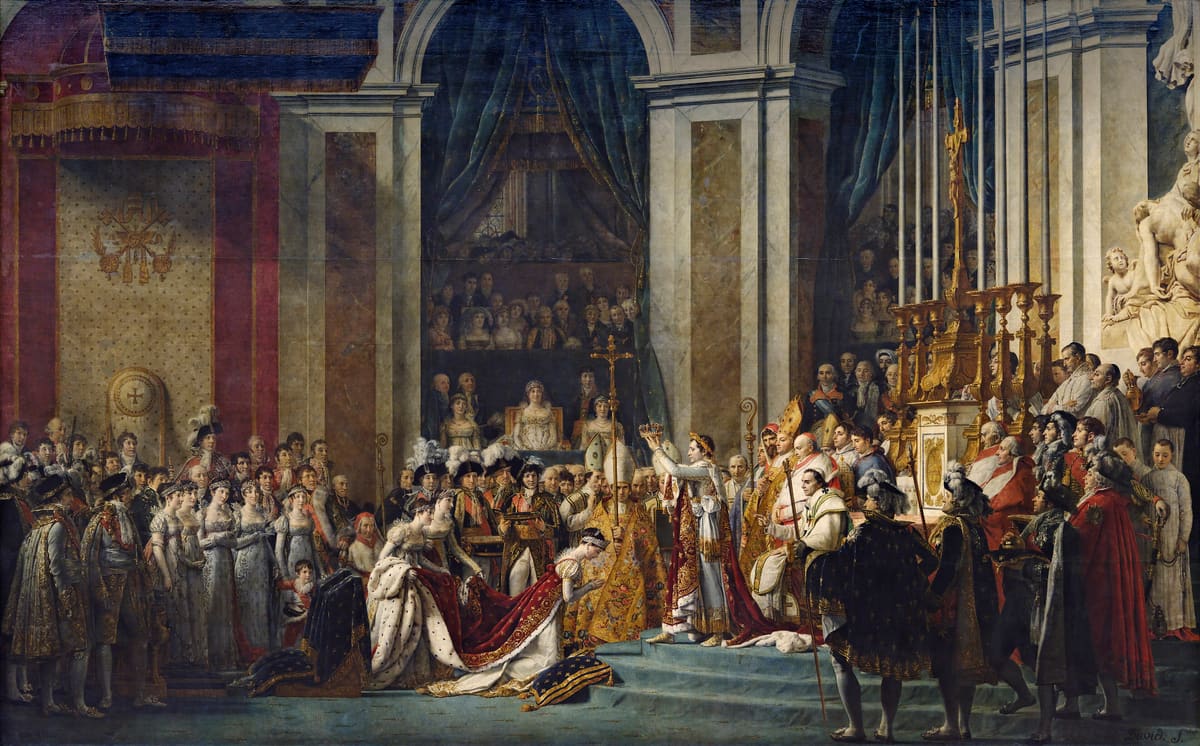
The Coronation of Napoleon is one of the largest paintings in the Louvre — nearly ten metres wide. Jacques-Louis David, official painter to the Emperor, worked on it from 1805 to 1807. It records the coronation ceremony held in Notre-Dame de Paris on 2 December 1804. It is oil on canvas; a second, autograph version is at Versailles.
It is a portrait of an event rather than a view of a place, and it edits the truth in the Emperor's favour.
A ceremony, staged for the record
David attended the coronation, made drawings, had costumes and a scale model of the setting built, and spent more than two years assembling the huge canvas with the help of pupils.
Scholarship He chose not the moment Napoleon crowned himself, but the moment just after, as Napoleon raises a crown over his kneeling wife, Joséphine. He also altered the facts: Napoleon's mother, who boycotted the ceremony, is placed prominently in the stands, and the Pope, who is said to have kept his hands in his lap, was repainted to give a blessing after Napoleon objected.
Where was The Coronation of Napoleon painted?
The ceremony took place in the cathedral of Notre-Dame de Paris, on the Île de la Cité, on 2 December 1804. For the day the cathedral was fitted out with temporary Neoclassical decoration — hangings, a raised throne platform, classical arches — much of which David includes.
Museum interpretation The cathedral is real and can be visited (it reopened in December 2024 after the 2019 fire), but the painting is a portrait of the people and the moment, not a topographic view of the building, so it carries no exact-location marker on this site.
What is in the painting?
In a vast decorated interior, Napoleon stands in gold-embroidered coronation robes, arms raised, holding a crown above the head of Joséphine, who kneels before him in white with a long train held by attendants. Behind them the Pope, Pius VII, sits and raises a hand.
Rows of family, marshals, ministers, foreign envoys and clergy fill the space. High in a box at the centre, David has painted himself and his family, sketching.
Look closely
Napoleon's mother
Seated in the central tribune, given a place of honour — although she refused to attend the real ceremony.
David in a box
The painter put himself and his family in an upper box at the centre, sketching the scene.
The Pope's hand
Raised in blessing — added after Napoleon objected that a Pope doing nothing would look ridiculous.
The crown Napoleon wears
He has already crowned himself with the small closed crown before lifting the other over Joséphine.
The temporary architecture
The classical arches and hangings were built into the cathedral just for the day and are recorded here.
Details that are easy to miss. Napoleon's mother, Letizia, sits prominently in the central tribune although she refused to attend the real ceremony; David painted himself, sketchbook in hand, in a box above her; the Pope's raised hand was added after Napoleon complained that a Pope who did nothing would look foolish; and Napoleon has already crowned himself — the small closed crown he wears — before crowning his wife.
Analysis
Composition & perspective
A long horizontal frieze of figures, arranged in a shallow band, with Napoleon and Joséphine isolated at the exact centre by a pool of light.
Scholarship David spreads more than a hundred figures across the canvas in a measured, relief-like line, sorted by rank. The central group — Napoleon, the crown, Joséphine, the Pope — is set apart by space and a fall of light. The temporary architecture of the ceremony gives a stable geometric frame.
Colour and light
Deep reds, gold and ermine of the robes and hangings, against the cool stone, lit as if by a single controlled beam.
Scholarship The colour is rich and ceremonial — crimson velvet, cloth of gold, white fur and satin — set against the grey of the cathedral. David lights the central act brightly and lets the crowd recede into a warm gloom, so the eye goes straight to the crown.
Handling and technique
Smooth, highly finished Neoclassical paint, with individual portrait heads worked from life or from drawings.
The surface is polished and detailed to the standard of official Empire art. Many of the faces are recognisable portraits of named people, painted from sittings or studies; the fabrics and regalia are rendered with near-inventory precision.
Meaning and interpretation
Interpretations differ. What the artist documented, what museums and scholars propose, and later or speculative theories are marked and kept separate.
Legitimacy, made visible
The painting's purpose was propaganda: to fix an image of Napoleon's rule as lawful, splendid and sanctioned by the Church, and to record every important supporter present. Its editing of the facts serves that end.
Church subordinated to State
Historians note that by showing Napoleon crowning Joséphine himself, with the Pope seated behind merely blessing, David makes visible the new order — the Emperor as the source of his own authority, the Church attending rather than granting it.
History & provenance
- 1805–07Painted by David with studio assistance for the Emperor.
- 1808Exhibited to acclaim; David begins a second, autograph version.
- 19th c.Enters the French national collections.
- 1889The main version installed in the Louvre, where it remains.
The first version has been in the Louvre since 1889; the second, largely autograph replica, painted 1808–22, is at the Château de Versailles.
Sources
- Musée du Louvre, Paris — collection entry for ‘Le Sacre de l'empereur Napoléon Ier’ (INV 3699; oil on canvas, c. 621 × 979 cm)
- Château de Versailles — the second, autograph version of the Coronation
- Philippe Bordes, ‘Jacques-Louis David: Empire to Exile’ (2005)
Frequently asked
Where did the coronation take place?
In the cathedral of Notre-Dame de Paris, on 2 December 1804. The cathedral was fitted with temporary Neoclassical decoration for the day.
Can you visit the cathedral?
Yes. Notre-Dame de Paris reopened in December 2024 after the 2019 fire. But the painting is a portrait of the ceremony and its participants, not a view of the building, so it has no exact-location marker here.
Why is Napoleon crowning Joséphine and not himself?
David chose the moment just after Napoleon had crowned himself, when he lifts the crown over his kneeling wife — a more graceful subject, and one that shows the Emperor as the source of the crown.
Did David change what really happened?
Yes. Napoleon's mother, who boycotted the ceremony, is shown seated prominently in the stands, and the Pope was repainted to give a blessing after Napoleon objected to him doing nothing.
Is David in the painting?
Yes — he painted himself with his family in a box high at the centre, sketchbook in hand.
Where is the painting now?
In the Louvre, Paris (since 1889). A second version by David is at Versailles.
Related paintings


More by Jacques-Louis David
