View of Toledo
The real city of Toledo under a black storm sky — with its buildings deliberately shuffled for effect.
Tagus River
The painting depicts a real landscape or cityscape. The precise viewpoint the artist used may be unknown, so the marker shows the general area.
View of Toledo — at a glance
- Artist
- El Greco (Doménikos Theotokópoulos, 1541–1614)
- Year
- c. 1596–1600
- Movement
- Spanish Mannerism
- Place
- Toledo, Spain — seen from the north
- Viewpoint
- The north bank of the Tagus — prospect survives; buildings rearranged in the painting
- Medium
- Oil on canvas
- Dimensions
- c. 121 × 109 cm
- Now at
- Metropolitan Museum of Art, New York
Overview
View of Toledo is one of only two surviving pure landscapes by El Greco. It shows the walled city of Toledo, in central Spain, from the north, climbing its granite hill above a bend of the river Tagus under a violent black-and-white sky. It is oil on canvas, about 121 by 109 cm, and it hangs in the Metropolitan Museum of Art in New York.
The city is real and identifiable, but El Greco rearranged it — the picture is a charged vision of Toledo rather than a record of it.
Where was View of Toledo painted?
Toledo sits on a steep granite hill nearly encircled by the river Tagus. El Greco, a Cretan who had trained in Venice and Rome, settled there around 1577 and stayed for the rest of his life.
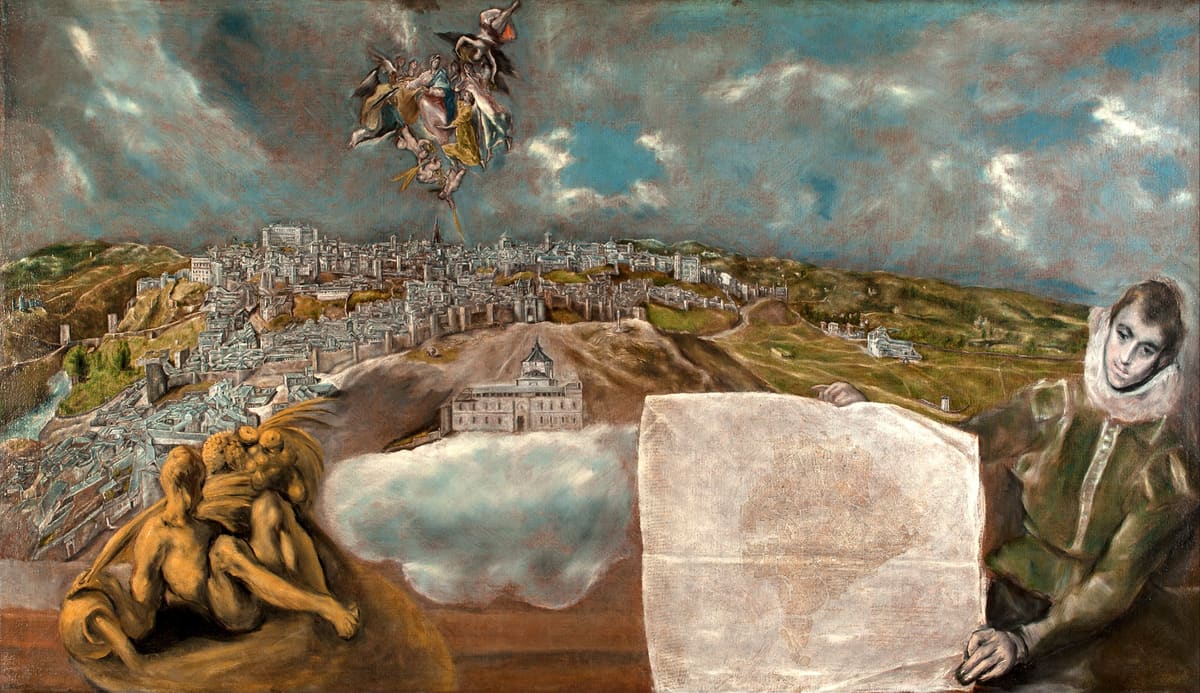
Artist's own account The general prospect can still be found from the north bank: the city on its hill, the tower of the cathedral and the block of the Alcázar fortress on the skyline, the Castle of San Servando and the Alcántara bridge at the right. But El Greco shifted the cathedral to the left of the Alcázar — in reality it stands to the right — and heightened and compressed the buildings along the river. In a note on his other Toledo picture he explained that he had moved a building so that it would show.
What is in the painting?
The city rises steeply in the centre and right, its walls, towers and the cathedral spire picked out in cold light against a sky of heavy grey-black cloud shot through with pale breaks. The Tagus curves round the base of the hill; the Alcántara bridge crosses it at the right, with the Castle of San Servando above.
In the green foreground, riverside buildings and a scatter of tiny figures — bathers, a man leading a horse — sit among trees that seem lit from within.
Look closely
The misplaced cathedral
Its tower stands to the left of the Alcázar block — the reverse of the real city.
The Alcántara bridge
At the right, crossing the Tagus, with the Castle of San Servando above — roughly where they really are.
The lit foreground
Trees, grass and riverside buildings glow while the sky stays dark — an impossible, electric light.
Tiny figures
Bathers and a man leading a horse cross the green foreground, dwarfed by the city.
The stacked skyline
Walls, towers and the spire are crowded and heightened so the hill seems to surge upward.
Details that are easy to miss. The cathedral tower is on the wrong side of the Alcázar block; tiny figures bathe and cross the river in the green foreground; the Alcántara bridge and the Castle of San Servando at the right are close to their real positions; and the foreground trees and grass are lit while the sky above them is black.
Analysis
Composition & perspective
The hill is thrust up hard in the centre, the buildings stacked and tilted, so a real skyline reads like a single surging form.
Scholarship El Greco raises and steepens the hill, crowds the towers together, and lets the whole city lean towards the viewer. The dark sky presses down; the pale buildings and the silver river push up against it. The small foreground figures make the city seem vast and the storm imminent.
Colour and light
A near-monochrome of storm greys and greens, with the city and river lit by a cold, sourceless light.
Scholarship The palette is restricted to blacks, greys, deep greens and a chill white. Light seems to come from no particular sun — the towers, the river and the foreground foliage glow while the sky stays dark, an unnatural, electric effect that anticipates modern landscape.
Handling and technique
Rapid, flickering brushwork, with the buildings and clouds worked in long nervous strokes.
El Greco paints wet and fast, the forms drawn out and elongated, the highlights dashed on. The handling is closer to his religious pictures of the same years than to any topographical view of the period.
Meaning and interpretation
Interpretations differ. What the artist documented, what museums and scholars propose, and later or speculative theories are marked and kept separate.
Not a topographical record
El Greco's own note on his companion Toledo picture shows he felt free to move buildings for the sake of the image. This canvas is understood as an expressive portrait of the city, not a survey.
A spiritual vision
Many writers read the storm-lit city as a charged, almost apocalyptic image — Toledo as the spiritual capital of Counter-Reformation Spain, seen through El Greco's mysticism. This is interpretation; the painting carries no inscription or text explaining it.
History & provenance
- c. 1596–1600Painted in Toledo.
- 17th–19th c.In Spanish and then other European collections.
- early 20th c.Acquired by the American collectors H. O. and Louisine Havemeyer.
- 1929Enters the Metropolitan Museum of Art through the Havemeyer bequest.
The painting came to the Metropolitan Museum of Art in New York in 1929 as part of the great Havemeyer bequest, and is one of the museum's most celebrated works.
Sources
- The Metropolitan Museum of Art, New York — collection entry for ‘View of Toledo’ (H. O. Havemeyer Collection, Bequest of Mrs. H. O. Havemeyer, 1929; oil on canvas, c. 121 × 109 cm)
- Fernando Marías, ‘El Greco: Life and Work’ (2013)
- Museo del Greco, Toledo — the artist's ‘View and Plan of Toledo’ and his note on rearranging the cathedral
Frequently asked
Is View of Toledo a real view?
It shows the real city of Toledo from the north, and the general skyline is recognisable, but El Greco rearranged it — moving the cathedral to the wrong side of the Alcázar and compressing the buildings.
Can you find the spot today?
The prospect of Toledo on its hill above the Tagus, with the Alcántara bridge and the Castle of San Servando, can still be seen from the north bank — though not with El Greco's rearranged buildings.
Why did El Greco move the cathedral?
In a note on his other Toledo picture he said he had shifted a building so that it would be visible. He treated the city's plan as something he could adjust for the image.
Is it a night scene?
No — it is a daytime storm. The sky is black with cloud, but the city, river and foreground are lit by a cold, sourceless light.
How many landscapes did El Greco paint?
Only two survive: this one and the ‘View and Plan of Toledo’ in the Museo del Greco. He was overwhelmingly a painter of religious subjects and portraits.
Where is the painting now?
In the Metropolitan Museum of Art, New York, since 1929.
Related paintings


More by El Greco
