The Parthenon
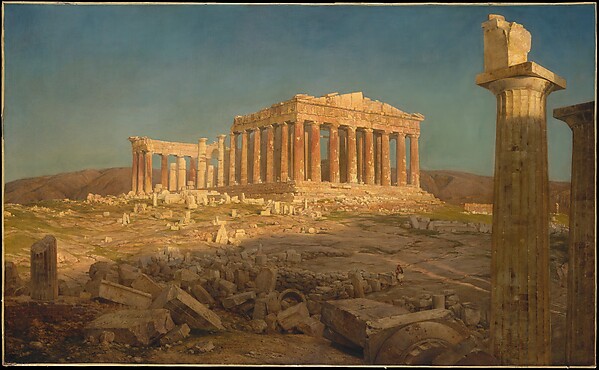
The Parthenon on the Acropolis of Athens in warm evening light, ringed by fallen marble — the ruin is unchanged and world-famous.
Acropolis of Athens
The painting shows a real, identified place that you can find today. The exact spot the artist worked from is not necessarily known.
The Parthenon — at a glance
- Artist
- Frederic Edwin Church (1826–1900)
- Year
- 1871
- Movement
- Hudson River School
- Place
- The Parthenon, Acropolis of Athens, Greece
- Viewpoint
- The temple's west front — the ruin is essentially unchanged and matchable (World Heritage Site)
- Medium
- Oil on canvas
- Dimensions
- c. 113 × 184 cm
- Now at
- Metropolitan Museum of Art, New York
Overview
The Parthenon is a large, exacting picture by Frederic Edwin Church, painted in 1871 from drawings and photographs he made on a visit to Athens in 1869. It shows the west front of the Parthenon on its rock in the clear golden light of late afternoon, the marble weathered to honey and grey, drums of fallen columns and carved blocks strewn across the foreground, a few tiny visitors, and the plain and hills of Attica beyond. It is oil on canvas, about 113 by 184 cm, and it hangs in the Metropolitan Museum of Art, New York.
Where was The Parthenon painted?
Scholarship The Parthenon, the temple of Athena built in 447–432 BC, stands on the Acropolis, the sacred rock in the centre of Athens. It was damaged by a Venetian bombardment in 1687 and by the removal of sculptures in the early nineteenth century, but the colonnade Church painted is essentially as it was in 1869 — and, allowing for a century and a half of conservation and anastylosis (some columns re-erected, scaffolding at times), the west front and the strewn marble can be matched closely today. The Acropolis is a UNESCO World Heritage Site and among the most visited monuments on earth.
What is in the painting?
The temple fills the upper right: the Doric columns of the west end, the ruined pediment, the architrave, the weathered surface catching low sun. The foreground is a field of tumbled marble — column drums, capitals, carved fragments — with two or three minute figures for scale. Beyond the edge of the rock, the hazy plain and the mountains of Attica; a warm, luminous sky.
Look closely
The weathered marble
Every flute, crack and stain of the honey-and-grey stone is rendered with near-archaeological precision.
The field of fragments
Column drums, capitals and carved blocks lie strewn across the foreground — the measure of the loss.
The tiny visitors
Two or three minute figures among the ruins give the temple its scale.
The plain of Attica
Beyond the rock, the hazy plain and the mountains of Attica under a warm sky.
Analysis
Composition and technique
The ruined colonnade set against sky, with a foreground of fallen marble measuring the loss, in warm raking light.
Scholarship Church renders every flute, crack and stain of the marble with near-archaeological precision, and lights the whole in a glowing evening tone that both dignifies the ruin and heightens the sense of time passed. The scattered fragments in front are the picture's quiet argument about mortality and greatness.
History & provenance
The painting is in the Metropolitan Museum of Art, New York.
Sources
- The Metropolitan Museum of Art, New York — collection entry for Frederic Edwin Church, ‘The Parthenon’ (1871)
- UNESCO World Heritage — Acropolis, Athens
Frequently asked
Where is the view in Church's Parthenon?
The west front of the Parthenon on the Acropolis of Athens, seen in late-afternoon light with fallen marble across the foreground and the plain of Attica beyond.
Can you go there?
Yes. The Acropolis is a UNESCO World Heritage Site and one of the most visited monuments in the world; the west front and the strewn marble can be matched closely, allowing for later conservation and re-erection of some columns.
When did Church see it?
He visited Athens in 1869 and made drawings and photographs, then painted the large canvas in 1871.
How accurate is the picture?
Very. Church rendered every flute, crack and stain of the marble with near-archaeological precision; only the glowing evening light is heightened for effect.
Where is the painting now?
In the Metropolitan Museum of Art, New York.
Related paintings

El Khasne, Petra
1874
Church's other great ancient-ruin picture from the same journey — the Treasury at Petra.

Niagara
1857
Church's Niagara of 1857 — natural rather than built grandeur, in the same glowing manner.

A View through Three of the North-Western Arches of the Third Storey of the Coliseum
1815
Eckersberg inside the Colosseum — the precise study of an ancient ruin.
More by Frederic Edwin Church