A View through Three of the North-Western Arches of the Third Storey of the Coliseum
A precise study looking out through three arches high up inside the Colosseum in Rome — the exact spot can still be found.
Colosseum
The painting shows a real, identified place that you can find today. The exact spot the artist worked from is not necessarily known.
A View through Three of the North-Western Arches of the Third Storey of the Coliseum — at a glance
- Artist
- Christoffer Wilhelm Eckersberg (1783–1853)
- Year
- 1815–1816
- Movement
- Danish Golden Age / Neoclassical study
- Place
- The upper storey of the Colosseum, Rome, Italy
- Viewpoint
- The third-storey north-western arcade — the building is unchanged; the spot can be matched
- Medium
- Oil on canvas
- Dimensions
- c. 32 × 49 cm
- Now at
- SMK – National Gallery of Denmark, Copenhagen
Overview
This small, exacting oil study by the Danish painter Christoffer Wilhelm Eckersberg was made in Rome in 1815–16, when he was studying there after training under David in Paris. It looks outward from inside the upper level of the Colosseum through three of its arched openings, framing views of the sky, distant Roman buildings and a hill, with the great curving brick-and-travertine structure filling most of the picture. It is oil on canvas, about 32 by 49 cm, and it hangs in the SMK – National Gallery of Denmark, Copenhagen.
Where was A View through Three of the North-Western Arches of the Third Storey of the Coliseum painted?
Scholarship The Colosseum (the Flavian Amphitheatre, completed AD 80) stands in the centre of Rome and is one of the most visited monuments in the world. Eckersberg painted from the third-storey arcade on the north-western side, looking out. The building is essentially unchanged, and this exact stretch of arcade and the framed views through the arches can be found and matched today, allowing for later consolidation of the ruin and the growth of the modern city beyond.
What is in the painting?
Three tall arched openings, side by side, in a massive wall of weathered brick and stone, with the springing of vaults above. Through the arches: bright sky, the tops of distant buildings and trees, a hint of a hill. Sunlight rakes across the near masonry, sharply modelling each block and the worn arch edges. There are no figures.
Look closely
The three arches
Three tall arched openings side by side in a massive wall of weathered brick and stone.
The views through
Each arch frames a small bright picture — sky, distant Roman roofs and trees, a hill.
The raking light
Sunlight models every block of the near masonry and the worn edges of the arches.
Analysis
Composition and technique
Three framed openings in a heavy wall — a picture about looking out from inside a ruin, painted with topographic precision.
Scholarship Eckersberg treats the architecture almost as a set of measured drawings brought to life by light: the arches are exactly placed, the perspective controlled, the sunlit and shadowed stone rendered block by block. The three views through the arches are small bright pictures within the picture. It is a founding work of precise, unsentimental Danish Golden Age painting.
History & provenance
The study is in the SMK – National Gallery of Denmark, Copenhagen.
Sources
- SMK – National Gallery of Denmark, Copenhagen — collection entry for C. W. Eckersberg, ‘A View through Three of the North-Western Arches of the Third Storey of the Colosseum’ (1815–16)
- Kasper Monrad, ‘Danish Golden Age Painting’ (SMK)
Related paintings

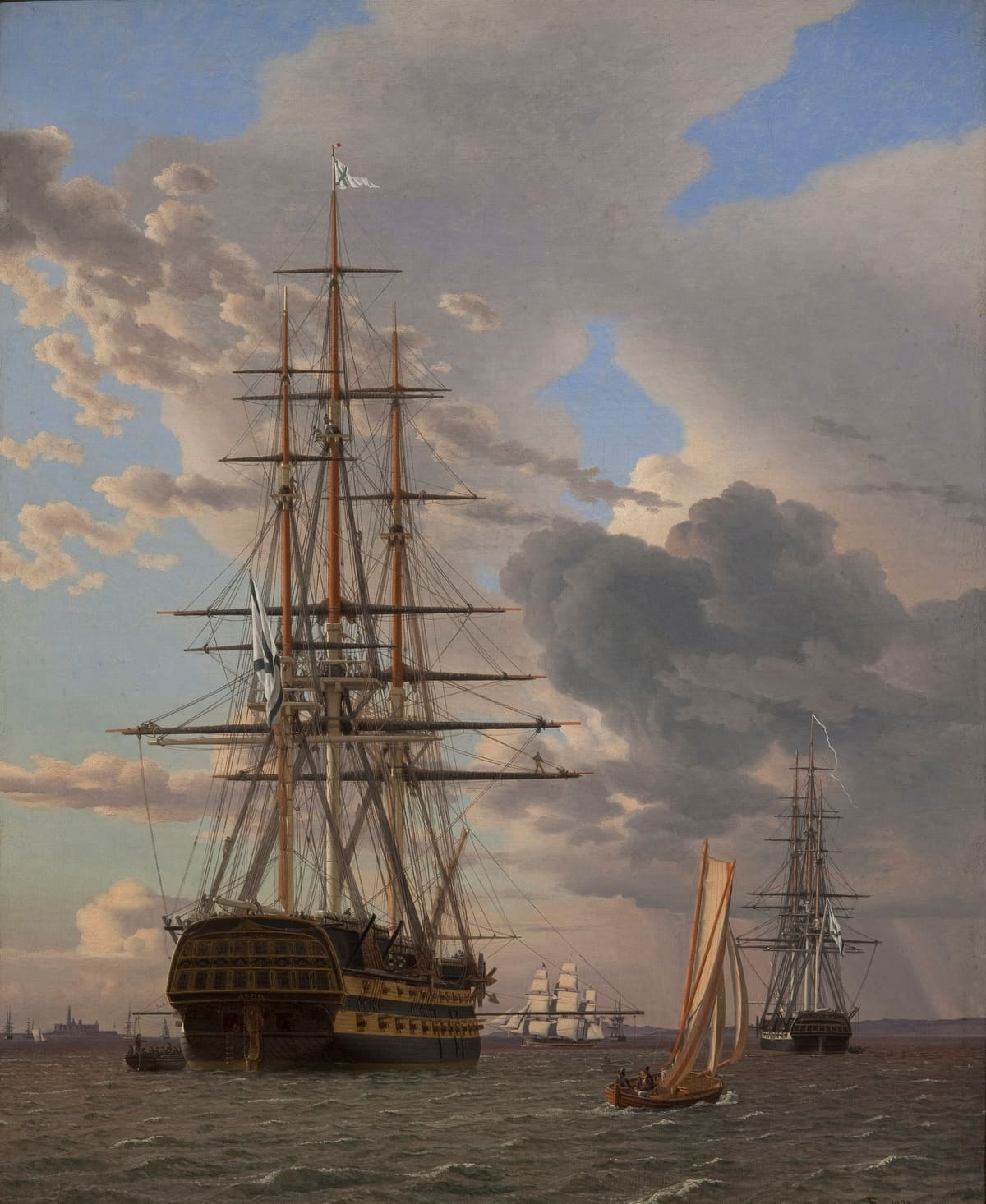
The Russian Ship of the Line "Asow" and a Frigate at Anchor in the Roads of Elsinore
1828
Eckersberg's precise marine of 1828 — the same measured eye at home in Denmark.

Castel Sant'Angelo and Tiber
1826
Corot's Roman studies of the 1820s — the next generation of northern painters at work in Rome.

Goethe in the Roman Campagna
1787
Tischbein's Goethe among the ruins of the campagna — the German version of the Roman sojourn.
Current display status
Currently on viewMore by Christoffer Wilhelm Eckersberg