The Blind Leading the Blind
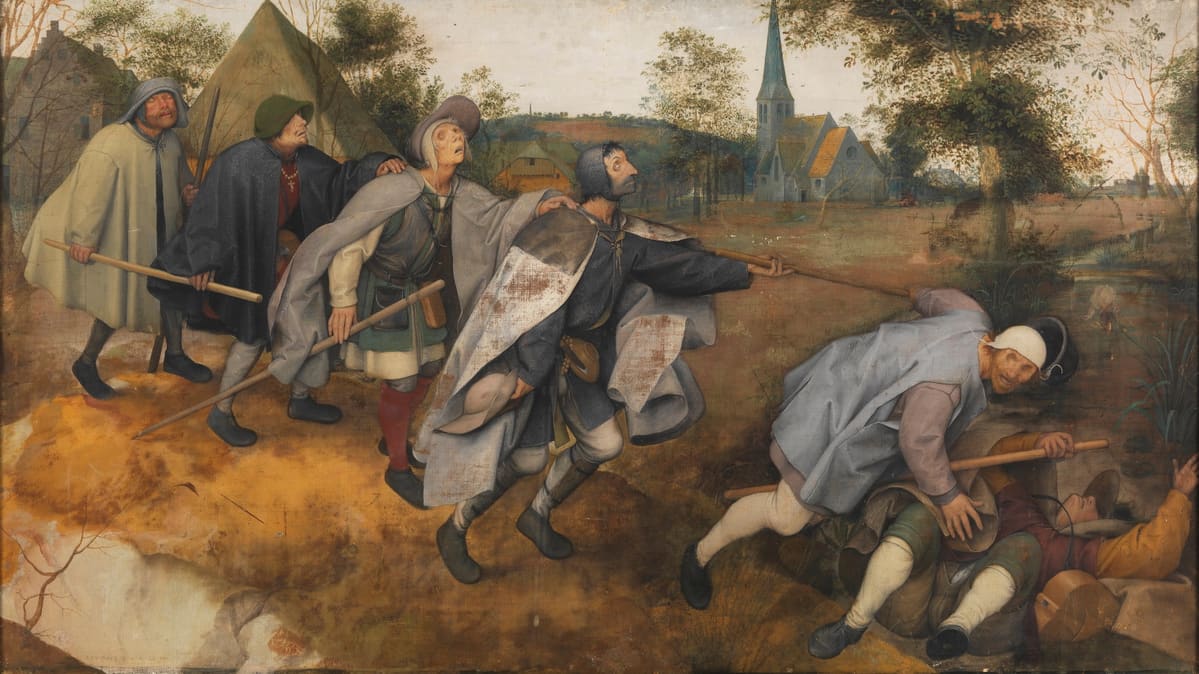
The Gospel proverb shown happening — a chain of blind men falling, past a village church usually identified as Sint-Anna-Pede.
Sint-Anna Church
The painting shows a real, identified place that you can find today. The exact spot the artist worked from is not necessarily known.
The Blind Leading the Blind — at a glance
- Artist
- Pieter Bruegel the Elder (c. 1525–1569)
- Year
- 1568
- Movement
- Northern Renaissance
- Place
- A Flemish village; the church usually identified as Sint-Anna-Pede, Dilbeek, near Brussels
- Viewpoint
- The subject is the proverb, not the place; the church is a real, standing building
- Medium
- Distemper (Tüchlein) on linen canvas
- Dimensions
- c. 86 × 154 cm
- Now at
- Museo di Capodimonte, Naples
Overview
The Blind Leading the Blind — also called The Parable of the Blind — is a painting Pieter Bruegel the Elder made in 1568, near the end of his life. It shows six blind men roped together, the first already fallen into a ditch and the rest toppling after him. It is painted in a thin, matte technique (distemper on linen), about 86 by 154 cm, and it hangs in the Museo di Capodimonte in Naples.
Where was The Blind Leading the Blind painted?
The setting is a Flemish village with a church behind the figures.
Scholarship That church is usually identified as the parish church of Sint-Anna-Pede, in Dilbeek just east of Brussels — a Romanesque-Gothic building that still stands, its stepped tower matching the one in the painting. The identification is widely repeated though not absolutely certain, and the proverb, not the place, is the subject.
What is in the painting?
Six ragged men cross a low bank in a diagonal line, each with a hand on the shoulder or staff of the man ahead. The leader has pitched backwards into a stream, face up, his lute-shaped hurdy-gurdy flying. The second is already off balance, mouth open, about to follow. Behind them the others walk on, unaware, faces turned up and sightless.
A quiet village lies beyond: houses, a woman, cattle, and the church with its stepped tower.
Look closely
The stages of the fall
Each man is at a different point of losing balance, from upright and oblivious at the back to fully fallen at the front.
The hurdy-gurdy
The fallen leader clutches a beggar's stringed instrument as he goes over backwards.
Six kinds of blindness
The men's eyes are painted precisely enough that doctors have tried to diagnose each condition.
The quiet church
A pale village church with a stepped tower stands calmly behind the tumbling line of men.
The pointing diagonal
The line of figures aims straight at the ditch they are all about to reach.
Details that are easy to miss. The six men have different eye conditions, painted precisely enough that ophthalmologists have tried to diagnose each; the fallen leader clutches a hurdy-gurdy, a beggar's instrument; a small church with a stepped tower stands quietly behind; and the diagonal of the men points exactly at the ditch they are all heading for.
Analysis
Composition & perspective
A single descending diagonal of figures, staged so the viewer reads the fall in stages, left to right.
Scholarship Bruegel lines the six men up along a slope that drops towards the ditch, and gives each a different stage of losing balance — from the upright, oblivious man at the back to the fully fallen leader at the front. The line runs the eye straight down into the water. The peaceful village behind sharpens the disaster in front.
Colour and light
Muted greys, browns and greens of a Flemish autumn, with the pale church as a still point behind the tumbling men.
Scholarship The palette is subdued — the men's worn clothes in grey, ochre and dull green, the ground and water in brown and slate. The light is even and grey. The one calm vertical is the pale stone church, set against the chaos of the foreground.
Technique
Painted in glue-based distemper on fine linen — a fragile medium that gives a flat, fresco-like surface.
Rather than oil on panel, Bruegel used ‘Tüchlein’ technique: thin, water-based paint on unprimed linen. It was cheaper and quicker and produced a matte, chalky finish, but it is delicate; the painting has survived in reasonable condition for four and a half centuries.
Meaning and interpretation
Interpretations differ. What the artist documented, what museums and scholars propose, and later or speculative theories are marked and kept separate.
The Gospel proverb, illustrated
The picture takes the saying from Matthew 15:14 — ‘if the blind lead the blind, both shall fall into the ditch’ — and simply shows it occurring. At the plainest level it is a warning against following those who cannot see the way.
A comment on the times?
Painted during the Duke of Alba's harsh rule in the Netherlands, the picture has often been read as a veiled political or religious comment — blind obedience leading a whole community to ruin. Bruegel left no text explaining it, so this reading is inference.
History & provenance
- 1568Painted in the last year or two of Bruegel's life.
- 17th c.In the Farnese collection; taken to Naples.
- 18th c.Passes with the Farnese inheritance to the Bourbons of Naples.
- TodayMuseo e Real Bosco di Capodimonte, Naples.
The painting has been in Naples since the 17th century, arriving with the Farnese collection, and hangs in the Museo di Capodimonte. A slightly later copy by Bruegel's son records the composition.
Sources
- Museo e Real Bosco di Capodimonte, Naples — collection entry for ‘The Parable of the Blind’ (distemper on canvas, c. 86 × 154 cm)
- Manfred Sellink, ‘Bruegel: The Complete Paintings, Drawings and Prints’ (2007)
- J. R. J. van Asperen de Boer et al. — technical studies of Bruegel's Tüchlein technique
Frequently asked
What proverb is the painting based on?
The saying in Matthew's gospel (15:14): ‘if the blind lead the blind, both shall fall into the ditch.’ Bruegel shows it happening — a chain of six blind men going down one after another.
Is the church in it a real place?
It is generally identified as the church of Sint-Anna-Pede, in Dilbeek just east of Brussels, which still stands and has a matching stepped tower. The identification is widely repeated but not certain.
Can you visit the church?
Yes, if the identification is right: Sint-Anna-Pede church in Dilbeek is a working parish church and a protected monument.
Why are the men's faces so specific?
Bruegel painted six different kinds of blindness in enough detail that eye doctors have since tried to diagnose each man from the picture.
Is there a political meaning?
The painting was made during the Duke of Alba's repression of the Netherlands and has often been read as a veiled comment on blind obedience leading a community to ruin. Bruegel left nothing to confirm that.
Where is the painting now?
In the Museo di Capodimonte in Naples, where it has been since the 17th century.
Related paintings

More by Pieter Brueghel the Elder

The Procession to Calvary

The People's Census at Bethlehem
