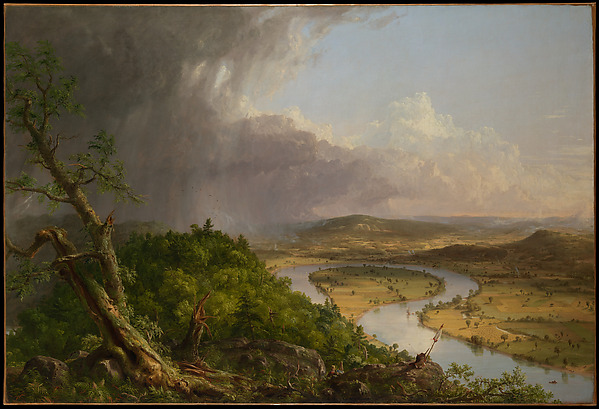
Looking Down Yosemite Valley, California
The cliffs and river of Yosemite Valley in golden light — a Bierstadt panorama of a place that became a national park.
Sentinel Rock
The painting depicts a real landscape or cityscape. The precise viewpoint the artist used may be unknown, so the marker shows the general area.
Looking Down Yosemite Valley, California — at a glance
- Artist
- Albert Bierstadt (1830–1902)
- Year
- 1865
- Movement
- Hudson River School (Rocky Mountain School)
- Place
- Yosemite Valley, Sierra Nevada, California, USA
- Viewpoint
- Looking west down the valley — now Yosemite National Park; the cliffs and river are unchanged and matchable
- Medium
- Oil on canvas
- Dimensions
- c. 165 × 245 cm
- Now at
- Birmingham Museum of Art, Alabama
Overview
Looking Down Yosemite Valley, California is one of the large Yosemite pictures Albert Bierstadt painted after visiting the valley in 1863. It looks westward down the length of the glacial valley in the low light of late afternoon: the Merced River winding through the flat, wooded floor, sheer granite cliffs rising on both sides — El Capitan on the right, Cathedral Rocks and Bridalveil Fall on the left — and the sun a blaze of gold above the far end. It is oil on canvas, about 165 by 245 cm, and it hangs in the Birmingham Museum of Art, Alabama.
Where was Looking Down Yosemite Valley, California painted?
Scholarship Yosemite Valley is a deep glacier-carved valley on the Merced River in the Sierra Nevada of central California. In 1864, the year before Bierstadt painted this, President Lincoln signed the Yosemite Grant protecting the valley and the Mariposa Grove — a first step towards the national park idea; Yosemite became a national park in 1890. The valley, El Capitan, Cathedral Rocks and Bridalveil Fall are unchanged and world-famous, so Bierstadt's view down the valley can be matched closely from near the valley floor, allowing for his heightened light and slightly compressed scale.
What is in the painting?
The valley floor, in shadow, runs back down the centre: the Merced River curving among pines and meadows, a few deer. On the right, the vast unbroken face of El Capitan; on the left, the pinnacles of Cathedral Rocks and the thin fall of Bridalveil. At the far end, the valley opens to a sky filled with the setting sun, gold and hazy, the cliffs silhouetted against it. Warm light, deep shadow.
Look closely
El Capitan
The vast unbroken granite face rises on the right of the valley.
Bridalveil Fall
A thin fall drops from the cliffs on the left, by Cathedral Rocks.
The Merced River
The river curves through the shadowed, wooded valley floor, with a few deer.
The sunset blaze
The valley opens at the far end to a sky filled with hazy gold light, the cliffs silhouetted.
Analysis
Composition and technique
A framed corridor of granite cliffs leading the eye down the shadowed valley to a blaze of sunset light.
Scholarship Bierstadt uses the cliffs as a natural proscenium and the river as a path into a glowing distance, heightening the contrast of dark foreground and radiant far light for maximum drama. The detail is precise, the scale grand — the American West as spectacle.
Meaning and interpretation
Interpretations differ. What the artist documented, what museums and scholars propose, and later or speculative theories are marked and kept separate.
Wilderness as national treasure
Bierstadt's huge, glowing Yosemite pictures helped fix the valley in the public mind as a wonder worth protecting, feeding directly into the movement that produced the Yosemite Grant of 1864 and, later, the national park system. The golden light frames the wilderness as a kind of promised land.
History & provenance
The painting is in the Birmingham Museum of Art, Alabama.
Sources
- Birmingham Museum of Art, Alabama — collection entry for Albert Bierstadt, ‘Looking Down Yosemite Valley, California’ (1865)
- National Park Service — Yosemite National Park; the Yosemite Grant of 1864
Frequently asked
Where is the view in this painting?
Looking west down the length of Yosemite Valley, on the Merced River in the Sierra Nevada of California, with El Capitan on the right and Cathedral Rocks and Bridalveil Fall on the left.
Can you go there?
Yes. The valley is the heart of Yosemite National Park; El Capitan, Cathedral Rocks, Bridalveil Fall and the river are unchanged and world-famous, and Bierstadt's view can be matched closely from near the valley floor.
How is it connected to the national parks?
In 1864 — the year before this picture — Lincoln signed the Yosemite Grant protecting the valley, a first step towards the national park idea; Yosemite became a national park in 1890. Bierstadt's grand Yosemite pictures helped build public support for protection.
Is the light realistic?
Bierstadt heightened the sunset glow and the contrast between the shadowed valley and the radiant far end for drama, and slightly compressed the scale, but the topography is recognisable.
Where is the painting now?
In the Birmingham Museum of Art, Alabama.