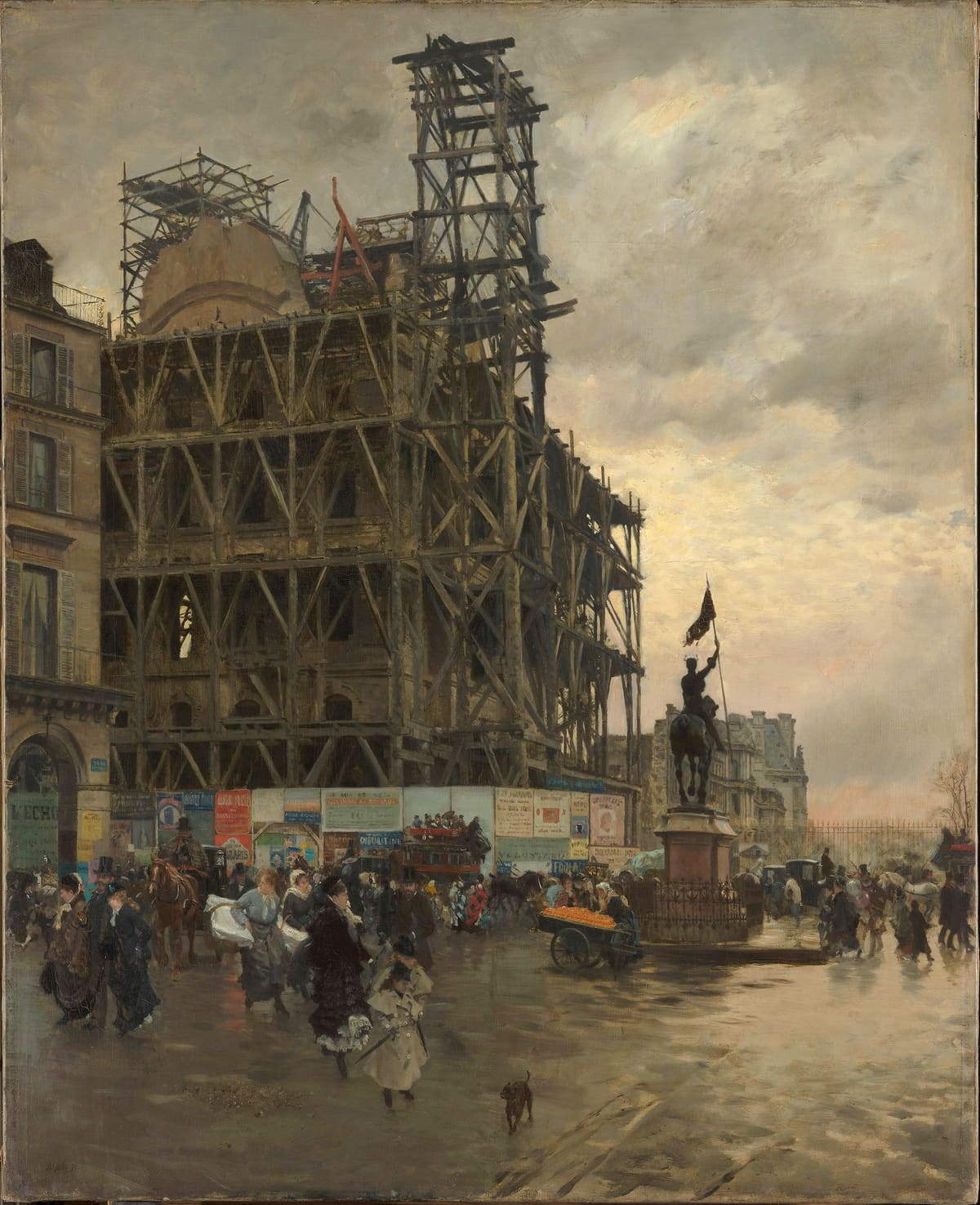
La Place des Pyramides, Paris (I)
The Place des Pyramides by the Tuileries in Paris, with the new gilded statue of Joan of Arc — the square and the statue are unchanged.
place des Pyramides
A standpoint is recorded for this painting, but it has not been independently confirmed against a museum or scholarly source, so treat it as approximate.
La Place des Pyramides, Paris (I) — at a glance
- Artist
- Giuseppe De Nittis (1846–1884)
- Year
- 1875
- Movement
- Impressionism (Italian; Paris circle)
- Place
- Place des Pyramides, Paris 1er, beside the Tuileries Garden
- Viewpoint
- Across the square toward the Joan of Arc statue — square, statue and arcades unchanged
- Medium
- Oil on canvas
- Now at
- Musée d'Orsay, Paris
Overview
La Place des Pyramides is a small, brilliant street scene by the Italian painter Giuseppe De Nittis, who worked mainly in Paris and was close to the Impressionists. It was made in 1875 and shows the little square on the north side of the Tuileries Garden on a bright, breezy day. It is oil on canvas and hangs in the Musée d'Orsay, Paris.
Where was La Place des Pyramides, Paris (I) painted?
Museum interpretation The square lies where the rue des Pyramides meets the rue de Rivoli, against the north-west corner of the Tuileries. At its centre is Emmanuel Frémiet's gilded bronze equestrian statue of Joan of Arc, unveiled in 1874 — a year before the painting. The statue, the square, the ironwork and the long arcaded front of the rue de Rivoli are all unchanged, and the viewpoint can be matched exactly.
What is in the painting?
The gleaming gold statue of Joan on horseback rises at the right, scaffolding-free and new. Carriages, riders and pedestrians cross the open square; workers and a barrier suggest the ground is still being finished. The pale stone arcades of the rue de Rivoli run back on the left, and the bare trees of the Tuileries show beyond the railings.
Look closely
The gilded Joan of Arc
Frémiet's new gold-painted bronze statue, unveiled in 1874 — the year before the painting.
The rue de Rivoli arcades
The long arcaded front runs back sharply on the left, still exactly as shown.
Signs of unfinished ground
A barrier and workers suggest the square's paving was still being completed.
The Tuileries trees
Bare winter trees show beyond the garden railings at the right.
Analysis
Composition and light
A wide, airy square with the statue and the arcades framing a deep, sunlit street view.
Scholarship De Nittis sets the golden statue against the pale architecture and lets the rue de Rivoli recede sharply on the left. The bright, gusty light, the flicker of moving figures and the quick touch are close to Impressionism, though De Nittis kept a firmer drawing.
History & provenance
The painting entered the French national collections and hangs in the Musée d'Orsay, Paris.
Featured in Famous Painting Locations: 13 Real Places You Can Visit
Sources
- Musée d'Orsay, Paris — collection entry for Giuseppe De Nittis, ‘La Place des Pyramides’ (1875; oil on canvas)
- Ville de Paris — the Frémiet statue of Joan of Arc, Place des Pyramides (unveiled 1874)

