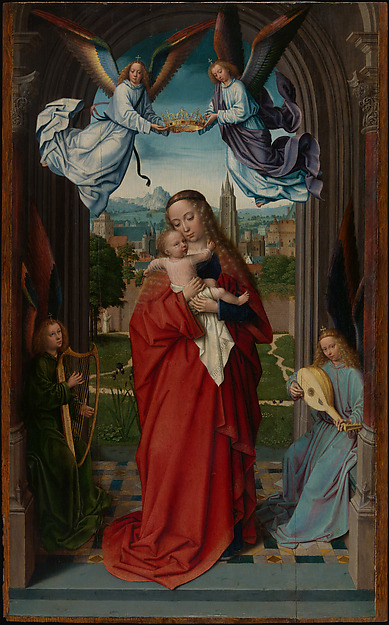
Virgin and Child with Four Angels
The Virgin and Child in a flowery meadow, with the towers and gates of Gerard David's Bruges precisely painted behind them.
Church of Our Lady
The painting shows a real, identified place that you can find today. The exact spot the artist worked from is not necessarily known.
Virgin and Child with Four Angels — at a glance
- Artist
- Gerard David (c. 1460–1523)
- Year
- c. 1510–1515
- Movement
- Early Netherlandish painting
- Place
- A devotional scene with a real view of Bruges, Belgium
- Viewpoint
- The Church of Our Lady tower and a city gate (the Gentpoort) painted behind the Virgin — both still stand
- Medium
- Oil on panel
- Dimensions
- c. 63 × 39 cm
- Now at
- Metropolitan Museum of Art, New York
Overview
Virgin and Child with Four Angels is a small devotional panel by Gerard David, the leading painter of Bruges after Memling, made about 1510–15. The standing Virgin holds the Christ Child in an enclosed garden; two angels overhead lower a jewelled crown, two more play a lute and a harp at her feet. Behind, over a low wall, stretches a detailed townscape. It is oil on panel, about 63 by 39 cm, and it hangs in the Metropolitan Museum of Art, New York.
Where was Virgin and Child with Four Angels painted?
Scholarship The city behind the Virgin is David's own Bruges, painted with care: the tall brick tower of the Church of Our Lady (the Onze-Lieve-Vrouwekerk) rises at one side, and a fortified city gate — usually identified as the Gentpoort — with its towers and a bridge appears on the other, among gabled houses and trees. The Church of Our Lady's tower (one of the tallest brick towers in the world) and the Gentpoort both still stand in Bruges, so the landmarks in the background can be found today.
What is in the painting?
The Virgin, in a deep blue robe, stands in the foreground on a patch of grass dotted with flowers, the naked Child on her arm reaching for grapes. Two small angels fly above holding a gold crown over her head; two seated angels play stringed instruments below. A low wall and a rose hedge; beyond, the Bruges skyline — church tower, city gate, roofs, water — under a pale sky.
Look closely
The Church of Our Lady tower
The tall brick tower rises at one side of the background — one of the tallest brick towers in the world, still standing.
The city gate
A fortified gate with towers and a bridge, usually identified as the Gentpoort of Bruges.
The flowery meadow
The Virgin stands on grass dotted with flowers — the hortus conclusus, symbol of her purity.
The music-making angels
Two seated angels play a lute and a harp at the Virgin's feet.
Analysis
Composition and technique
A large central Virgin in an enclosed garden, with a minutely painted real cityscape opening behind the wall.
Scholarship David sets the sacred figures close and monumental against the low garden wall, then paints the distant city with jewel-like Netherlandish precision — every tower, gable and tree distinct. The enclosed flowery garden (hortus conclusus) is a traditional symbol of the Virgin's purity.
History & provenance
The painting is in the Metropolitan Museum of Art, New York (Bequest of Benjamin Altman).
Sources
- The Metropolitan Museum of Art, New York — collection entry for Gerard David, ‘Virgin and Child with Four Angels’ (c. 1510–15)
- Maryan W. Ainsworth, ‘Gerard David’ (Metropolitan Museum of Art, 1998)
Related paintings

More by Gerard David
