The Horse Fair
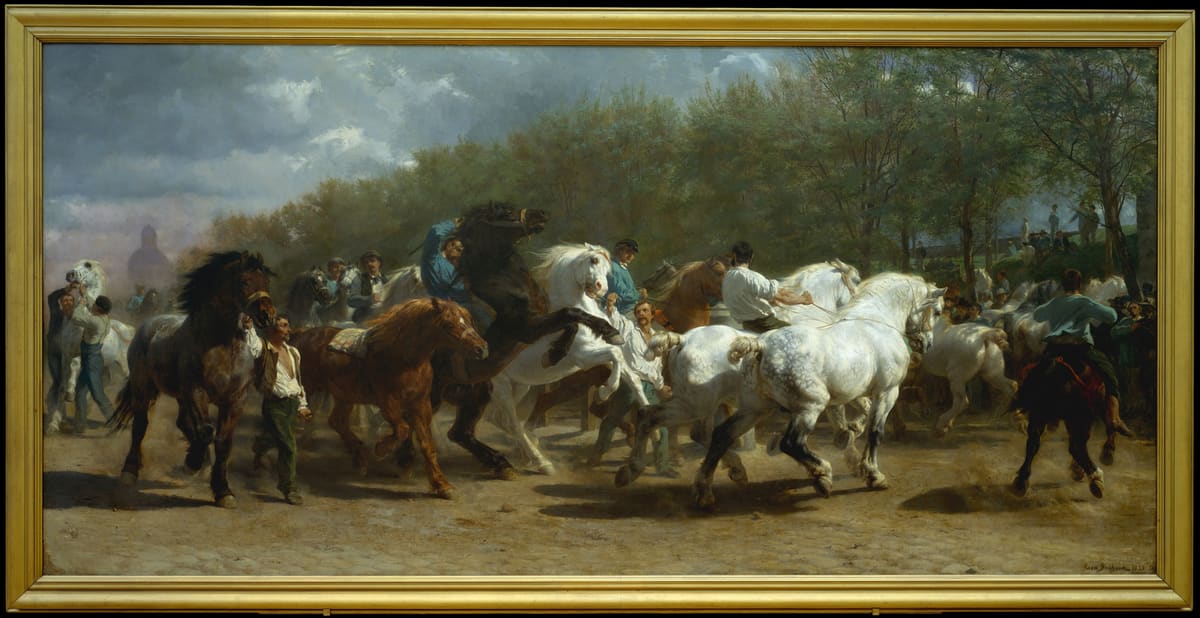
The twice-weekly Paris horse market, held along the wall of the Salpêtrière hospital — its dome still rises behind the trees.
boulevard de l'Hôpital
The painting shows a real, identified place that you can find today. The exact spot the artist worked from is not necessarily known.
The Horse Fair — at a glance
- Artist
- Rosa Bonheur (1822–1899)
- Year
- 1852–1855
- Movement
- Realism / Animalier painting
- Place
- Boulevard de l'Hôpital, Paris 13e
- Viewpoint
- The market avenue by the Salpêtrière — boulevard and hospital survive; the fair is gone
- Medium
- Oil on canvas
- Dimensions
- c. 245 × 507 cm
- Now at
- Metropolitan Museum of Art, New York
Overview
The Horse Fair is a very large painting — about 2.4 by 5 metres — that Rosa Bonheur worked on from 1852 to 1855. It shows powerful horses being led, ridden and struggled with along a tree-lined avenue at a Paris market. It is oil on canvas and hangs in the Metropolitan Museum of Art in New York.
It made Bonheur, in her early thirties, the most famous woman painter in the world.
The story behind the painting
Bonheur spent about eighteen months studying the Paris horse market before painting it, going twice a week to sketch the animals and dealers.
Scholarship To move safely and unremarked among the men and horses, she wore men's clothing, for which she held an official police permit — a ‘permission de travestissement’ she renewed for years. The finished canvas was shown at the 1853 Salon, toured Britain and the United States with great success, and was seen privately by Queen Victoria.
Where was The Horse Fair painted?
The horse market was held twice a week on the boulevard de l'Hôpital, in what is now the 13th arrondissement of Paris, running along the outer wall of the Salpêtrière — a huge hospital that had begun as a poorhouse and asylum.
Museum interpretation The domed building glimpsed through the plane trees at the left is the Salpêtrière's chapel. The boulevard, the plane trees and the hospital with its dome are all still there; the horse fair itself ended long ago.
What is in the painting?
Draught and riding horses — many of them heavy grey Percherons — are led and ridden along a broad avenue under tall plane trees. In the centre, a rearing white horse is fought down by a groom; another bolts; dealers in smocks and hats hold reins and shout.
The dome of the Salpêtrière rises through the leaves at the left. The ground is churned; dust hangs in the air.
Look closely
The Salpêtrière dome
The domed building through the plane trees at the left is the chapel of the hospital that lined the market.
The rearing white horse
At the centre, a groom in a blue smock fights to bring down a rearing horse — the peak of the action.
The Percherons
The heavy silver-grey draught horses are Percherons, a French working breed.
The churned avenue
The broad ground is trodden to dust, with haze hanging over the moving animals.
The frieze design
The horses cross the canvas in one long band, composed like a classical relief but full of movement.
Details that are easy to miss. The domed building through the trees at the left is the chapel of the Salpêtrière hospital; the heavy grey horses are Percherons, a French draught breed; a rider in a blue smock at the centre struggles to control a rearing white horse; and Bonheur is sometimes said to have put herself into the picture as one of the mounted figures, though this is not certain.
Analysis
Composition & perspective
A surging frieze of horseflesh crosses the canvas left to right, built like a classical relief but full of motion.
Scholarship Bonheur arranges the animals in a broad band moving across the picture, with the rearing horses at the centre as the peak of the action and calmer teams at the sides. She had studied both Géricault's horse paintings and casts of the Parthenon frieze, and the design carries that ambition — a modern market treated with the weight of ancient sculpture.
Colour and light
Silvery greys of the Percherons and the dusty avenue, warmed by chestnut coats and the men's clothes, under a broken cloudy sky.
Scholarship The dominant note is the grey of the heavy horses and the pale, trodden ground, with browns and bays among them and touches of blue and red in the dealers' clothes. The light is that of an overcast Paris day, with a break of brightness over the avenue.
Handling and technique
Firmly drawn and solidly modelled, from close anatomical study of living horses.
Bonheur painted animals from long, direct observation — she kept livestock and even visited slaughterhouses to understand anatomy. The horses in the picture are individually studied and convincingly heavy; the paint is worked up to a high, exhibition finish.
Meaning and interpretation
Interpretations differ. What the artist documented, what museums and scholars propose, and later or speculative theories are marked and kept separate.
Animals as a serious subject
Bonheur's project was to treat animals — their power, movement and character — with the scale and seriousness usually given to history painting, and to do so from real observation rather than sentiment.
A woman claiming a public arena
The picture is also read biographically: a young woman, in men's clothes and with a police permit, entering a rough all-male marketplace to make the largest and most ambitious animal painting of the century. Her fame rested partly on that story.
History & provenance
- 1852–55Painted after eighteen months of study at the Paris horse market.
- 1853Shown at the Paris Salon.
- 1850s–80sToured Britain and the United States; engraved and hugely popular.
- 1887Bought by Cornelius Vanderbilt and given to the Metropolitan Museum of Art, New York.
After decades of touring and reproduction the painting was acquired by Cornelius Vanderbilt, who presented it to the Metropolitan Museum of Art in 1887. A smaller version by Bonheur is in the National Gallery, London.
Sources
- The Metropolitan Museum of Art, New York — collection entry for ‘The Horse Fair’ (Gift of Cornelius Vanderbilt, 1887; oil on canvas, c. 245 × 507 cm)
- Dore Ashton & Denise Browne Hare, ‘Rosa Bonheur: A Life and a Legend’ (1981)
- The National Gallery, London — entry for Bonheur's smaller version of The Horse Fair
Frequently asked
Where was the Paris horse fair held?
On the boulevard de l'Hôpital, in what is now the 13th arrondissement, along the outer wall of the Salpêtrière hospital. The market ran twice a week.
Can you visit the spot?
Yes. The boulevard, the plane trees and the Salpêtrière hospital with its domed chapel are all still there, though the horse fair ended long ago.
Why did Bonheur wear men's clothes to study it?
To move safely and unnoticed among the male dealers and the horses. She held an official police permit for cross-dressing, which she renewed for years.
What is the domed building in the picture?
The chapel of the Salpêtrière hospital, glimpsed through the trees at the left of the canvas.
How big is The Horse Fair?
About 2.4 by 5 metres — the scale of a Salon history painting, applied to a working animal market.
Where is the painting now?
In the Metropolitan Museum of Art, New York, given by Cornelius Vanderbilt in 1887.
