American Gothic
The plain Iowa cottage — and its one grand Gothic window — that Grant Wood sketched from the street in 1930.
American Gothic House
The painting shows a real, identified place that you can find today. The exact spot the artist worked from is not necessarily known.
American Gothic — at a glance
- Artist
- Grant Wood (1891–1942)
- Year
- 1930
- Movement
- Regionalism / American Scene
- Place
- Eldon, Iowa, USA (the house)
- Viewpoint
- The Dibble House — a real, visitable building; figures added separately
- Medium
- Oil on Beaver Board
- Dimensions
- 78 × 65.3 cm (upright)
- Now at
- Art Institute of Chicago (Friends of American Art Collection, 1930.934)
Overview
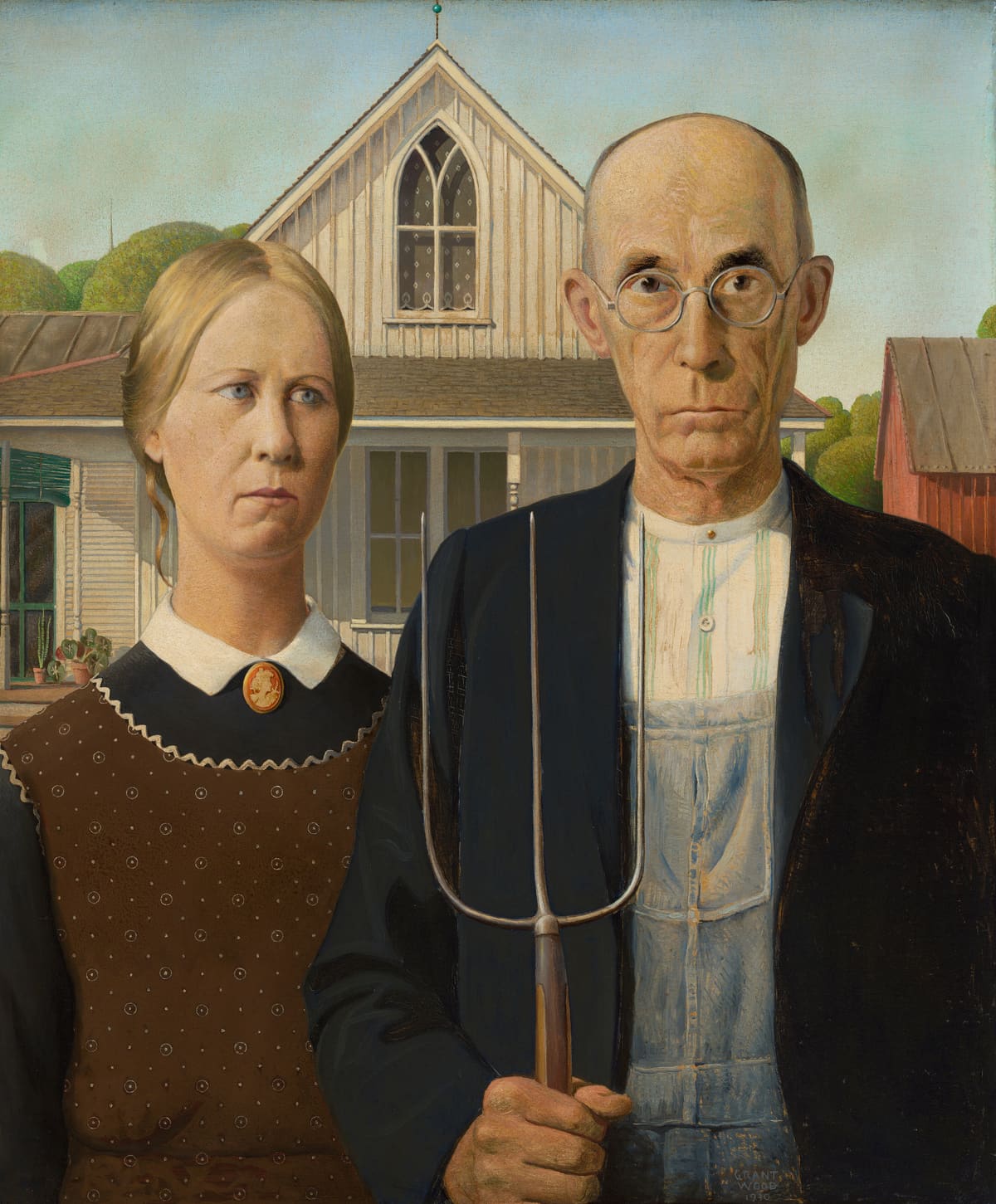
American Gothic is a small oil painting Grant Wood made in 1930. It shows a man with a pitchfork and a woman standing in front of a white farmhouse whose gable carries a pointed Gothic-Revival window. It is oil on Beaver Board, about 78 by 65 cm, and it has belonged to the Art Institute of Chicago since the year it was painted.
It is one of the most reproduced and parodied images in American art, and has been read as everything from a tribute to rural steadfastness to a joke at small-town expense — an argument that started as soon as it was shown and has never fully settled.
“There is satire in it, but only as there is satire in any realistic statement.”
The story behind the painting
In August 1930 Wood was visiting a fellow artist in Eldon, a small town in south-east Iowa, when he noticed a modest board-and-batten cottage with a surprisingly ambitious arched window in its gable. He made a quick sketch of the house on the spot.
Back in his studio in Cedar Rapids he painted the house from that sketch, and then added two figures posed separately: his sister, Nan Wood Graham, for the woman, and his dentist, Dr Byron McKeeby, for the man. He dressed them in old-fashioned clothes and arranged them as the kind of people he imagined would live in such a house.
Artist's own account Wood said he intended the pair as father and daughter, not husband and wife, but when viewers assumed they were married he did not correct them.
He entered the finished picture in the Art Institute of Chicago's 43rd Annual Exhibition in the autumn of 1930. It won a small cash prize, the museum bought it, and Wood became nationally famous almost overnight.
Where was American Gothic painted?
The house is the Dibble House, built about 1881–82: a plain workers' cottage in the Carpenter Gothic manner, its one flourish the pointed-arch window in the upper gable — an out-of-scale medieval touch on an ordinary farmhouse, and the source of the painting's title.
It still stands at 301 American Gothic Street in Eldon, in south-east Iowa. It is owned by the State Historical Society of Iowa, which runs the American Gothic House Center next door; the porch and the Gothic window are essentially unchanged, and visitors routinely pose in the doorway, sometimes with a borrowed pitchfork.
Scholarship Only the house is a real place. Wood never brought the models to Iowa — he painted them in the studio — so there is no viewpoint where the whole scene lines up, just the front of the house.
What is in the painting?
A man in a collarless shirt, denim overalls and a dark jacket stands square to the viewer, gripping a three-tined pitchfork upright in his fist. Beside him, slightly turned, a woman in a dark dress under a rickrack-trimmed apron, a cameo brooch at her throat and a single loose curl of hair escaping an otherwise severe style.
Behind them is the white gable with its arched window and a scrap of porch; to the left, a red barn and a second building among trees. The three prongs of the pitchfork are echoed in the stitched seams of the man's overalls and, many have noticed, in the bars of the window above.
Look closely
The pitchfork
Held upright in the man's fist; its three prongs are repeated in his overall seams and the window bars above.
The Gothic window
The pointed-arch window in the gable — a Carpenter Gothic flourish out of scale with the plain house, and the source of the title.
The apron and brooch
A rickrack-trimmed apron over a dark dress, with a cameo brooch at the collar — borrowed old-fashioned clothes.
The loose curl
A single strand of hair escapes the woman's severe style — the one soft note against all the rigidity.
Plants on the porch
A snake plant and geraniums — the same plants Wood painted on the porch in the portrait of his mother, Woman with Plants.
The barn and second house
A red barn and another building sit among trees to the left, behind the couple.
Details that are easy to miss. The one loose curl at the woman's neck against her otherwise tight hair; the cameo brooch; the rickrack trim on the apron; the drawn blind in the little upstairs window; the potted plants on the porch — a snake plant and geraniums — the same plants Wood put on the porch of the portrait of his mother, Woman with Plants; and the way the pitchfork lines up exactly with the seams of the overalls and the bars of the window.
Analysis
Composition & perspective
The picture is built on hard verticals — pitchfork, window, faces — that make the couple as upright and fixed as the house behind them.
Scholarship The two figures fill the foreground like a double portrait, frontal and nearly symmetrical, with the pitchfork on the centre line. That vertical is repeated in the window mullions, the board-and-batten siding and the long face of the man. The woman turns a few degrees away, breaking the symmetry just enough. Everything is held in the same crisp focus from front to back.
Colour and light
Wood kept the colour dry and plain and the light flat and shadowless, giving the scene a hard, almost toy-like clarity.
The palette is cool and restrained — denim blue, the small print of the apron, white clapboard, the dull red of the barn. There is almost no cast shadow. Outlines are sharp and even. The effect owes a great deal to the early Netherlandish and German panel paintings Wood had studied on trips to Europe.
Handling and technique
It is painted on a pressed-board panel with fine brushes and smooth, near-invisible strokes, in the manner of a 15th-century Flemish portrait.
The support is Beaver Board, a commercial wood-pulp panel. The paint is thin and tightly controlled, the detail meticulous. Wood signed it on the bib of the man's overalls: GRANT WOOD / 1930.
Meaning and interpretation
Interpretations differ. What the artist documented, what museums and scholars propose, and later or speculative theories are marked and kept separate.
What Wood said
Wood's own statements point both ways. He denied it was a caricature and called the couple the kind of good, solid people he had known all his life, but he also allowed that “there is satire in it, but only as there is satire in any realistic statement.” He is documented as intending father and daughter, and as letting the “married couple” reading stand.
Emblem of Midwestern grit
One long-running reading, encouraged during the Depression, takes the pair as figures of plain, enduring rural virtue — the steadfast American at a hard moment.
A look at small-town narrowness
Others, from Gertrude Stein onward, have read the stern faces, the raised pitchfork and the buttoned-up dress as a wry, even pointed portrait of repressive small-town life. Scholars today mostly treat the picture as deliberately ambiguous rather than deciding for either side.
History & provenance
- 1881–82The Dibble House is built in Eldon, Iowa.
- Aug 1930Wood sees the house on a trip to Eldon and sketches it.
- 1930Shown at the Art Institute of Chicago's 43rd Annual; wins a prize; bought by the Friends of American Art.
- 1930s–40sReproduced, parodied and argued over; becomes a national icon.
- TodayAt the Art Institute of Chicago; the house is a State Historical Society of Iowa site.
Wood sold the painting straight to the Art Institute of Chicago in November 1930, where it entered the Friends of American Art Collection (reference 1930.934). It has stayed there ever since and has become one of the most parodied images in art.
Sources
- Art Institute of Chicago — collection entry, catalogue data and provenance for ‘American Gothic’ (oil on Beaver Board, 78 × 65.3 cm; Friends of American Art Collection, 1930.934)
- State Historical Society of Iowa — American Gothic House Center, Eldon (history of the Dibble House)
- Grant Wood, published statements on the picture (‘there is satire in it …’; father-and-daughter intent), quoted in the standard literature
- Nan Wood Graham, ‘My Brother, Grant Wood’ (1993) — the model's account
- Steven Biel, ‘American Gothic: A Life of America’s Most Famous Painting’ (2005) — reception history and the satire-versus-tribute debate
- R. Tripp Evans, ‘Grant Wood: A Life’ (2010)
Frequently asked
Where was American Gothic painted?
The house is in Eldon, in south-east Iowa. Grant Wood sketched it there in 1930, then painted it and the two figures separately back in his studio in Cedar Rapids.
Can you visit the house?
Yes. The Dibble House still stands at 301 American Gothic Street in Eldon. It is a State Historical Society of Iowa site with a visitor centre next door, and people regularly pose in the doorway.
Who are the two people?
Wood's sister, Nan Wood Graham, modelled for the woman, and his dentist, Dr Byron McKeeby, for the man. They posed separately and never went to Iowa.
Are they husband and wife, or father and daughter?
Wood said he meant them as father and daughter, but he never corrected viewers who assumed they were a married couple, and both readings have circulated ever since.
Is American Gothic satire?
That has been argued since 1930. Wood denied it was a caricature and called the couple good, solid people, but also said “there is satire in it, but only as there is satire in any realistic statement.” It is now usually read as deliberately ambiguous.
Why is it called “Gothic”?
After the pointed-arch window in the gable of the house — a Gothic-Revival (Carpenter Gothic) feature that looks oversized on such a plain cottage. That window is what caught Wood's eye.
What is the pitchfork about?
It marks the man as a farmer, and its three-pronged shape is echoed in the seams of his overalls and the bars of the window — a visual rhyme running through the picture.
How big is American Gothic, and what is it painted on?
It is oil on Beaver Board (a pressed-wood panel), about 78 by 65 cm — a small picture.
Where is the painting now?
In the Art Institute of Chicago, which bought it in 1930 and has held it ever since.